HR Process Mapping To Recruit Qualified Candidates

Rating:
90%
HR Process Mapping To Recruit Qualified Candidates HR Process Mapping To Recruit Qualified Candidates
Slide 1 of 9

or

Favourites Favourites

Try Before you Buy Download Free Sample Product

Audience Impress Your
Audience
Editable 100%
Editable
Time Save Hours
of Time
The Biggest Sale is ending soon in
0
0
:
0
0
:
0
0
Rating:
90%
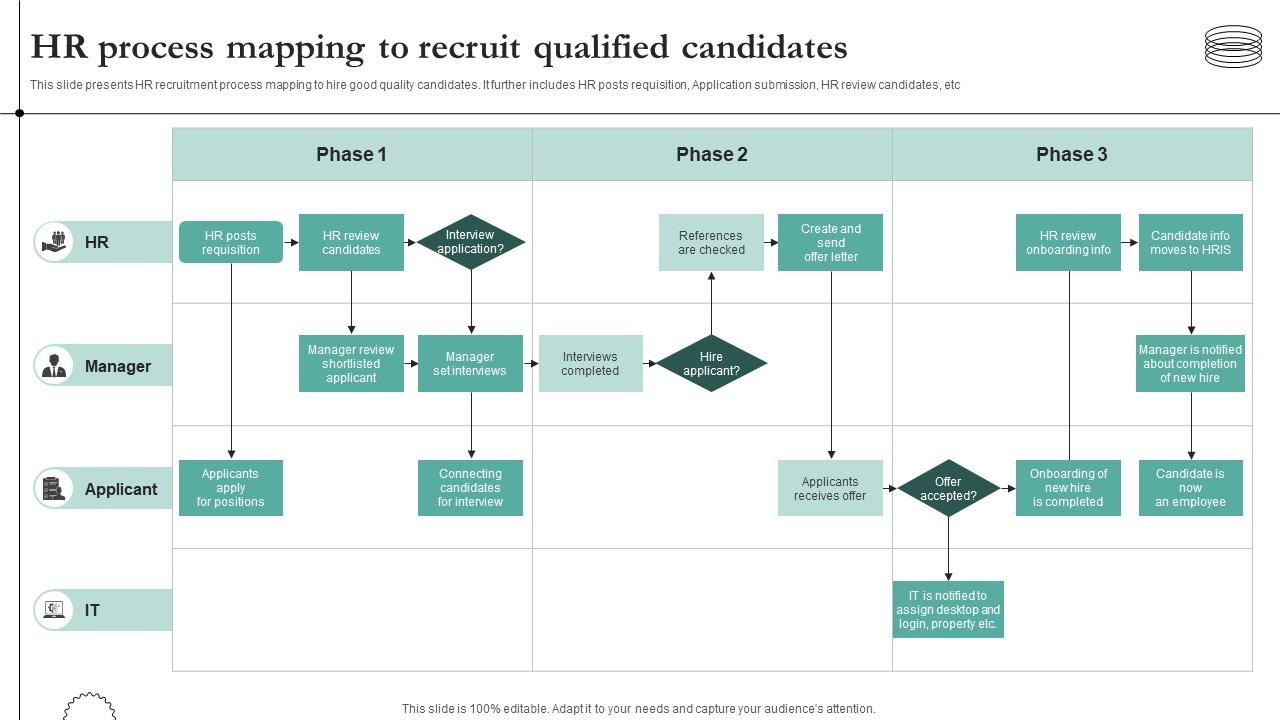
This slide presents HR recruitment process mapping to hire good quality candidates. It further includes HR posts requisition, Application submission, HR review candidates, etc Introducing our HR Process Mapping To Recruit Qualified Candidates set of slides. The topics discussed in these slides are Candidates, Manager, Completed. This is an immediately available PowerPoint presentation that can be conveniently customized. Download it and convince your audience.

FAQs for HR Process Mapping To

Effective HR process mapping initiatives involve stakeholder identification, current state documentation, performance metrics analysis, technology integration assessment, and compliance requirements evaluation. These elements work together by streamlining workflows, identifying bottlenecks, and standardizing procedures across departments, with many organizations finding that comprehensive mapping ultimately reduces processing times and enhances employee experiences.

HR process mapping improves employee onboarding experiences by identifying bottlenecks, standardizing workflows, and ensuring consistent communication touchpoints throughout the journey. Through systematic visualization, organizations streamline documentation requirements, automate routine tasks, and create personalized pathways, with many companies finding that mapped processes reduce onboarding time while enhancing new hire satisfaction and retention rates.

Common pitfalls include inadequate stakeholder involvement, over-complicating simple processes, failing to capture real workflows versus documented ones, and neglecting change management considerations. Many organizations find that rushing the mapping phase, ignoring technology integration opportunities, and not regularly updating process maps ultimately undermines their HR transformation efforts and operational efficiency gains.

Technology integration enhances HR process mapping efficiency by automating data collection, providing real-time analytics, and enabling collaborative workflow visualization across departments. Through cloud-based platforms and AI-powered tools, organizations streamline recruitment pipelines, performance reviews, and employee onboarding processes, while reducing manual documentation time, ultimately delivering faster decision-making and improved employee experiences.

HR process mapping supports compliance by creating clear documentation of procedures, establishing audit trails, and ensuring consistent adherence to labor laws, data protection regulations, and industry standards. These detailed workflows enable organizations to identify compliance gaps, streamline regulatory reporting, and demonstrate due diligence during audits, with many companies finding that systematic process documentation significantly reduces compliance risks while enhancing operational transparency.

Employee feedback serves as a critical validation and improvement mechanism for HR process mapping, identifying pain points, bottlenecks, and disconnects between documented workflows and actual employee experiences. Through surveys, focus groups, and regular touchpoints, HR teams can refine process maps to better reflect reality, streamline complex procedures, and enhance overall employee satisfaction, ultimately delivering more efficient operations and improved workplace experiences.

Visual tools and software enhance HR process mapping by providing drag-and-drop interfaces, standardized symbols, real-time collaboration features, and automated workflow documentation. These platforms enable HR teams to create clear recruitment flows, onboarding sequences, and performance review cycles while facilitating cross-departmental input, ultimately delivering greater process transparency and faster implementation across organizations.

HR teams can engage stakeholders through collaborative workshops, cross-functional interviews, shadowing exercises, feedback sessions, and visual mapping tools that encourage active participation. These strategies enhance buy-in by involving department heads, employees, and managers directly in documenting workflows, identifying pain points, and proposing improvements, ultimately delivering more accurate process maps and smoother implementation across the organization.

HR process mapping drives organizational change and agility by identifying inefficiencies, standardizing workflows, and creating transparent communication channels across departments. Through detailed process visualization, organizations can streamline recruitment, onboarding, and performance management, while enabling rapid adaptation to market changes, ultimately delivering enhanced employee experiences and competitive advantage in increasingly dynamic business environments.

Organizations should consider metrics like process cycle time, employee satisfaction scores, compliance adherence rates, cost per hire, time-to-productivity for new hires, and error reduction percentages when evaluating HR process maps. These measurements enable HR teams to identify bottlenecks, streamline workflows, and enhance employee experiences, with many companies finding that systematic evaluation ultimately delivers improved operational efficiency and strategic talent management outcomes.

HR process mapping enhances talent management by visualizing recruitment workflows, performance evaluation cycles, career development pathways, and succession planning frameworks, identifying bottlenecks and redundancies that slow decision-making. Through streamlined processes, organizations can accelerate hiring timelines, deliver more consistent performance reviews, and create clearer advancement opportunities, ultimately improving employee retention and competitive positioning.

Best practices for maintaining HR process maps include regular reviews and updates, version control systems, stakeholder feedback integration, digital documentation platforms, and cross-functional validation sessions. These approaches streamline accuracy by establishing quarterly review cycles, capturing process changes immediately, and involving HR teams, managers, and employees in continuous improvement, ultimately delivering enhanced operational efficiency and ensuring compliance standards remain current across growing organizations.

Process mapping enhances HR communication by creating visual workflows that clearly define roles, responsibilities, handoff points, and decision-making authorities across recruitment, onboarding, performance management, and employee relations functions. These standardized documentation tools eliminate silos, reduce miscommunication between teams, and ensure consistent messaging, with many organizations finding that transparent process visibility ultimately streamlines coordination and improves employee experiences.

Recruitment, onboarding, performance management, employee development, and compliance tracking benefit most from HR process mapping. These processes streamline talent acquisition through standardized interview workflows, enhance performance reviews with clear evaluation criteria, and ensure regulatory compliance across organizations, with many companies finding that mapped HR processes reduce hiring time by 30-40% while improving employee satisfaction.

Organizations ensure scalable HR process maps by designing flexible workflows with standardized procedures, automated decision points, and modular components that adapt to increasing headcount. Through cloud-based HR systems and standardized templates, companies streamline recruitment, onboarding, and performance management across multiple departments, ultimately delivering consistent employee experiences while maintaining operational efficiency as they expand into new markets.

Ratings and Reviews

90% of 100
Review Form
Write a review
Most Relevant Reviews
  1. 80%

    by Dexter Weaver

    I am a big fan of their newsletters because that is how I found my perfect requirement at the time of urgency. Thank God, I kept opening those.
  2. 100%

    by Donn Hart

    SlideTeam is my go-to resource for professional PPT templates. They have an exhaustive library, giving you the option to download the best slide!

2 Item(s)

per page: