


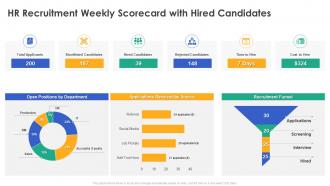
Hr recruitment weekly scorecard with hired candidates ppt powerpoint icons slide





Try Before you Buy Download Free Sample Product
 Impress Your
Audience
 100%
Editable
 Save Hours
of Time


Our HR Recruitment Weekly Scorecard With Hired Candidates Ppt Powerpoint Icons Slide are topically designed to provide an attractive backdrop to any subject. Use them to look like a presentation pro.
People who downloaded this PowerPoint presentation also viewed the following :
Hr recruitment weekly scorecard with hired candidates ppt powerpoint icons slide with all 7 slides:
Use our HR Recruitment Weekly Scorecard With Hired Candidates Ppt Powerpoint Icons Slide to effectively help you save your valuable time. They are readymade to fit into any presentation structure.






FAQs for Hr recruitment weekly scorecard with hired candidates ppt
Key HR recruitment scorecard metrics include time-to-fill, cost-per-hire, quality-of-hire ratings, source effectiveness, candidate experience scores, and offer acceptance rates. These metrics enable organizations to streamline their hiring processes, optimize resource allocation, and enhance talent acquisition strategies, with many companies finding that comprehensive scorecards ultimately deliver faster recruitment cycles and improved candidate quality.
Organizations tailor recruitment scorecards by customizing metrics to reflect industry-specific requirements, such as technical certifications for IT roles, compliance knowledge for healthcare positions, or sales performance indicators for retail sectors. This strategic alignment enables companies to measure candidates against relevant competencies, streamline hiring decisions, and ultimately deliver better role-fit outcomes while reducing turnover costs.
Candidate experience significantly influences recruitment scorecard metrics through response rates, offer acceptance percentages, employer brand perception, and time-to-hire optimization. A positive candidate journey enhances talent pipeline quality, reduces recruitment costs, and strengthens organizational reputation, with many companies finding that streamlined, respectful processes ultimately deliver higher-quality hires and competitive hiring advantages.
Hiring managers can utilize recruitment scorecards by analyzing candidate performance metrics, interview scores, skills assessments, and cultural fit indicators to compare applicants objectively. These standardized evaluation tools streamline decision-making by providing quantifiable data points, reducing hiring bias, and enabling managers to identify top talent more efficiently, ultimately delivering faster recruitment cycles and improved candidate quality across organizations.
Common pitfalls include using too many metrics, focusing only on speed rather than quality, ignoring candidate experience measurements, and failing to align metrics with business objectives. Many HR departments find that overly complex scorecards become ineffective, while those balancing quantitative measures like time-to-fill with qualitative assessments ultimately deliver better hiring outcomes and strategic talent acquisition.
Recruitment scorecards should be reviewed quarterly and updated annually, with immediate adjustments following major organizational changes, market shifts, or hiring goal modifications. This strategic approach ensures metrics remain aligned with evolving business objectives and talent market conditions, with many HR departments finding that regular reviews enhance recruitment efficiency, reduce time-to-hire, and ultimately deliver stronger candidate quality.
Diversity and inclusion metrics in recruitment scorecards include candidate pipeline demographics, interview panel composition, bias training completion rates, inclusive job posting language scores, and hiring outcome diversity ratios. These measurements enable organizations to track progress systematically, identify potential barriers in their recruitment process, and ensure equitable opportunities across all candidate groups, ultimately delivering more diverse talent pools and enhanced organizational culture that drives competitive advantage.
Recruitment scorecards help minimize biases by standardizing evaluation criteria, using structured scoring systems, and ensuring consistent candidate assessment across all interviewers. These tools enable HR teams to focus on objective qualifications rather than subjective impressions, with many organizations finding that structured scorecards reduce unconscious bias by up to 50%, ultimately delivering fairer hiring outcomes.
Technology tools that enhance HR recruitment scorecards include applicant tracking systems, AI-powered screening platforms, video interviewing software, assessment automation tools, and predictive analytics dashboards. These technologies streamline candidate evaluation by standardizing scoring criteria, reducing bias through data-driven insights, and accelerating decision-making processes, with many organizations finding that automated scorecards deliver faster hiring cycles and improved candidate quality.
Recruitment scorecards improve collaboration by establishing shared metrics, standardized evaluation criteria, and transparent communication channels between HR and hiring managers. These tools enable both parties to align on candidate requirements, track progress consistently, and make data-driven decisions together, ultimately reducing miscommunication while accelerating the hiring process through unified objectives.
Qualitative metrics include candidate experience feedback, hiring manager satisfaction ratings, cultural fit assessments, interview quality evaluations, and recruiter effectiveness scores. These metrics enhance quantitative data by providing deeper insights into recruitment process effectiveness, with many organizations finding that combining both approaches delivers more strategic hiring decisions, improved retention rates, and ultimately stronger organizational performance.
Organizations measure long-term hire success through recruitment scorecards by tracking performance ratings, retention rates, promotion velocity, cultural fit assessments, and productivity metrics over 12-24 month periods. These comprehensive scorecards enable HR teams to identify which recruitment channels, interview processes, and candidate profiles consistently deliver high-performing employees, ultimately refining hiring strategies and improving workforce quality.
Recruitment strategy benchmarks should include time-to-fill, cost-per-hire, quality-of-hire metrics, candidate experience scores, and source effectiveness ratios. These metrics enable organizations to streamline hiring processes, optimize resource allocation, and enhance talent acquisition outcomes, with many companies finding that strategic measurement ultimately delivers faster placements, reduced recruitment costs, and improved workforce quality.
Recruitment scorecards facilitate onboarding by providing structured assessment data about new hires' skills, competencies, and cultural fit, enabling HR teams to design personalized orientation programs. This strategic approach streamlines the transition process through targeted training modules, mentorship matching, and role-specific development plans, ultimately reducing time-to-productivity and enhancing employee retention rates.
Training HR staff on recruitment scorecards involves comprehensive workshops covering scorecard fundamentals, hands-on practice sessions with real candidate data, mentoring programs pairing experienced staff with newcomers, and regular refresher training on evolving metrics. These approaches enhance staff confidence by building analytical skills, improving decision-making consistency, and ensuring accurate candidate evaluation, with many organizations finding that structured training programs ultimately deliver faster hiring processes and better recruitment outcomes.
-
Great experience, I would definitely use your services further.
-
Use of icon with content is very relateable, informative and appealing.