

HR Strategy Deployment Matrix For Organization Ppt Diagram Graph Charts




Try Before you Buy Download Free Sample Product
 Impress Your
 Audience
 100%
100% Editable
 Save Hours
 of Time


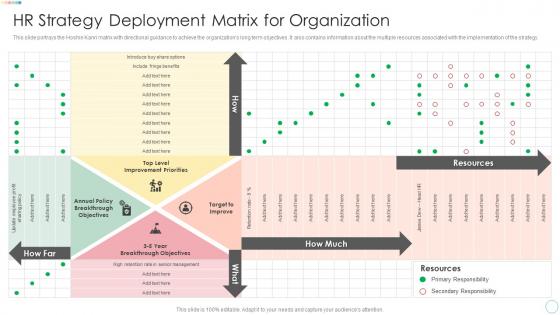
This slide portrays the Hoshin Kanri matrix with directional guidance to achieve the organizations long term objectives. It also contains information about the multiple resources associated with the implementation of the strategy.
People who downloaded this PowerPoint presentation also viewed the following :
HR Strategy Deployment Matrix For Organization Ppt Diagram Graph Charts with all 6 slides:
Use our HR Strategy Deployment Matrix For Organization Ppt Diagram Graph Charts to effectively help you save your valuable time. They are readymade to fit into any presentation structure.





FAQs for HR Strategy Deployment Matrix For Organization Ppt
You need strategic objectives, specific HR initiatives, and clear ownership assignments. Timelines and success metrics too, obviously. Nobody wants those awkward meetings where everyone's looking around like "wait, whose job was this?" Resource requirements matter - don't forget dependencies between programs. I'd honestly start with just 3-4 major objectives instead of going crazy trying to fix everything at once. Build in regular check-ins so you can actually track what's working and pivot when stuff isn't. Think of it as your roadmap connecting people strategy to real business results.
So basically you make this visual grid that connects your HR stuff to actual business goals. List out your top 3-5 objectives first. Then honestly audit which HR programs actually drive results vs just busy work - and trust me, there's always more fluff than you think. The matrix shows you gaps where priorities aren't getting support, plus redundancies you didn't notice. Sounds boring but it's weirdly satisfying once you see everything mapped out. You'll catch things like "wait, we're doing three different leadership programs but nothing for retention?"
Honestly, I'd start with the basics that actually matter - employee engagement scores, retention rates, and how long it takes to fill key positions. Training completion stats are solid too. Don't go overboard though, like 3-5 metrics tops or you'll drown in data. Revenue per employee is clutch if you want to show business impact. Customer satisfaction can work too since HR touches that indirectly. Pick stuff you can actually measure well first - I've seen too many teams get burned trying fancy analytics before nailing the fundamentals. Make sure someone owns each metric and do quarterly reviews to stay on track.
Okay so basically it becomes this shared language between you and other departments. Everyone can see exactly who's doing what and when - no more "wait, I thought you were handling that" disasters. Instead of those vague meetings about "talent stuff," you've got concrete actions with actual owners. Department heads love it because they can finally see how their piece fits into the whole HR puzzle. Honestly saved my butt so many times. Just bring it to your cross-functional meetings and watch people actually stay on track for once.
You absolutely need to get stakeholders involved when building your HR Strategy Deployment Matrix - seriously, this can make or break everything. Leadership, managers, employees... get input from all of them to figure out what capabilities you actually need. I've watched too many matrices get built in isolation and just sit there doing nothing. When people are involved early, they help you spot the real strategic priorities and skill gaps. Also, they're gonna be the ones using it anyway, so their feedback is super valuable. Oh, and it gets everyone bought in from the start. Run some structured interviews or workshops first - way before you start building anything.
Honestly, tech transforms your HR matrix from a static nightmare into something actually useful. Real-time dashboards through Tableau or even souped-up spreadsheets automatically pull from your HRIS and survey data. Way better than those PowerPoint decks that die the second you save them. You'll get live visibility into how initiatives track against goals, plus automated alerts when numbers hit your thresholds. I'd start small though - just connecting a few data sources to auto-populate saves hours of manual updates monthly. Makes the whole thing way less painful.
Honestly, the worst mistake is trying to tackle everything at once - your team will hate you and nothing gets done right. Don't make it overly complicated either, or people just won't use it. Middle managers are key here (trust me on this one), so get them excited about it before rolling it out to everyone else. Oh, and actually schedule regular check-ins! I've seen so many pretty matrices just collect dust because nobody follows up. Start with maybe 3-5 priorities max, win over your managers first, then do monthly reviews. Way less painful that way.
So basically, a Deployment Matrix maps out what skills your team actually has versus what you need to hit your goals. Pretty eye-opening stuff. You assess everyone's current abilities against the competencies each role requires, and boom - the gaps become super clear. Think of it like a skills snapshot of your whole company. Once you see where the biggest holes are, you can decide whether to train people up or bring in new hires. Honestly, I'd just pick one department first and test it out. You'll probably find gaps you didn't even know existed.
Quarterly reviews are the bare minimum, but honestly? Monthly works better if your company's in rapid growth mode. First thing - ask your stakeholders what's actually working versus what's just sitting there looking pretty on paper. Most of these matrices turn into expensive paperweights if you don't stay on them. Check if your initiatives are actually hitting those strategic goals or just burning budget. Business priorities shift constantly, so hunt for gaps and update your resource allocation accordingly. Oh, and definitely make this a regular leadership meeting topic - otherwise it'll get buried under the daily chaos and you'll forget it exists.
Start by figuring out who really calls the shots versus what the org chart says. Your engineering teams probably run themselves more than most places anyway. First, customize those stakeholder roles to match reality. Then fix the communication flows so they actually reflect how info travels around your company - not some generic template. You can tweak the timeline phases too based on your planning cycles. Honestly, most of these frameworks assume everyone follows the same playbook, but that's rarely how it works. Add checkpoints that make sense for your culture. The whole point is making it work for how stuff actually gets done there.
Yeah, company size totally changes how complex your matrix gets. Small teams? Maybe 3-4 roles, simple connections between HR stuff and results. But enterprise level is a whole different beast - multiple business units, different regions, tons of stakeholders wanting different things. Honestly, it's exhausting just thinking about it sometimes. Like cooking dinner versus catering a massive event, you know? Same concept, but the execution is night and day. My advice? Start basic and layer in complexity as you grow. Don't try building some perfect system right off the bat.
So basically, you map out all your HR stuff across different departments and levels, right? It shows people how their job actually connects to the big picture - which honestly makes a huge difference for morale. Career paths become way clearer, and employees can see where they might go next instead of just wondering. Nobody wants to feel stuck or confused about their future! You'll spot communication gaps that are probably making people quit. Oh, and it stops you from throwing random perks at problems. The matrix forces you to focus retention efforts on what actually moves the business forward. I'd start by just looking at where your current programs actually sit.
Honestly, skip the boring PowerPoint stuff - nobody learns that way. Get them working through real scenarios with the matrix right from day one. I'd start by teaching how to spot strategic priorities, then show them how HR initiatives actually connect to business results. Use your company's real problems as examples instead of some generic case study from 2015 or whatever. Templates are clutch - give them something they can use immediately. The whole thing falls apart if it feels too academic. Follow up with coaching sessions after a few weeks because people forget fast. Make it hands-on and practical, that's what actually sticks.
Honestly, the Deployment Matrix is a game-changer for succession planning. It maps your current talent against future roles, so you can see gaps where you're missing backup people. Plus you'll spot high-performers ready to move up. Think of it as a talent GPS - shows where everyone is now and their next possible moves. Leadership loves the visual format too, makes presentations way easier. I update mine every quarter and use it during talent reviews. Way better than just going with your gut on promotions, though sometimes you still gotta trust instincts a bit.
Yo! Toyota's probably the best example - they used this deployment matrix thing to tie their HR stuff directly into lean manufacturing. Pretty smart. Microsoft under Nadella is another solid one where they completely mapped their culture overhaul to business priorities. Oh and GE back in the Welch days, though their "rank and yank" system was kinda brutal if you ask me. The main thing is you've gotta document how your current HR programs actually connect to what the business needs, then figure out what's missing. Honestly most companies skip that first step and wonder why nothing works.
-
A perfect platform for all your presentation needs. Unlimited products at an affordable price.
-
Stunning collection! With a wide variety of options available, I was able to find a perfect slide for my presentation. Thank you, SlideTeam!