HSE Approaches To Boost Safety Culture
Try Before you Buy Download Free Sample Product
Audience
Editable
of Time
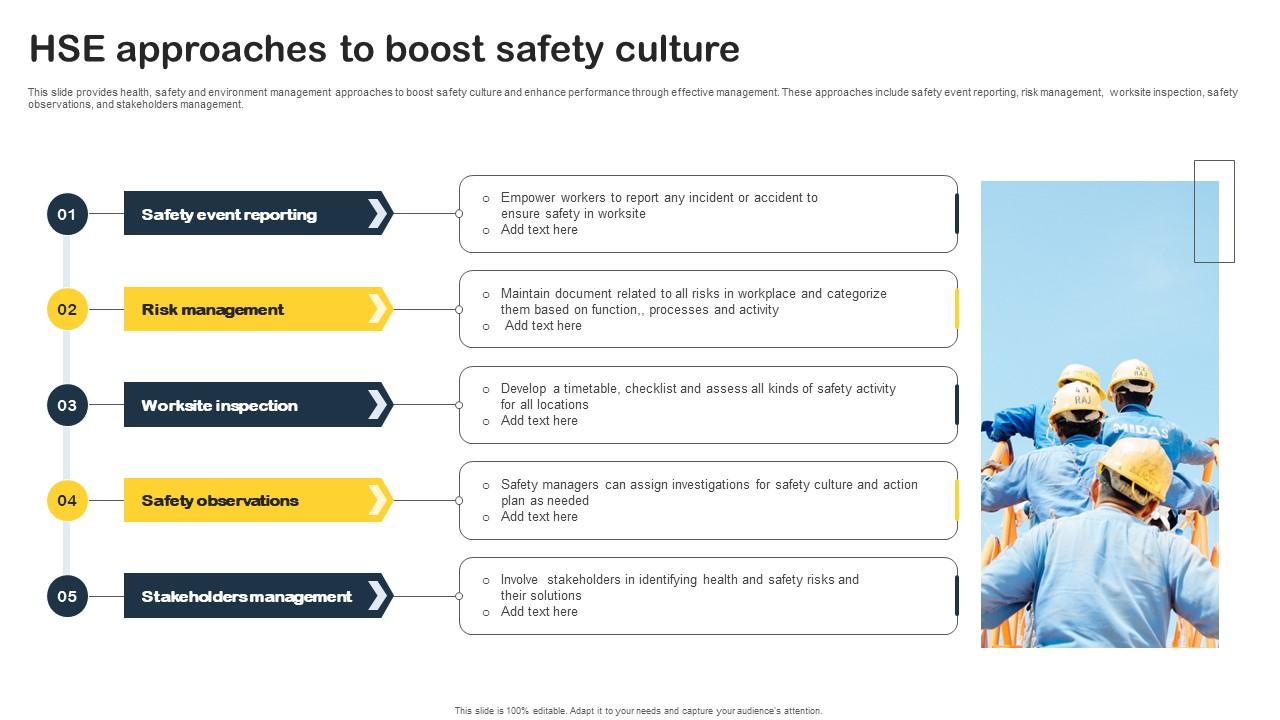
This slide provides health, safety and environment management approaches to boost safety culture and enhance performance through effective management. These approaches include safety event reporting, risk management, worksite inspection, safety observations, and stakeholders management.
People who downloaded this PowerPoint presentation also viewed the following :
HSE Approaches To Boost Safety Culture with all 6 slides:
Use our HSE Approaches To Boost Safety Culture to effectively help you save your valuable time. They are readymade to fit into any presentation structure.
FAQs for HSE Approaches To
Honestly, it all starts with leadership actually giving a damn - not just saying they care but backing it up with real decisions and money. People need to feel safe reporting screw-ups without getting thrown under the bus (this part's critical). Open communication is everything. Make safety part of everyday talk, not some boring monthly PowerPoint. Oh, and train people regularly so they actually know what they're doing. Here's the real litmus test though - would your newest guy feel comfortable shutting down work if something looked sketchy? If not, you've got more work to do.
Your team watches everything you do, so you really can't fake caring about safety. Walk around and actually ask people about their concerns - then do something about it. Don't be one of those managers who preaches "safety first" then freaks out about deadlines five minutes later. Honestly, those crunch moments are when your true priorities show. Be visible when making safety calls and explain your reasoning. I've watched too many leaders completely tank their credibility by talking a big game then cutting corners the second things get stressful.
Look, engaged employees are night and day different when it comes to safety. They'll actually speak up about hazards instead of just staying quiet and hoping someone else notices. You know what I mean? These are the people reporting near-misses and suggesting fixes because they genuinely care about preventing accidents. Compare that to workers who are just going through the motions - they follow the basic rules but won't stick their neck out. The real game-changer is when your team sees you actually act on their safety concerns. Once they know you're listening, they'll start calling out unsafe stuff even when management isn't watching.
Honestly, those old once-a-year safety meetings are pretty useless. Monthly talks or quarterly sessions work way better because people actually remember stuff when it's repeated regularly. Everyone learns differently too – some folks need to see it, others have to get their hands dirty practicing it. The trick is connecting it to what they're doing every day, not just rattling off generic rules from a manual. You'll start seeing them catch hazards they walked past before and actually speak up about sketchy situations. I'd start with quick 15-minute huddles each week, just pick one topic and keep it simple.
Look, you'll want to mix the obvious stuff (injury rates, incidents) with the predictive metrics that actually matter. Near-miss reports are huge - plus track safety training completion and how many people jump into safety programs. Honestly, those employee perception surveys are probably your best bet though. They show if workers actually feel safe speaking up about problems or if they're just keeping quiet. Way better to measure the behaviors that stop accidents than just counting bodies afterward. Focus on the attitudes and actions that prevent issues - that's where the real value is.
Dude, start with anonymous surveys to figure out what's actually broken. Most places have managers who preach safety but then rush everyone through shortcuts - that's your red flag right there. Nobody wants to speak up if they think they'll get blamed or fired for it. Focus groups work too, just let people vent honestly. The reporting thing is huge - people need to feel like heroes for catching problems, not snitches. Oh, and forget the motivational posters until you fix the real stuff first. Half the time leadership just doesn't want to admit their culture sucks anyway.
Yeah, good communication is huge for safety culture. Without it, people don't really get what's dangerous or what they're supposed to do. Plus when communication sucks, nobody wants to report problems or ask questions - they're scared they'll look dumb or get in trouble. I've honestly seen way too many accidents that could've been avoided if someone had just said something earlier. The trick is making it two-way though. Don't just lecture people about procedures and call it a day. Actually listen to what your team's telling you. Ask them what's making it hard to communicate right now - you might be surprised what you hear.
Look, people only trust incident reporting when they know it won't bite them later. Make it super clear upfront that no one's getting fired or written up - though honestly, that's the hardest part because actions speak louder than words here. What really works is showing them the changes that came from their reports. Share updates on what you learned and fixed. Short reports work too. When your team sees incidents actually improve things instead of creating drama, they'll start speaking up more. Always circle back with whoever reported it and say thanks.
Honestly, it all comes down to what leadership actually does vs what they say. When managers consistently walk the walk on safety - like really addressing incidents openly and not cutting corners when deadlines hit - people start seeing protocols as legit instead of just annoying paperwork. Actions speak way louder than those cheesy safety posters, you know? If your boss dismisses safety concerns or rushes through stuff under pressure, that's what sticks. Teams pick up on that energy fast. But when the organization genuinely backs up their safety talk with real action, employees naturally buy in more and actually follow the rules consistently.
Look, don't treat safety like some separate thing you deal with later. Build it right into how you work from day one. Sure, training and decent equipment costs money upfront - nobody's denying that. But here's the thing: one bad accident can literally shut you down for weeks. The legal mess alone will make your head spin. I learned this the hard way at my last job, honestly. Make it crystal clear to everyone that rushing and skipping safety steps isn't an option, even when deadlines are breathing down your neck. Safe deadlines are the only real deadlines.
Honestly, the best approach is weaving safety into everything instead of treating it like some checkbox item. Quick safety talks at shift start really help. When people spot hazards or near-misses, make sure they can speak up without getting in trouble - actually celebrate it when they do. Give your team permission to stop work if something feels sketchy. The places I've worked where safety actually stuck? They followed through every single time someone raised a concern. Your daily actions matter way more than whatever gets said in meetings. Consistency is everything here - if you say safety's a priority, you've got to live it.
Different industries handle safety in totally different ways. Aviation's all about checklists and reporting close calls - honestly, they've got it down to a science. Healthcare tries the no-blame approach so people actually admit mistakes. Construction's super rule-heavy because, well, people can literally die. Tech used to be pretty relaxed but now they're scrambling with all the data breach stuff. The cool thing is you can steal ideas from anywhere. Manufacturing loves aviation's checklist thing, and that psychological safety approach from healthcare? Works everywhere when you want people to speak up about sketchy situations.
Dude, psychological safety is huge for this stuff. When people feel safe speaking up, you actually hear about problems before they become disasters. Nobody wants to be "that guy" who rocks the boat - I get it, office politics are weird like that. But staying quiet is how accidents happen. Try responding really well when someone does raise concerns, even small ones. Ask your team straight up what worries them safety-wise. Don't blame people for bringing bad news either - that kills honesty fast. You'd be shocked what people notice but never mention because they think it'll cause drama.
Honestly, start small - pick whatever's driving you crazy about your current safety setup and tackle that first. Mobile apps are great for instant incident reporting, and those analytics dashboards actually give you some pretty useful insights (once you get past the learning curve). Real-time tracking helps you catch problems before they blow up. VR training sounds fancy but it's genuinely helpful for dangerous scenarios - way better than just talking through procedures. Oh, and anonymous feedback tools are clutch because people will actually tell you what's going wrong without worrying about getting in trouble. Don't try to overhaul everything at once though.
Make reporting near-misses a no-blame thing - people need to feel safe speaking up without getting thrown under the bus. Do quick safety huddles to talk through what's working and what isn't. I'd focus on tracking stuff like training participation rather than just waiting for incidents to happen. Leadership has to actually show up for safety activities, not just talk about it. Celebrate wins publicly when teams do something smart. Oh, and try a monthly challenge where people pitch solutions to real hazards they're seeing. You'll be surprised how many good ideas come from the folks actually doing the work daily.
-
Commendable slides with attractive designs. Extremely pleased with the fact that they are easy to modify. Great work!
-
Easily Understandable slides.