


Implementation of ICT Strategic Plan to Optimize Business Productivity complete deck Strategy CD




Try Before you Buy Download Free Sample Product
 Impress Your
 Audience
 100%
100% Editable
 Save Hours
 of Time


ICT strategic plan identifies the critical characteristics for adequate information and technology management. Grab our Implementation of ICT Strategic Plan to Optimize Business Productivity template. It aims to ensure that corporate data and systems are secured, protected, tested, controlled, developed, and maintained in line with organizational goals. Our Information and Communication Technology deck covers an overview of ICT, key trends, and business development needs. It ICT technologies such as workforce management, people, service management, process, and business security. Additionally, our Workforce management PPT highlights statistics for workforce management software role of technology shift scheduling, time tracking, and employee performance management model. It also depicts service management tools such as service desk software, configuration management database, automated deployment provisioning tools, and cloud management platform. Lastly, our Service Desk module includes business security types such as network security, endpoint security, security control models, and data encryption. Download our 100 percentage editable and customizable template, which is also compatible with Google Slides.
People who downloaded this PowerPoint presentation also viewed the following :
Content of this Powerpoint Presentation
Slide 1: This slide introduces Implementation of ICT Strategic Plan to Optimize Business Productivity. Commence by stating Your Company Name.
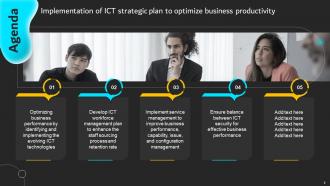
Slide 2: This slide depicts the Agenda of the presentation.
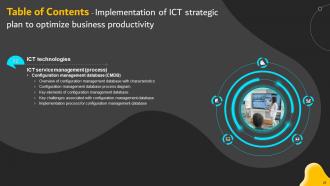
Slide 3: This slide includes the Table of contents.
Slide 4: This slide highlights the Title for the Topics to be covered further.
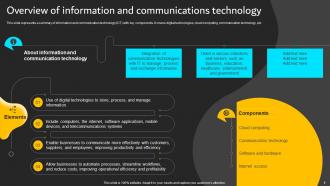
Slide 5: This slide represents a summary of information and communication technology (ICT) with key components.
Slide 6: This slide shows trends associated with information and communications technology (ICT).
Slide 7: This slide portrays the need for information and communications technology (ICT) in businesses.
Slide 8: This slide includes the Heading for the Contents to be discussed in the following template.
Slide 9: This slide reveals ICT technology selection with the aim of enhancing business overall productivity and growth.
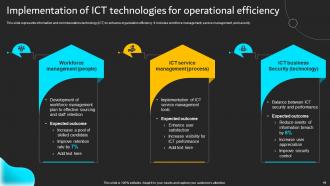
Slide 10: This slide highlights information and communications technology (ICT) to enhance organization efficiency.
Slide 11: This slide exhibits the Title for the Ideas to be covered in the upcoming template.
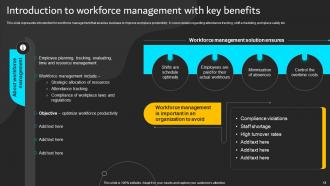
Slide 12: This slide represents introduction for workforce management that enables business to improve workplace productivity.
Slide 13: This slide states the statistics for workforce management solutions.
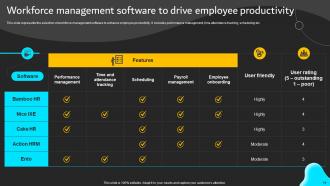
Slide 14: This slide outlines the selection of workforce management software to enhance employee productivity.
Slide 15: This slide represents role of technology in workforce management.
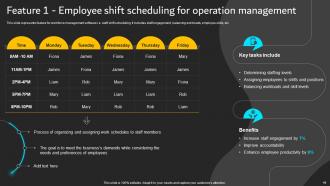
Slide 16: This slide portrays feature for workforce management software i.e. staff shift scheduling.
Slide 17: This slide shows a feature for workforce management software, i.e., staff time tracking.
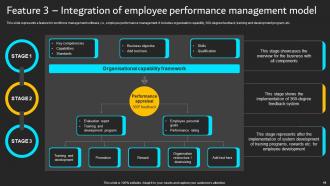
Slide 18: This slide reveals a feature for workforce management software, i.e., employee performance management.
Slide 19: This slide states the Heading for the Ideas to be discussed next.
Slide 20: This slide highlights the overview for IT service desk software.
Slide 21: This slide represents different types of service desk support that help the organization to improve operational effectiveness.
Slide 22: This slide portrays the selection of service desk management software to enhance efficiency and streamline processes.
Slide 23: This slide shows the enterprise framework for service desk management post implementation of service desk software.
Slide 24: This slide presents the customer service desk process flow.
Slide 25: This slide displays the Title for the Contents to be covered in the upcoming template.
Slide 26: This slide represents meaning of CMDB (Configuration Management Database) with its key characteristics.
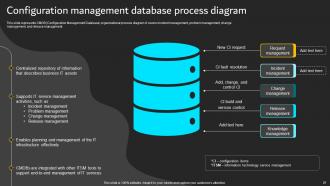
Slide 27: This slide illustrates CMDB (Configuration Management Database) organizational process diagram.
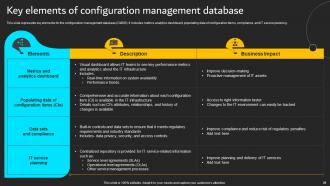
Slide 28: This slide shows the key elements for the configuration management database (CMDB).
Slide 29: This slide presents challenges and solutions associated with configuration management database.
Slide 30: This slide states the six-step implementation process for the configuration management database.
Slide 31: This slide shows the Heading for the Topics to be discussed next.
Slide 32: This slide represents meaning of automated deployment and provisioning tools with its key features.
Slide 33: This slide portrays various deployment automation and provisioning tools that helps organizations to streamline operational process.
Slide 34: This slide states best practices associated with deployment automation.
Slide 35: This slide contains the Title for the Topics to be coveerd next.
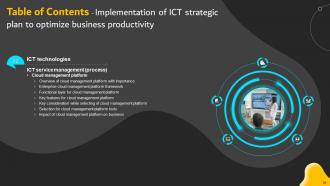
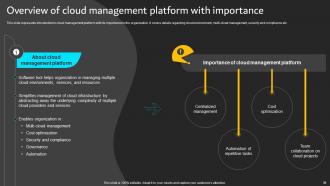
Slide 36: This slide represents introduction to cloud management platform with its importance to the organization.
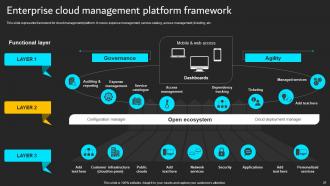
Slide 37: This slide showcases the framework for cloud management platform.
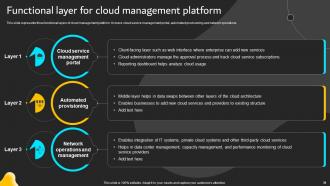
Slide 38: This slide portrays three functional layers of cloud management platform.
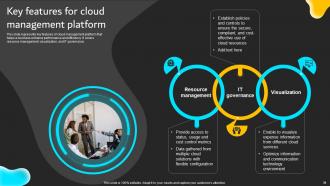
Slide 39: This slide exhibits key features of cloud management platform that helps a business enhance performance and efficiency.
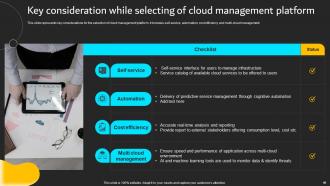
Slide 40: This slide presents key considerations for the selection of cloud management platform.
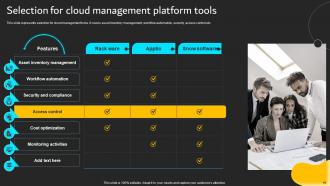
Slide 41: This slide portrays the selection for cloud management tools.
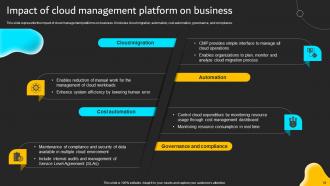
Slide 42: This slide highlights the impact of cloud management platforms on business.
Slide 43: This slide shows the Heading for the Contents to be further discussed.
Slide 44: This slide represents overview of ICT (information and communication technology) business security.
Slide 45: This slide reveals various types of information and communication technology (ICT) securities used by businesses.
Slide 46: This slide covers essential information and communication technology (ICT) security measures businesses use.
Slide 47: This slide presents the network security model for effective communication in the organization.
Slide 48: This slide exhibits the best practices for effective endpoint security.
Slide 49: This slide represents key access security control models for organizations.
Slide 50: This slide shows data encryption model for effective information security.
Slide 51: This slide depicts the Title for the Ideas to be covered next.
Slide 52: This slide represents impact of information and communication technology (ICT) implementation on business.
Slide 53: This slide incorporates dashboard to track workforce performance post-software implementation.
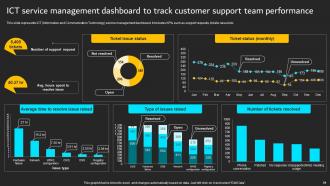
Slide 54: This slide presents ICT (Information and Communication Technology) service management dashboard.
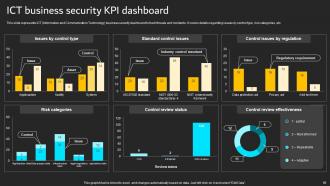
Slide 55: This slide highlights ICT (Information and Communication Technology) business security dashboard to track threats and incidents.
Slide 56: This is the Icons slide containing all the Icons used in the plan.
Slide 57: This slide is used for depicting some Additional information.
Slide 58: This slide represents information and communication technology (ICT) in schools.
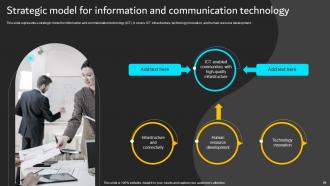
Slide 59: This slide portrays a strategic model for information and communication technology (ICT).
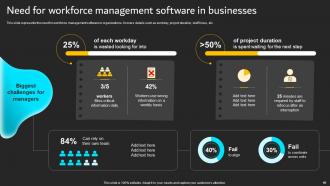
Slide 60: This slide showcases the need for workforce management software in organizations.
Slide 61: This slide reveals 4 R’s for workforce management in the organization.
Slide 62: This slide includes the company's mission, vision, and goals.
Slide 63: This is Our team slide. State your team-related information here.
Slide 64: This is the Puzzle slide with related imagery.
Slide 65: This slide elucidates the Circular diagram.
Slide 66: This is the Idea Generation slide for encouraging fresh ideas.
Slide 67: This is the Thank you slide for acknowledgement.
Implementation of ICT Strategic Plan to Optimize Business Productivity complete deck Strategy CD with all 72 slides:
Use our Implementation of ICT Strategic Plan to Optimize Business Productivity complete deck Strategy CD to effectively help you save your valuable time. They are readymade to fit into any presentation structure.


























FAQs for Implementation of ICT Strategic Plan to Optimize Business Productivity complete
So you need five main things in your ICT plan. First, nail down your vision and objectives - make sure they actually match what your business wants to achieve. Then comes the boring part: mapping out all your current tech stuff. Takes forever but you gotta do it. After that, figure out what's missing between where you are now and where you want to be. Your roadmap should have real timelines and budget numbers, not just wishful thinking. Oh, and don't skip the governance stuff and risk management - learned that one the hard way. Everything should connect to actual business results, not just cool tech for the sake of it.
Honestly, just map your tech stuff directly to what the business actually wants to accomplish. Customer satisfaction down? Your IT spending better fix that specifically. Get IT and business leaders talking regularly - otherwise you'll end up with expensive gadgets nobody uses (classic mistake). Build flexibility into your roadmap since priorities shift constantly. Oh, and bring in actual users early in the process. They'll tell you what's broken faster than any consultant will. Bottom line: connect every tech decision to measurable business results, or you're just burning money.
Track both the tech stuff (uptime, security incidents, project timelines) and business impact (cost savings, productivity gains). ROI matters but honestly, some things are just foundational investments - you can't put a dollar figure on everything. The real trick? Set your baseline measurements first, before you implement anything. Otherwise you're just guessing at impact later. I'd pick maybe 5-6 metrics that your stakeholders actually care about and focus on those. Don't get buried in spreadsheets tracking every possible data point - been there, it's exhausting.
Ugh, new tech is constantly making your current IT plans feel ancient. I swear, just when you get comfortable with your strategy, suddenly everyone's talking about AI or quantum computing. Don't chase every trend though - that's a recipe for disaster. Instead, figure out what actually fits your business goals. Set aside some budget for testing stuff out. Maybe do tech reviews every few months? The trick is staying flexible without completely scrapping your roadmap every time something shiny pops up. It's exhausting but you've got to adapt somehow.
You really can't skip stakeholder engagement if you want your ICT plan to actually work. Get everyone involved early - users, department heads, IT people, executives, maybe even outside partners. They'll tell you what's actually broken and what workflows you need to think about. Honestly, I've seen too many plans fail because someone didn't ask the right people what they needed. When folks feel like they had a say in planning, they won't fight you during rollout. Keep checking in with them throughout the process, not just that one kickoff meeting. Their input will save you from building something nobody wants to use.
Risk management has to be woven into your ICT plan from day one, not tacked on later. Start with a simple risk matrix for your top priorities - cyber threats, system failures, vendor lock-in, compliance stuff. Map mitigation strategies to each strategic goal and actually budget for security upfront (learned this the hard way). Assign owners to each risk so someone's accountable. Build risk assessments right into project timelines and set up regular reviews since threats keep evolving. Honestly, I've seen too many plans where risk management gets buried in some appendix nobody reads.
Start by documenting everything you've got - hardware, software, network stuff. This part's honestly a pain and takes forever, but you can't skip it. Check how each piece is performing and whether it's secure or outdated. Then compare your setup to what others in your industry are doing. Look for gaps between what you can do now vs what the business actually needs. Oh and don't forget your team's skills - sometimes that's the real bottleneck. Be harsh about what's actually broken versus just annoying. Prioritize fixes based on budget and what'll make the biggest difference to operations.
Quarterly reviews work great for most places - that's what I'd go with. Don't lock yourself into super rigid deadlines though. Flexible milestones are way better. Keep an eye on new tech trends that might mess with your strategy too. Honestly, I've watched so many "five-year plans" just collect dust after like 18 months because nobody touched them again. Get people from other departments involved in your reviews since they usually catch business changes before IT notices. Oh, and set up some industry alerts so you're not caught off guard. Your plan should evolve, not stay frozen in time.
So here's what works: build your case around the stuff that either makes money or fixes the biggest headaches. Finance people hate when you ask for everything at once, so break it into phases. Maybe start with a pilot or something smaller first. Look into vendor partnerships too - sometimes they'll help with costs if it means landing a deal. Grants are worth checking if you're in education or nonprofit space. The trick is having backup plans because honestly? Your budget's probably getting slashed anyway. Just make sure you can actually measure whatever outcomes you're promising.
Think of it as your GPS for going digital. You'll know which tech to focus on first and when to roll things out without breaking your budget. Otherwise you're just buying random software and praying it works - trust me, that never ends well. A good plan keeps everything coordinated so your team doesn't lose their minds trying to adapt to five new systems at once. Plus it actually connects back to what your business is trying to accomplish. Map out what you've got now vs where you want to be in a few years and work backwards from there.
Honestly, most people mess up by being way too vague about what they actually want to achieve. Then they try to do everything at once - I swear, it's like watching someone try to renovate their entire house in a weekend. Focus on your top 3 business needs first. Get your actual users involved from day one, not after you've built something. Oh, and don't chase shiny new tech just because it sounds cool. Your timeline needs to be realistic too. Change management is huge but everyone forgets about it. Work backwards from what you actually need to accomplish.
Honestly, having solid data changes everything when you're making tech decisions. Instead of guessing what'll work, you can actually see which systems are paying off and where you're wasting money. Set up some basic KPIs first - stuff like uptime, user satisfaction, cost per transaction. Short, measurable things. When budget season rolls around, stakeholders eat that stuff up because it's real proof your investments are working. Oh and you'll catch problems way earlier too, which saves you from those 2am crisis calls nobody wants. Start with just a few metrics though - don't go overboard right away.
Look, cybersecurity can't be something you tack on later - it needs to be baked into your whole ICT strategy from day one. Every tech decision you make, whether it's moving to the cloud or going digital, has to have security woven right through it. Do your risk assessments upfront. Budget for proper incident response and governance structures. I learned this the hard way at my last job, but trust me - fixing security gaps after the fact costs way more than doing it right initially. Think of it like... you wouldn't build a house and then realize you forgot the locks, right? Same principle here.
So first thing - audit what remote stuff you already have. Cloud infrastructure is huge, plus you'll need solid VPN access and collaboration tools like Teams or Slack. Endpoint security is critical since everyone's working from random coffee shops now (honestly such a pain from a security standpoint). Don't forget bandwidth planning for all those video calls and file sharing. Mobile device management policies matter too. The whole thing needs to be flexible so you can scale based on how many people are remote that week. Oh and make sure your infrastructure can actually handle the load!
Honestly, I'd go with TOGAF if you're dealing with enterprise-level stuff, or Balanced Scorecard when you need to connect IT decisions back to actual business results. SWOT analysis is basic but super useful for figuring out where you stand right now. COBIT's solid for governance-heavy environments. Lean/agile works better if your company moves fast and doesn't mind changing direction. Here's the thing though - people waste so much time jumping between frameworks instead of just committing to one. Start simple with SWOT to get your bearings, then maybe add Balanced Scorecard so your IT spending actually moves the needle business-wise. Whatever you pick, make sure it fits how mature your organization actually is, not where you wish it was.
-
Stunning collection! With a wide variety of options available, I was able to find a perfect slide for my presentation. Thank you, SlideTeam!
-
Based on my personal experience, I would recommend other people to subscribe to SlideTeam. No one can be disappointed here!