In Sprint Automation Powerpoint Ppt Template Bundles

Rating:
95%
In Sprint Automation Powerpoint Ppt Template Bundles
Slide 1 of 20
Favourites Favourites

Try Before you Buy Download Free Sample Product

Audience Impress Your
Audience
Editable 100%
Editable
Time Save Hours
of Time
The Biggest Sale is ending soon in
0
0
:
0
0
:
0
0
Rating:
95%
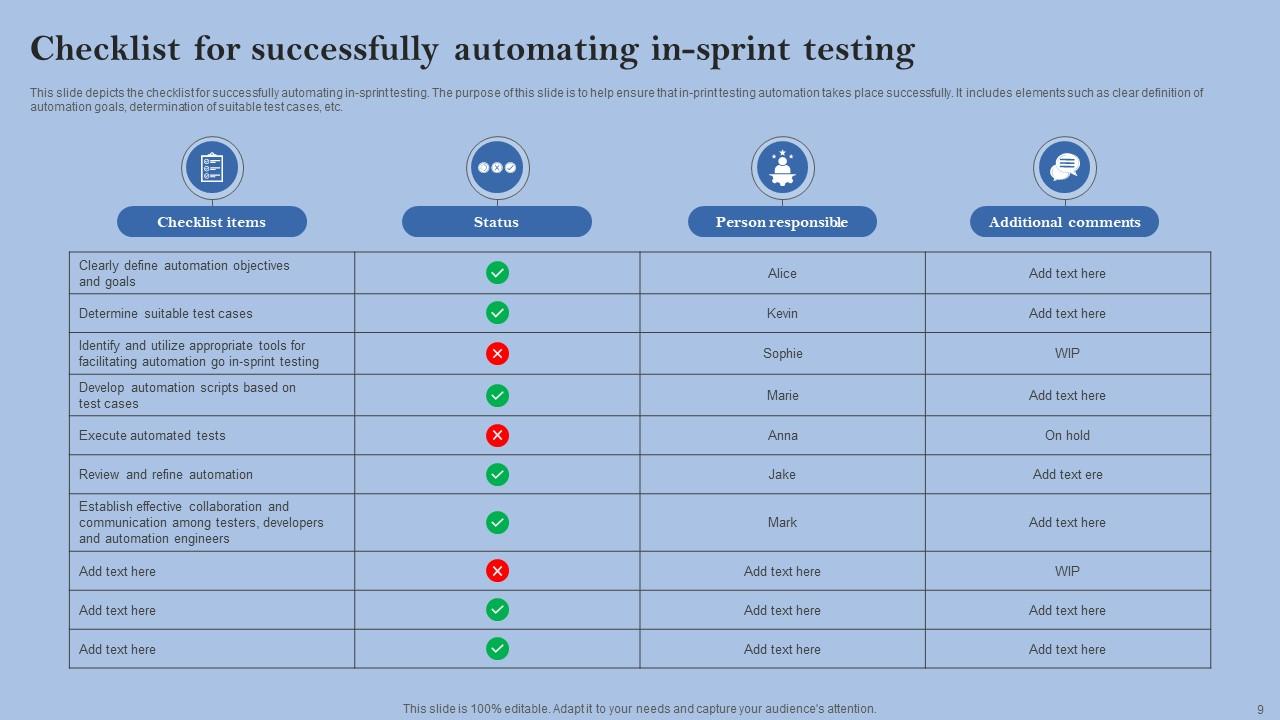
Engage buyer personas and boost brand awareness by pitching yourself using this prefabricated set. This In Sprint Automation Powerpoint Ppt Template Bundles is a great tool to connect with your audience as it contains high-quality content and graphics. This helps in conveying your thoughts in a well-structured manner. It also helps you attain a competitive advantage because of its unique design and aesthetics. In addition to this, you can use this PPT design to portray information and educate your audience on various topics. With twelve this is a great design to use for your upcoming presentations. Not only is it cost-effective but also easily pliable depending on your needs and requirements. As such color, font, or any other design component can be altered. It is also available for immediate download in different formats such as PNG, JPG, etc. So, without any further ado, download it now.

People who downloaded this PowerPoint presentation also viewed the following :

FAQs for In Sprint Automation Powerpoint

Honestly, the time savings alone make it worth it - no more repetitive garbage tasks eating up everyone's day. Your team can actually focus on stuff that matters instead of mindless data entry (which nobody likes anyway). Fewer screwups too, since computers don't have off days like we do. Oh, and processes keep running even when Jim calls in sick again. My advice? Don't go crazy trying to automate everything at once. Just pick that one annoying task everyone complains about and start there. Build some momentum first.

Honestly, automation is a game-changer for getting more done. Robots in factories can work around the clock - no lunch breaks or sick days. Pretty crazy when you think about it. Your team gets freed up from boring repetitive stuff to tackle the work that actually needs a human brain. Finance companies went from taking days to process transactions to doing it in minutes. That's insane! Healthcare uses it for monitoring patients and dispensing meds, which cuts down on mistakes. Even restaurants use automated scheduling now. Look at whatever's eating up the most time in your day-to-day - that's where you'll want to start.

So AI basically turns automation from dumb robots into something that can actually think. Your old systems just follow whatever rules you programmed, but AI learns and adapts as it goes. It's like comparing a calculator to someone who can do math AND figure out which math to do. You can automate the brainy stuff now - data analysis, predicting when machines will break, workflow management. Honestly, it's pretty wild how much less handholding everything needs. Look for tasks in your work that need simple decisions made. Those are goldmines for AI automation.

Honestly, just start with stuff you already have. Gmail's got templates and auto-replies built right in. Google Sheets can do basic automation too. Zapier's free plan is surprisingly good - no coding needed, just connects your apps together. Pick ONE annoying task that wastes your time daily. Maybe auto-sorting customer emails or scheduling social posts ahead of time. Buffer has a decent free version for that. Don't go crazy trying to automate everything at once though - I made that mistake before. Start small, see what works, then add more. Even automating one stupid repetitive thing feels amazing.

Look, everyone thinks robots are gonna swipe all our jobs overnight, but that's not really what happens. Yeah, some positions vanish - can't sugarcoat that. But most of the time automation just changes how we work. New roles pop up too, like someone's gotta fix those machines and make sense of all the data they spit out. The whole "robot apocalypse" thing is way overblown if you ask me. Instead of panicking, figure out what parts of your job could get automated. Then build skills that work *with* tech, not against it. Oh, and start messing around with whatever automation tools are big in your industry now.

Basically, machines don't have bad days like we do. They'll run the same process perfectly every time - no getting distracted or forgetting steps when you're swamped. I mess up data entry constantly when I'm multitasking, but automated systems catch those little errors instantly. They're honestly way better at repetitive stuff that needs to be exact. Look at where your team screws up most often - that's probably your sweet spot for automation. The validation checks happen in real time too, which is pretty nice when you think about it.

Honestly, the main things that keep me up at night about automation are job displacement, algorithmic bias, and privacy stuff. When you automate processes, people lose jobs - so maybe think about retraining programs or phasing things in slowly? Also, if your training data sucks, your system will be biased too. I've watched hiring algorithms completely tank because of this. Oh, and there's this whole creepy surveillance angle where automation can track what employees do all day. Super uncomfortable. My advice? Get different people involved early in planning and always ask yourself who's gonna get screwed over by these changes.

Dude, automation is a game changer for PM work. Start with something simple like auto task assignments when you hit milestones. Zapier's great for syncing your project tools with Slack or email - saves so much back-and-forth. The reporting stuff alone will give you hours back each week, no joke. You can set up triggers for deadline warnings and budget alerts too. Oh, and resource allocation based on who's actually available? Chef's kiss. I'd pick one workflow first though - don't go crazy trying to automate everything at once. You'll just stress yourself out.

Honestly, it's all over the map depending on what industry you're talking about. Manufacturing companies are going crazy with robots because the math just works out - no sick days, no vacation time, you know? But healthcare and schools are way more cautious since you can't exactly automate bedside manner or teaching kids. Finance is kind of doing both - they'll automate the boring paperwork stuff but still want actual people making the big calls. Construction and hotels are still pretty old school though. My advice? Just see what your competitors are already doing before you dive in headfirst.

Start with Zapier or Power Automate - they're perfect for connecting apps without any coding headaches. Python's amazing if you don't mind learning some basics, especially for data stuff. IFTTT works great for simple triggers (I probably overuse it tbh). Pick one task that makes you want to scream and automate that first. Seriously, start small. Once you see how much time you save, you'll get addicted and want to automate everything. UiPath's solid for complex workflows later on, but honestly? Don't overwhelm yourself at the beginning.

Track both hard savings (labor costs, time, fewer errors) and the softer stuff like happier employees - because honestly, nobody wants to do mind-numbing tasks forever. Factor in all your costs: software, training, maintenance, the works. Then divide annual benefits by total costs. Most automation should pay for itself in 12-18 months if you're doing it right. Oh, and set up some kind of dashboard to watch these numbers - you'll want to tweak things as you go. The ROI calculation isn't rocket science, but don't skip the employee satisfaction piece. That matters more than people think.

Ugh, you're gonna hit so many roadblocks. Old tech that doesn't talk to anything modern, zero documentation (seriously, who does that?), and weird proprietary stuff everywhere. There's always some guy who built it in 2003 and never told anyone how it works. Mission-critical systems make it worse since you can't just break things to figure them out. Map everything first though - like actually document all the connections and dependencies. Sounds boring but trust me, you'll thank yourself later when you're not debugging at 2am trying to remember what connects where.

Honestly, automation can be a game-changer for customer experience if you don't mess it up. Chatbots give instant responses, orders process way faster, and support runs 24/7. Human errors drop too, which is huge - nobody wants to deal with preventable screwups. But here's the thing: you can't automate everything. People still want actual humans for the messy, complicated stuff. I'd tackle your most boring, repetitive tasks first. Just make sure customers can easily jump to a real person when the bot inevitably hits a wall.

Focus on stuff that works WITH automation, not against it. Critical thinking and creativity are key - machines still can't match human judgment or empathy. Sure, being tech-savvy helps, but you don't need to suddenly become a coding wizard or anything. Adaptability matters way more than learning every new tool that pops up. Communication skills will be huge since you'll probably work alongside AI systems daily. Honestly? Figure out what parts of your job could get automated, then double down on the human stuff that actually adds value. That's where you'll stay irreplaceable.

Honestly, just be super upfront about it from the start. Don't blindside your team - that's how you lose good people. Tell them which boring tasks are getting automated and how it frees them up for cooler projects. Oh, and definitely invest in training so they can level up their skills instead of panicking about job security. Frame it like "what tedious stuff would you love to never do again?" rather than "robots are coming for you." The whole point is making their work more interesting, not scary. Companies that surprise people with this stuff always regret it later.

Ratings and Reviews

95% of 100
Review Form
Write a review
Most Relevant Reviews
  1. 100%

    by I'm TumTumThui

    nice
  2. 100%

    by I'm TumTumThui

    nice
  3. 80%

    by Clement Patel

    Good research work and creative work done on every template.
  4. 100%

    by Curtis Herrera

    Satisfied with the way SlideTeam resolved my query regarding the right business PPTs that I was having difficulty finding. I found the perfect match with their assistance.

4 Item(s)

per page: