Incident impact details for response reporting to management

Rating:
87%
Incident impact details for response reporting to management
Slide 1 of 2
Favourites Favourites

Try Before you Buy Download Free Sample Product

Audience Impress Your
Audience
Editable 100%
Editable
Time Save Hours
of Time
The Biggest Sale is ending soon in
0
0
:
0
0
:
0
0
Rating:
87%
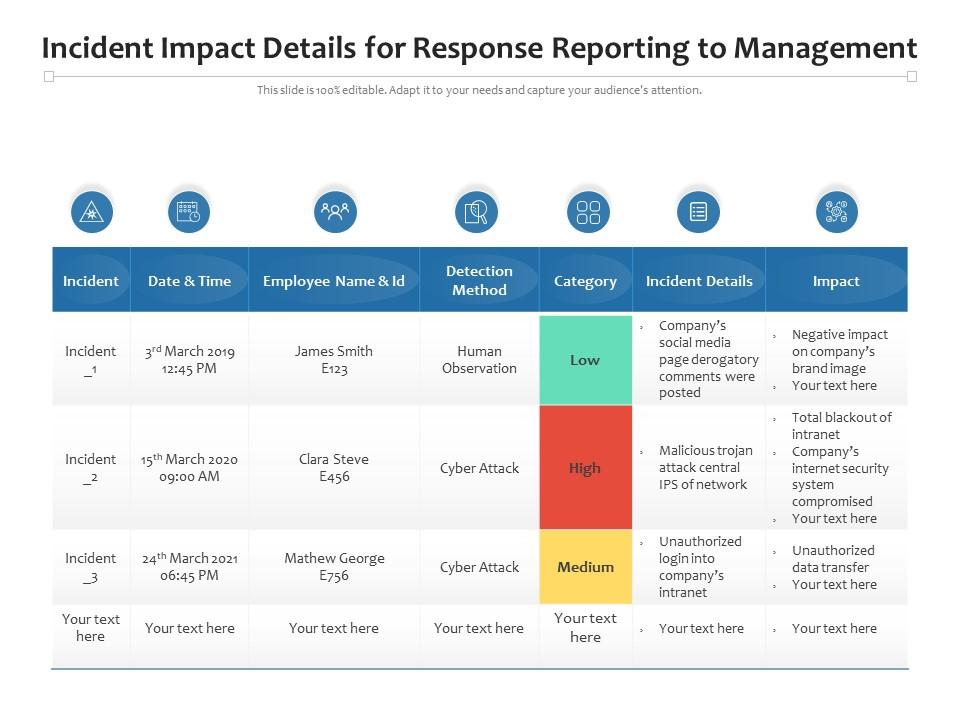
Presenting our well-structured Incident Impact Details For Response Reporting To Management. The topics discussed in this slide are Incident, Employee Name, Detection Method, Category, Impact. This is an instantly available PowerPoint presentation that can be edited conveniently. Download it right away and captivate your audience.

FAQs for Incident impact details for response

Key factors determining incident impact include affected system criticality, number of users impacted, financial losses, regulatory compliance implications, and reputational damage potential. Organizations across sectors like healthcare, financial services, and retail increasingly use structured impact assessment frameworks to evaluate these factors systematically, ultimately enabling faster response prioritization and more effective resource allocation during crisis situations.

Incident metrics can be effectively measured and analyzed through tracking mean time to detection, resolution duration, frequency patterns, severity classifications, and customer impact scores. These measurements enable organizations to identify recurring issues, optimize response procedures, and enhance system reliability, with many IT departments finding that comprehensive metric analysis ultimately delivers faster incident resolution and improved service availability.

Incident impact assessments enhance organizational resilience by identifying vulnerabilities, quantifying potential losses, and enabling proactive mitigation strategies. Through systematic evaluation of operational, financial, and reputational consequences, organizations streamline response protocols, optimize resource allocation, and strengthen business continuity plans, ultimately delivering faster recovery times and competitive advantage in crisis situations.

Communication serves as the backbone of incident management, enabling rapid response coordination, stakeholder alignment, and damage mitigation through clear information flow and transparent updates. Effective communication protocols streamline decision-making, minimize confusion during crisis situations, and maintain customer trust, with many organizations finding that proactive communication strategies ultimately reduce incident duration and enhance organizational resilience.

Data visualization tools enhance incident understanding by transforming complex data into clear charts, graphs, heatmaps, timelines, and dashboards that reveal patterns and trends. Through interactive visualizations, organizations can quickly identify affected systems, track resolution progress, and communicate impact severity to stakeholders, while enabling faster decision-making and ultimately improving incident response effectiveness across operations.

Common challenges include data fragmentation across multiple systems, difficulty quantifying intangible impacts like reputation damage, inconsistent assessment methodologies, and delayed information flow from various departments. Large organizations often struggle with coordinating cross-functional teams, establishing standardized metrics, and balancing immediate operational concerns with long-term strategic implications, ultimately requiring robust frameworks to ensure comprehensive impact evaluation.

Historical data enables organizations to predict incident impact through pattern analysis, trend identification, and risk modeling algorithms that analyze past severity levels, resolution times, and affected systems. By examining correlations between incident characteristics and business outcomes, companies across sectors like banking and healthcare can proactively allocate resources, implement preventive measures, and minimize operational disruptions, ultimately delivering faster incident response and reduced business continuity risks.

Cybersecurity breaches, system outages, supply chain disruptions, data loss events, and compliance violations typically create the most significant operational impact. These incidents affect organizations by halting critical processes, compromising customer data, and disrupting service delivery, with many financial services and healthcare institutions finding that recovery costs often exceed initial damage assessments.

Organizational culture significantly influences incident impact perception by shaping communication transparency, risk tolerance levels, and accountability frameworks across departments. Companies with open cultures typically acknowledge broader impacts including reputational damage and stakeholder trust, while risk-averse cultures may focus primarily on immediate operational disruptions, ultimately affecting how thoroughly organizations assess and respond to incidents.

Stakeholder involvement shapes incident impact assessment by providing diverse perspectives on operational disruptions, customer effects, regulatory implications, and financial consequences across different business areas. Through collaborative input from IT teams, business units, customer service, and leadership, organizations gain comprehensive visibility into cascading effects, prioritize recovery efforts more effectively, and ultimately deliver more accurate impact evaluations that drive strategic incident response decisions.

Organizations can mitigate incident effects through proactive monitoring systems, comprehensive response protocols, cross-functional team training, automated escalation procedures, and regular communication frameworks. These practices enable faster detection, streamlined resolution processes, and coordinated stakeholder updates, with many companies finding that structured incident management reduces downtime costs while enhancing customer trust and operational resilience.

Incident impact analysis informs risk management strategies by identifying vulnerability patterns, quantifying potential losses, and revealing systemic weaknesses across organizational processes. Through comprehensive impact assessments, companies can prioritize resource allocation, develop targeted mitigation protocols, and establish preventive measures, with many financial services and healthcare organizations finding that data-driven risk strategies significantly reduce operational disruptions.

Psychological effects of incidents on employees include acute stress reactions, decreased confidence, anxiety about future occurrences, reduced job satisfaction, and potential long-term trauma responses. These impacts can be measured through employee surveys, psychological assessments, absenteeism tracking, performance metrics, and workplace climate evaluations, with many organizations finding that early intervention significantly improves recovery outcomes and maintains productivity.

Organizations use incident simulations to prepare for real-world scenarios by conducting tabletop exercises, creating realistic breach scenarios, testing response protocols, and training cross-functional teams under controlled conditions. Through these simulations, companies in healthcare, finance, and retail can identify response gaps, refine communication procedures, and enhance coordination skills, ultimately delivering faster containment times and minimizing business disruption during actual incidents.

Incident impact assessment varies significantly across industries based on regulatory requirements, operational priorities, and risk tolerance levels. Healthcare focuses on patient safety and HIPAA compliance, financial services emphasize fraud prevention and regulatory reporting, while manufacturing prioritizes production continuity and worker safety, with each sector ultimately developing specialized frameworks that align with their unique operational challenges and stakeholder expectations.

Ratings and Reviews

87% of 100
Review Form
Write a review
Most Relevant Reviews
  1. 80%

    by Dexter Weaver

    It saves your time and decrease your efforts in half.
  2. 100%

    by Charles Nguyen

    Amazing product with appealing content and design.
  3. 80%

    by Damian Martin

    Colors used are bright and distinctive.

3 Item(s)

per page: