Incident management response design framework
Try Before you Buy Download Free Sample Product
Audience
Editable
of Time
Finetine the frequency with our Incident Management Response Design Framework. Your views will be recieved loud and clear.
People who downloaded this PowerPoint presentation also viewed the following :
Content of this Powerpoint Presentation
Description:
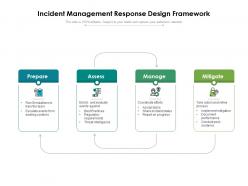
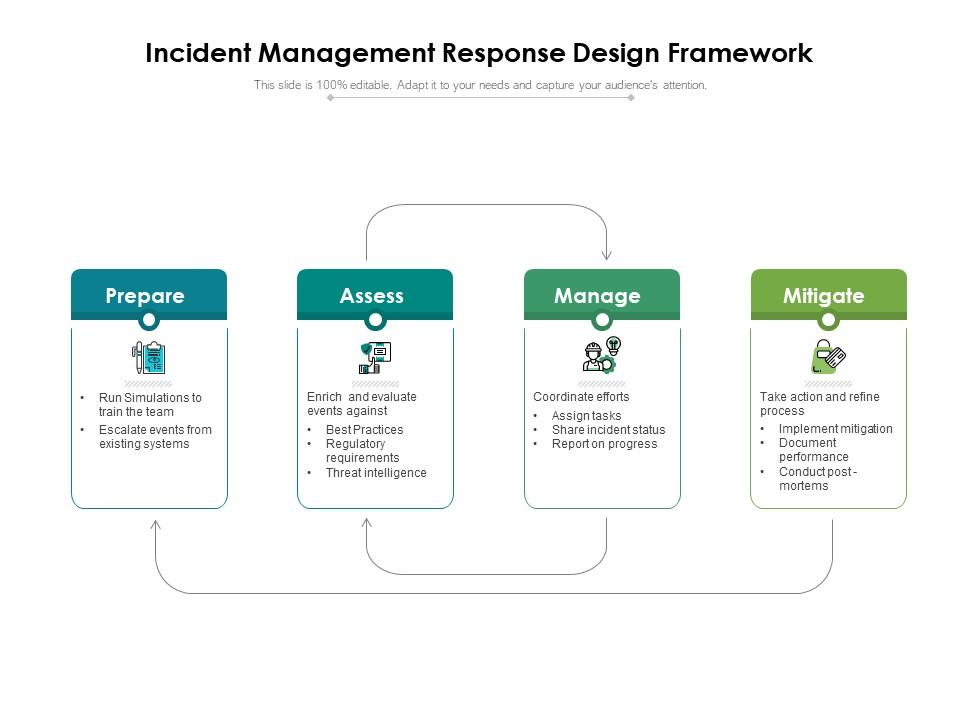
The image is a PowerPoint slide titled "Incident Management Response Design Framework." It outlines a structured approach to managing incidents within an organization. The slide is divided into four key phases, each with specific actions:
1. Prepare:
Run simulations to train the team.
Escalate events from existing systems.
2. Assess:
Enrich and evaluate events against best practices, regulatory requirements, and threat intelligence.
3. Manage:
Coordinate efforts by assigning tasks, sharing incident status, and reporting on progress.
4. Mitigate:
Take action and refine the process, which includes implementing mitigation strategies, documenting performance, and conducting post-mortems.
Use Cases:
This type of slide could be applied across various industries for risk management and incident response training:
1. Information Technology:
Use: Cybersecurity threat response planning.
Presenter: IT Security Manager
Audience: IT staff, security analysts
2. Healthcare:
Use: Patient safety and critical incident management.
Presenter: Risk Manager
Audience: Healthcare providers, hospital administrators
3. Manufacturing:
Use: Handling equipment failures or safety incidents.
Presenter: Operations Manager
Audience: Plant workers, safety officers
4. Finance:
Use: Responding to financial fraud or data breaches.
Presenter: Compliance Officer
Audience: Finance department, auditors
5. Utilities:
Use: Managing response to utility disruptions or emergencies.
Presenter: Emergency Response Coordinator
Audience: Field technicians, crisis management team
6. Transportation:
Use: Addressing incidents in transportation networks.
Presenter: Safety Director
Audience: Operators, logistics personnel
7. Education:
Use: Developing response plans for on-campus incidents.
Presenter: Campus Safety Officer
Audience: Faculty, administration staff
Incident management response design framework with all 5 slides:
Find the right channel to air your thoughts. Our Incident Management Response Design Framework will finetune the frequency.
FAQs for Incident management
Key components of an effective Incident Management Framework include incident detection and alerting systems, classification and prioritization protocols, response team structures, communication procedures, and resolution tracking mechanisms. These components work together by streamlining response times, ensuring proper resource allocation, and maintaining clear accountability chains, with many organizations finding that structured frameworks significantly reduce downtime and enhance operational resilience.
The Incident Management Framework seamlessly integrates with ITIL best practices by aligning incident classification, escalation procedures, and service restoration processes with ITIL's structured approach to service management. This strategic combination enables organizations to streamline response times, enhance service continuity, and maintain comprehensive documentation, with many IT departments finding that ITIL integration delivers improved customer satisfaction and operational efficiency.
Automation streamlines incident detection, response, and resolution by enabling faster alert generation, automatic ticket creation, and intelligent routing to appropriate teams. Through automated monitoring tools and response systems, organizations significantly reduce response times, minimize human error, and enhance overall service reliability, with many IT departments finding that automation delivers cost savings while improving customer satisfaction.
Organizations measure Incident Management Framework success through key performance indicators like mean time to resolution, incident recurrence rates, customer satisfaction scores, and system availability metrics. These measurements enable companies across sectors like telecommunications, healthcare, and financial services to identify bottlenecks, streamline response processes, and ultimately deliver improved service reliability while reducing operational costs.
Organizations commonly face challenges including inadequate staff training, unclear escalation procedures, poor communication protocols, insufficient documentation processes, and resistance to cultural change when implementing frameworks. These obstacles can significantly impact response times and resolution effectiveness, with many enterprises finding that gradual rollouts, comprehensive training programs, and strong leadership commitment ultimately streamline adoption and enhance operational resilience.
Incident categorization improves efficiency by enabling faster triage, appropriate resource allocation, automated routing to specialized teams, and standardized response procedures. This systematic approach streamlines resolution times, reduces manual handoffs, and ensures critical incidents receive immediate attention, with many organizations finding that proper categorization decreases average resolution time by 40-60% while improving customer satisfaction.
Essential tools include incident tracking systems, monitoring and alerting platforms, communication tools, knowledge bases, automation software, and analytics dashboards. These technologies streamline incident detection, response coordination, and resolution tracking, with many organizations finding that integrated platforms combining real-time monitoring, automated workflows, and centralized communication ultimately deliver faster resolution times and improved service reliability.
Incident response times can be minimized through automated alert systems, predefined escalation procedures, cross-trained response teams, real-time monitoring dashboards, and streamlined communication protocols. These approaches enable organizations to detect issues faster, route incidents efficiently, and coordinate responses seamlessly, with many companies finding that strategic automation and clear workflows ultimately reduce downtime while enhancing customer satisfaction.
Communication and collaboration are critical for incident management success, enabling rapid information sharing, coordinated response efforts, cross-functional expertise integration, and stakeholder alignment throughout resolution processes. These elements streamline decision-making by connecting technical teams, management, and affected departments simultaneously, while ensuring transparent updates minimize confusion and accelerate recovery, ultimately delivering faster resolution times and stronger organizational resilience.
Industries adapt their Incident Management Framework through specialized compliance protocols, automated regulatory reporting, and industry-specific escalation procedures tailored to their regulatory environment. Financial services implement stringent data breach protocols, healthcare organizations integrate HIPAA compliance workflows, and manufacturing sectors focus on safety incident documentation, with many organizations finding that customized frameworks streamline regulatory adherence while maintaining operational efficiency.
Best practices for training staff on the Incident Management Framework include role-specific simulations, regular tabletop exercises, clear escalation procedures, hands-on system training, and cross-functional workshops. These approaches enhance preparedness by building muscle memory, improving communication protocols, and fostering collaboration between IT, operations, and management teams, ultimately delivering faster incident resolution and minimized business disruption.
Data analytics enhances decision-making in an Incident Management Framework by providing real-time insights, predictive capabilities, and comprehensive reporting that enables faster, more informed responses. Through advanced analytics tools, organizations can identify incident patterns, predict potential failures, and optimize resource allocation, with many finding that data-driven approaches significantly reduce resolution times and improve service reliability.
Continuous improvement strategies include regular post-incident reviews, metrics analysis, process automation, staff training programs, and stakeholder feedback integration. These approaches streamline response times, enhance documentation accuracy, and strengthen prevention capabilities, with many organizations finding that systematic review cycles and cross-departmental collaboration ultimately deliver faster resolution times and reduced operational disruptions.
Incident post-mortems contribute by identifying framework gaps, process inefficiencies, and response bottlenecks that weren't apparent during initial design phases. Through systematic analysis of what worked and what didn't, organizations continuously refine their incident management protocols, update escalation procedures, and strengthen preventive measures, ultimately delivering more resilient operations and faster recovery times.
Third-party vendors provide specialized expertise, monitoring tools, escalation support, and recovery services within incident management frameworks. These strategic partnerships enable organizations to access 24/7 support capabilities, advanced technical resources, and industry-specific knowledge, while streamlining response times and enhancing overall incident resolution effectiveness across complex IT environments.
No Reviews