
Investment Financing And Dividend Decision By Executive

Rating:
100%
Investment Financing And Dividend Decision By Executive
Slide 1 of 6
Favourites Favourites

Try Before you Buy Download Free Sample Product

Audience Impress Your
Audience
Editable 100%
Editable
Time Save Hours
of Time
The Biggest Sale is ending soon in
0
0
:
0
0
:
0
0
Rating:
100%
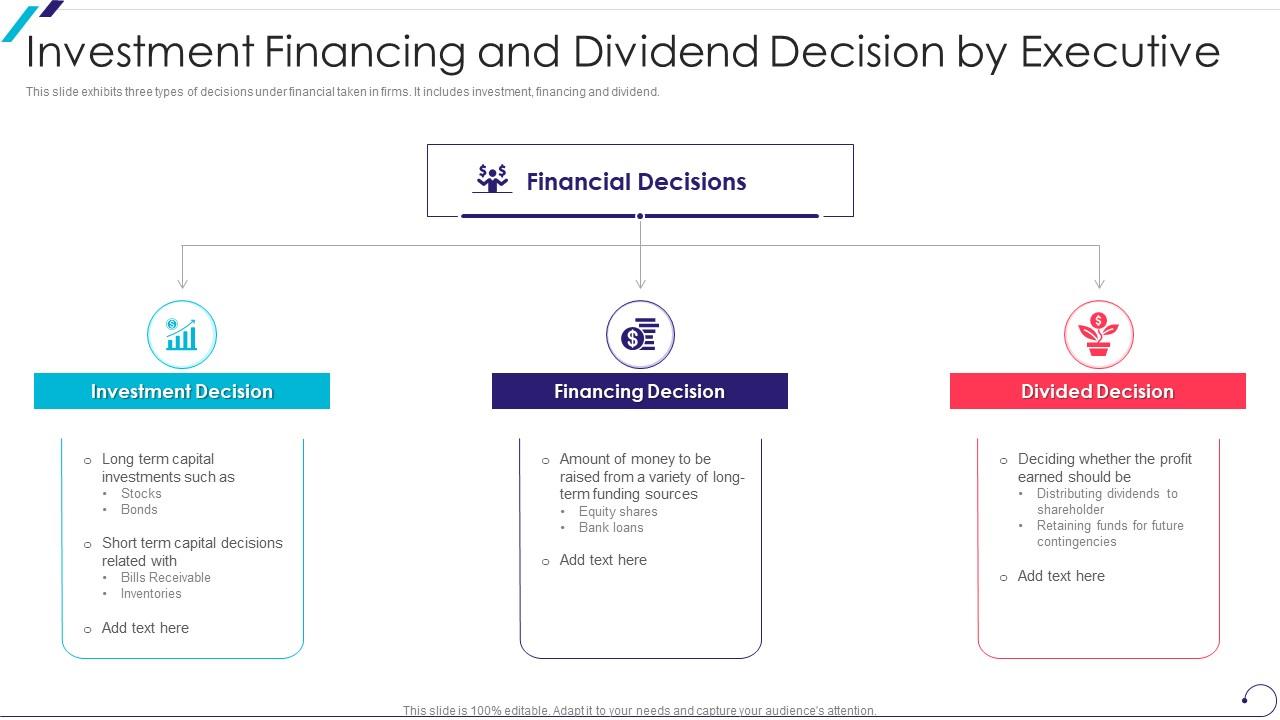
This slide exhibits three types of decisions under financial taken in firms. It includes investment, financing and dividend. Presenting our set of slides with Investment Financing And Dividend Decision By Executive. This exhibits information on three stages of the process. This is an easy to edit and innovatively designed PowerPoint template. So download immediately and highlight information on Investment Decision, Financing Decision, Divided Decision.
People who downloaded this PowerPoint presentation also viewed the following :

FAQs for Investment Financing And Dividend

Key factors include a compelling business model, strong management team, clear market opportunity, realistic financial projections, and competitive differentiation. These elements demonstrate viability by showcasing scalability potential, addressing investor concerns about risk mitigation, and proving market demand, with many successful startups finding that comprehensive preparation and strategic positioning ultimately deliver higher valuations and better partnership opportunities.

Equity financing involves higher risk but unlimited return potential through ownership stakes, while debt financing offers predictable returns with lower risk through fixed interest payments and collateral protection. With equity investments, investors in startups and growth companies can achieve substantial gains during successful exits, whereas debt financing provides steady income streams and principal protection, ultimately delivering different risk-return profiles for diverse investment strategies.

Venture capitalists provide capital, strategic guidance, industry expertise, and operational support to high-growth startups and emerging companies. These investors streamline business development by offering mentorship, network connections, and market insights, with many technology, healthcare, and fintech companies finding that VC partnerships accelerate scaling while delivering competitive advantages.

Angel investors evaluate businesses through comprehensive due diligence, examining the management team's experience, market size and opportunity, product viability, financial projections, and competitive positioning. These investors typically prioritize scalable business models with strong leadership, especially in technology and healthcare sectors, with many finding that companies demonstrating clear revenue potential and experienced founders ultimately receive funding more quickly.

Common misconceptions about crowdfunding include believing it's easy money requiring minimal effort, that all campaigns succeed, and that it's only for creative projects rather than serious business ventures. Many entrepreneurs underestimate the extensive marketing, community building, and campaign management required, while others overlook crowdfunding's potential for market validation, customer acquisition, and building brand loyalty alongside capital raising, ultimately delivering strategic advantages beyond traditional financing.

Financial projections significantly impact investment negotiations by establishing valuation benchmarks, demonstrating growth potential, validating market assumptions, and providing risk assessment frameworks for due diligence discussions. These projections enable investors and entrepreneurs to negotiate equity stakes, funding amounts, and milestone-based terms more strategically, with many venture capital firms and angel investors finding that comprehensive financial models ultimately streamline deal structures and accelerate investment decisions.

Industries significantly influence investment financing through varying risk profiles, capital requirements, regulatory frameworks, and growth cycles that shape investor preferences and available funding structures. Technology startups typically access venture capital and growth equity, while manufacturing companies rely on asset-based lending and equipment financing, with sectors like healthcare and energy requiring specialized investors familiar with regulatory complexities, ultimately determining both funding availability and terms.

Using personal savings for investment financing offers complete ownership control, no interest payments, and faster decision-making without lender approvals or credit requirements. While this approach eliminates debt obligations and provides maximum flexibility, it also presents liquidity risks and opportunity costs, with many entrepreneurs finding that strategic combinations of personal funds and external financing ultimately deliver better resource diversification and growth potential.

The regulatory environment significantly shapes investment financing through compliance requirements, capital adequacy rules, disclosure mandates, and risk management frameworks that determine available funding structures. These regulations influence venture capital operations, private equity structures, and debt financing terms, with financial institutions finding that adaptive regulatory strategies enable enhanced investor protection, improved market stability, and ultimately competitive advantages in increasingly complex markets.

Entrepreneurs can prepare for due diligence by organizing financial records, creating detailed business plans, conducting internal audits, preparing legal documentation, and developing compelling pitch materials. Through thorough preparation across financial, operational, and strategic areas, startups streamline the investment process, build investor confidence, and ultimately secure better funding terms, with many finding that comprehensive due diligence readiness accelerates deal closure.

Businesses can leverage existing relationships by utilizing satisfied customers as references, partnering with current vendors for co-investment opportunities, and accessing networks through board members, advisors, and industry contacts. These established connections provide credibility and trust, with many investors finding that referrals from trusted sources significantly reduce due diligence time, ultimately enabling faster funding decisions and more favorable terms.

Emerging fintech trends impacting investment financing include robo-advisors, blockchain-based securities, AI-powered risk assessment, peer-to-peer lending platforms, and digital asset management tools. These technologies streamline capital allocation, enhance due diligence processes, and automate portfolio management, with many investment firms finding that digital solutions significantly reduce operational costs while delivering faster, more personalized financing services.

Companies effectively communicate their value proposition by presenting clear market opportunities, demonstrating competitive advantages, showcasing strong financial projections, and highlighting experienced leadership teams. Through compelling pitch decks, detailed business plans, and data-driven presentations, organizations streamline investor understanding while building credibility, with many startups and growth companies finding that storytelling combined with solid metrics ultimately delivers enhanced investor confidence and successful funding outcomes.

Investors prioritize revenue growth rate, market size and penetration, customer acquisition cost versus lifetime value, gross margins, and cash flow generation when evaluating growth potential. These metrics collectively demonstrate scalability and profitability, with many institutional investors finding that companies showing consistent improvement across these areas, particularly in expanding markets, ultimately deliver stronger returns and sustainable competitive advantages.

Businesses mitigate investment financing risks through diversified funding sources, comprehensive due diligence, strategic financial planning, robust cash flow management, and contingency reserves. Through thorough market analysis and phased implementation approaches, organizations minimize exposure while maintaining operational flexibility, with many companies finding that balanced portfolios and conservative leverage ratios ultimately deliver sustainable growth and competitive positioning.

Ratings and Reviews

100% of 100
Write a review
Most Relevant Reviews
  1. 100%

    by Dong Santos

    Qualitative and comprehensive slides.
  2. 100%

    by Darrick Simpson

    Very well designed and informative templates.

2 Item(s)

per page:








