IoT Trade And Shipping Process Flow In Supply Chain Management

Rating:
90%
IoT Trade And Shipping Process Flow In Supply Chain Management IoT Trade And Shipping Process Flow In Supply Chain Management
Slide 1 of 9

or

Favourites Favourites

Try Before you Buy Download Free Sample Product

Audience Impress Your
Audience
Editable 100%
Editable
Time Save Hours
of Time
The Biggest Sale is ending soon in
0
0
:
0
0
:
0
0
Rating:
90%
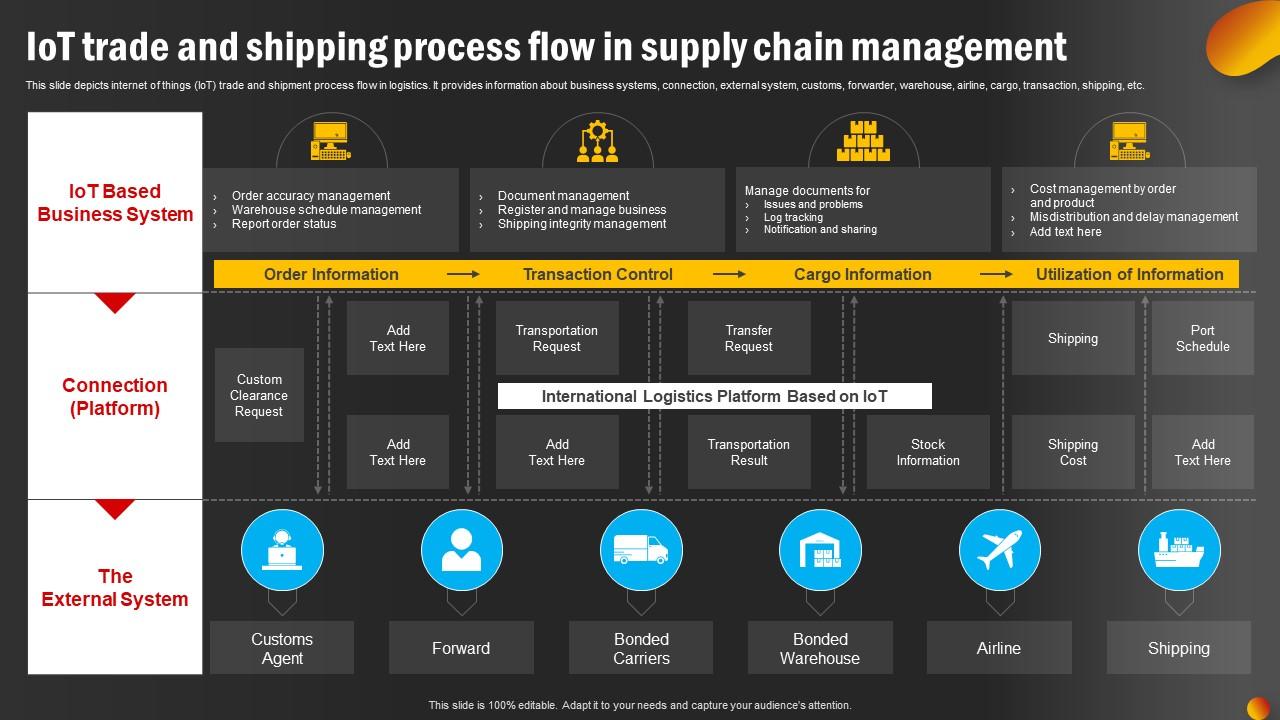
This slide depicts internet of things IoT trade and shipment process flow in logistics. It provides information about business systems, connection, external system, customs, forwarder, warehouse, airline, cargo, transaction, shipping, etc. Introducing our IoT Trade And Shipping Process Flow In Supply Chain Management set of slides. The topics discussed in these slides are Customs Agent, Forward, Bonded Carriers. This is an immediately available PowerPoint presentation that can be conveniently customized. Download it and convince your audience.

People who downloaded this PowerPoint presentation also viewed the following :

FAQs for IoT Trade And Shipping Process Flow In

Key benefits include real-time visibility, predictive maintenance, inventory optimization, enhanced traceability, and automated operations management. These technologies streamline logistics by reducing costs, minimizing disruptions, and improving delivery accuracy, with many manufacturing and retail organizations finding that IoT implementation ultimately delivers competitive advantage and significantly enhanced operational efficiency.

IoT enhances real-time tracking through GPS sensors, RFID tags, temperature monitors, cellular connectivity, and cloud-based dashboards that provide continuous location and condition updates. These technologies enable logistics companies to optimize routes, predict delays, monitor perishable goods, and proactively address issues, ultimately delivering improved customer satisfaction and operational efficiency.

IoT contributes to predictive maintenance through real-time sensor monitoring, automated alerts, condition-based scheduling, equipment performance analytics, and maintenance cost optimization. These technologies enable supply chain operations to prevent costly breakdowns, minimize downtime, and extend asset lifecycles, with manufacturing facilities and logistics companies finding that proactive maintenance strategies deliver significantly improved operational efficiency and reduced maintenance expenses.

Companies face challenges including high implementation costs, data security vulnerabilities, system integration complexities, staff training requirements, and managing massive data volumes from connected devices. While these hurdles initially seem daunting, many organizations in manufacturing, retail, and logistics find that strategic IoT deployment ultimately delivers enhanced visibility, reduced operational costs, and improved supply chain resilience.

IoT improves inventory management by providing real-time tracking, automated stock monitoring, predictive analytics, and demand forecasting capabilities across supply chain operations. Through smart sensors and connected devices, retailers and manufacturers streamline replenishment cycles, minimize overstock situations, and reduce spoilage significantly, ultimately delivering enhanced operational efficiency and cost reduction.

IoT supply chain adoption presents security challenges including device vulnerabilities, data breaches, network infiltration, inadequate authentication protocols, and unsecured communication channels. While these concerns require strategic attention, organizations are increasingly implementing multi-layered security frameworks, encrypted data transmission, and continuous monitoring systems, ultimately delivering enhanced visibility and operational control with proper cybersecurity investments.

IoT devices enhance supplier-retailer communication by providing real-time inventory tracking, automated reorder alerts, and shared visibility dashboards that eliminate information silos. Through connected sensors and smart analytics, retailers can seamlessly share demand forecasts while suppliers monitor stock levels and delivery schedules, ultimately streamlining operations and reducing costly miscommunications.

Big data analytics processes vast volumes of IoT-generated supply chain information to identify patterns, predict disruptions, and optimize operations through advanced algorithms, machine learning, and real-time processing capabilities. These analytics enable manufacturers and retailers to streamline inventory management, enhance demand forecasting, and minimize operational costs, with many logistics companies finding that data-driven insights ultimately deliver significant competitive advantages.

Businesses leverage IoT sensors to monitor emissions, track waste streams, measure energy consumption, and ensure regulatory compliance through real-time environmental data collection. These systems enable automated reporting to regulatory bodies, predictive maintenance to minimize environmental impact, and continuous monitoring of carbon footprints, with manufacturing and logistics companies finding that IoT delivers transparency and reduces compliance costs significantly.

IoT significantly enhances demand forecasting accuracy by providing real-time data from connected sensors, smart shelves, customer behavior analytics, and market trend indicators throughout supply chain networks. Through continuous data streams from retail locations, warehouses, and consumer touchpoints, organizations achieve more precise predictions, reduce inventory costs, and minimize stockouts, ultimately delivering improved customer satisfaction and competitive advantage.

Smart sensors and RFID technology enhance logistics operations by providing real-time inventory tracking, automated data collection, and predictive maintenance capabilities. Through IoT connectivity, warehouses and distribution centers can streamline order fulfillment, reduce manual errors, and optimize route planning, with many logistics companies finding that these technologies ultimately deliver faster delivery times and significantly lower operational costs.

IoT significantly automates warehouse operations through smart sensors, RFID tracking, automated picking systems, predictive maintenance tools, and real-time inventory monitoring. These technologies streamline logistics by reducing manual processes, minimizing errors, and optimizing storage layouts, with many distribution centers finding that automated systems deliver faster fulfillment times and lower operational costs.

IoT transforms supplier relationship management by enabling real-time visibility into supplier performance, automated compliance monitoring, and predictive analytics for demand forecasting. Through connected sensors and data platforms, organizations can proactively address supply disruptions, optimize inventory levels, and strengthen partnerships with transparent communication, ultimately delivering enhanced collaboration and reduced operational risks across their supply networks.

Companies can leverage IoT for enhanced customer experience through real-time shipment tracking, predictive delivery notifications, temperature monitoring for sensitive goods, automated inventory updates, and proactive issue resolution. These technologies streamline communication by providing transparent visibility, reducing delivery uncertainties, and enabling personalized service interactions, with many retail and e-commerce organizations finding that IoT-driven supply chain transparency significantly improves customer satisfaction and loyalty.

Future IoT supply chain trends include predictive analytics through advanced sensors, autonomous inventory management, real-time sustainability tracking, blockchain-integrated transparency, and AI-driven demand forecasting. These technologies streamline operations by minimizing waste, accelerating response times, and enhancing visibility across global networks, with manufacturers and retailers finding that interconnected systems ultimately deliver competitive advantage through improved efficiency and customer experiences.

Ratings and Reviews

90% of 100
Review Form
Write a review
Most Relevant Reviews
  1. 100%

    by Smith Diaz

    Excellent products for quick understanding.
  2. 80%

    by Noah Hernandez

    I took a chance with SlideTeam. I never looked back. Great products and great service.

2 Item(s)

per page: