


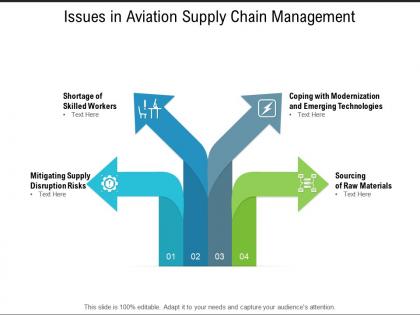
Issues in aviation supply chain management




Try Before you Buy Download Free Sample Product
 Impress Your
 Audience
 100%
100% Editable
 Save Hours
 of Time


Use our Issues In Aviation Supply Chain Management to steer your racing mind. Hit the right buttons and spur on your audience.
People who downloaded this PowerPoint presentation also viewed the following :
Issues in aviation supply chain management with all 5 slides:
Embellish your thoughts by using our Issues In Aviation Supply Chain Management. They will help you illustrate the brilliance of your ideas.




FAQs for Issues in aviation
Aviation supply chain regulatory compliance challenges include stringent safety certifications, complex international trade regulations, traceability requirements across multiple suppliers, environmental standards adherence, and continuous documentation updates. These compliance demands create operational complexity and cost pressures, with many airlines and manufacturers finding that strategic digital tracking systems and supplier partnerships help streamline certification processes while maintaining safety standards.
Fuel price fluctuations significantly impact aviation supply chains by affecting operational costs, route profitability calculations, and supplier contract negotiations throughout the network. Airlines adjust capacity planning, maintenance schedules, and cargo pricing strategies, while suppliers face pressure to optimize logistics costs, ultimately driving industry-wide efficiency improvements and strategic fuel hedging practices.
Technology revolutionizes aviation supply chain visibility through IoT sensors, blockchain systems, RFID tracking, real-time analytics, and cloud-based platforms. These solutions enable airlines and manufacturers to monitor inventory flows, predict maintenance needs, and streamline logistics operations, ultimately delivering enhanced operational efficiency and significantly reduced costs across increasingly complex global networks.
Predictive analytics enhances aviation inventory management by forecasting demand patterns, identifying maintenance schedules, and optimizing stock levels across multiple locations. Through machine learning algorithms, airlines and maintenance providers can reduce excess inventory costs, minimize aircraft downtime, and ensure critical parts availability, with many finding that predictive models deliver 20-30% inventory cost reductions while maintaining operational reliability.
Single-source supplier reliance in aviation creates significant risks including supply disruptions, price volatility, quality control vulnerabilities, regulatory compliance dependencies, and limited negotiation leverage. These concentration risks can ground fleets during supplier failures or natural disasters, with many airlines increasingly diversifying their supplier networks to ensure operational continuity, cost stability, and enhanced supply chain resilience.
Global geopolitics significantly affects aviation supply chains through trade restrictions, tariff policies, regulatory compliance requirements, cross-border transportation disruptions, and international partnership limitations. These political dynamics create both challenges and opportunities, with many airlines and manufacturers finding that diversifying supplier networks, establishing regional partnerships, and implementing flexible sourcing strategies ultimately delivers greater resilience and competitive advantage.
Sustainability initiatives can be integrated through green procurement policies, carbon footprint tracking systems, sustainable fuel sourcing, waste reduction programs, and supplier sustainability audits. Airlines and manufacturers increasingly find that these approaches streamline operations while reducing environmental impact, with companies like Boeing and Airbus leveraging sustainable partnerships to enhance operational efficiency and meet regulatory requirements.
Best practices for managing spare parts logistics include predictive maintenance analytics, strategic inventory positioning, supplier relationship management, digital asset tracking, and demand forecasting algorithms. These approaches streamline operations by reducing aircraft downtime, optimizing stock levels, and enhancing supply chain visibility, with many airlines finding that integrated digital platforms ultimately deliver significant cost savings and improved operational efficiency.
The COVID-19 pandemic has fundamentally reshaped aviation supply chain strategies through enhanced resilience planning, diversified supplier networks, increased inventory buffers, and accelerated digital transformation initiatives. Airlines and manufacturers now prioritize flexible sourcing arrangements, real-time visibility systems, and strategic partnerships that enable rapid adaptation to market disruptions, ultimately delivering more robust operational continuity and competitive advantage.
Organizations can implement risk diversification through multiple supplier networks, strategic inventory buffers, flexible logistics partnerships, real-time monitoring systems, and comprehensive contingency planning. Airlines and aerospace manufacturers increasingly leverage predictive analytics and alternative routing capabilities, while maintaining emergency supplier relationships across different geographical regions, ultimately delivering enhanced operational resilience and minimized revenue losses during unexpected weather events.
Drone technology revolutionizes aviation supply chains by automating inventory management, accelerating parts delivery, and enabling real-time tracking across warehouses and facilities. Airlines and aerospace manufacturers leverage drones for warehouse inspections, remote site deliveries, and supply monitoring, ultimately reducing operational costs, minimizing delivery times, and enhancing supply chain visibility in an increasingly complex logistics environment.
Digital twin technology revolutionizes aviation supply chain management by enabling real-time monitoring, predictive maintenance scheduling, inventory optimization, and enhanced supplier collaboration through virtual aircraft and component modeling. Airlines and manufacturers like Boeing increasingly leverage these digital replicas to reduce maintenance costs, minimize aircraft downtime, and streamline parts procurement, ultimately delivering improved operational efficiency and significant cost savings.
Collaboration among aviation stakeholders enhances efficiency by enabling real-time information sharing, coordinated demand forecasting, synchronized inventory management, and streamlined procurement processes across suppliers, manufacturers, airlines, and maintenance providers. Through integrated digital platforms and strategic partnerships, airlines, parts suppliers, and MRO facilities achieve reduced lead times, minimized stockouts, and optimized resource allocation, ultimately delivering cost savings and improved aircraft availability.
Key aviation supply chain metrics include on-time delivery rates, inventory turnover ratios, cost per flight hour, supplier quality scores, and aircraft availability percentages. These metrics enable airlines and manufacturers to streamline operations, reduce maintenance costs, and enhance fleet reliability, with many aviation companies finding that integrated performance dashboards ultimately deliver significant competitive advantage and operational efficiency.
The aviation industry can leverage blockchain technology for supply chain transparency by creating immutable records of parts provenance, automating compliance verification, and enabling real-time tracking across suppliers. Through distributed ledgers, airlines and manufacturers streamline maintenance schedules, reduce counterfeit parts risks, and enhance regulatory reporting, with many finding that blockchain ultimately delivers faster audits and improved safety compliance.
No Reviews