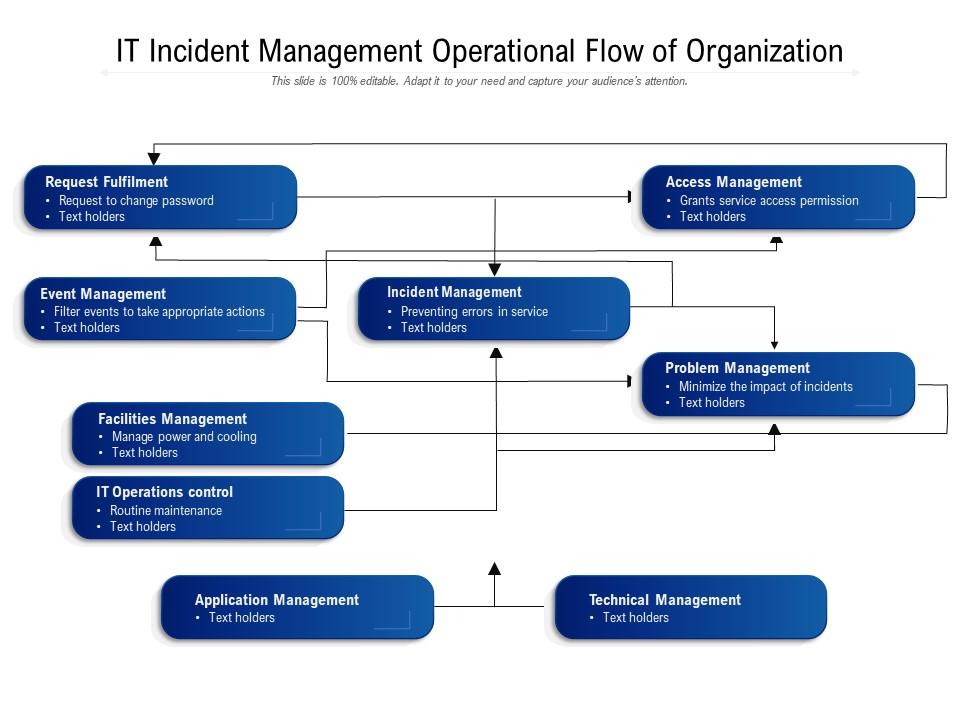
It incident management operational flow of organization
Try Before you Buy Download Free Sample Product
Audience
Editable
of Time
Our IT Incident Management Operational Flow Of Organization are explicit and effective. They combine clarity and concise expression.
People who downloaded this PowerPoint presentation also viewed the following :
It incident management operational flow of organization with all 2 slides:
Give your audience a fulfilling experience. They will find our IT Incident Management Operational Flow Of Organization elevating.
FAQs for It incident management operational
You'll want to start with incident detection and logging - that's your foundation. Then categorize and prioritize everything so you're not treating a minor bug like the world's ending. Get stuff assigned to the right teams quickly. Documentation is mind-numbing but trust me, future you will thank present you. Clear escalation procedures are huge when things go sideways. Communication channels with stakeholders matter more than people think. Post-incident reviews help you actually learn from the chaos. Honestly, just map out what you're doing now first, then figure out where the biggest holes are.
Focus on MTTR and MTTD first - those show how fast you're catching and fixing issues. Track incident volumes too, obviously. First-call resolution rates are huge because nobody wants to call support twice for the same thing. Customer satisfaction scores matter way more than people think, especially when your boss starts asking questions. Oh, and definitely watch repeat incidents since those tell you if you're actually solving problems or just slapping temporary fixes on everything. Throw these on a dashboard and check weekly for trends.
Communication will make or break your incident response, no joke. Keep everyone updated - users, stakeholders, your team, management. Nobody wants to deal with a million "what's happening??" messages when things are already on fire. I've watched incidents spiral because teams just weren't talking to each other. Seriously frustrating. Set up dedicated channels and assign someone to handle updates. Be honest about what you know and what you don't. Oh, and create templates for status updates so you're not starting from scratch every single time something breaks.
Honestly, automation is a game changer for incident response. Start with the boring stuff - ticket routing, basic diagnostics, status updates. Your alerts go straight to the right person instead of sitting in limbo. Teams can actually fix things rather than playing email tag all night. Those 3am disasters? Way less room for stupid mistakes when you're half asleep. I'd probably begin with just automating how tickets get categorized - nothing fancy. Then build from there once everyone's not freaking out about robots taking over. The time savings are pretty nuts once you get it rolling.
Ugh, the worst part is definitely communication breakdowns and everyone working in their own little bubbles. Incidents just drag on forever because nobody knows who's supposed to do what. What worked for us was getting a single place for all updates - not emails flying everywhere and random Slack threads. Document your current mess first (trust me, even chaos has patterns), then fix it piece by piece. Set up clear escalation paths so people aren't just panicking and guessing. Oh, and do those post-incident reviews religiously - that's where you actually learn stuff.
So ITIL is basically like having a game plan when stuff breaks instead of everyone panicking. You get clear roles, escalation steps, the whole deal. Their incident classification system is actually pretty solid - I'd start there since it'll help your team figure out what's urgent vs what can wait. The post-incident reviews are huge too (most people blow these off but they're gold). Yeah, it feels super rigid when you first use it, but honestly? Way better than the chaos of winging it every time. Your resolution times will definitely improve and stakeholders won't be left wondering what's happening.
Get a proper ticketing system first - ServiceNow, Jira Service Management, or Freshservice work great for logging everything. Slack or Teams are lifesavers for incident channels because email threads during outages? Absolute nightmare. PagerDuty handles your alerts and escalations automatically, which honestly saves so much headache. Oh, and set up a knowledge base in Confluence or whatever - you'll thank yourself later when you're scrambling for solutions at 2am. Start with ticketing and communication tools integrated, then add the monitoring stuff. Build it piece by piece.
Okay so definitely do post-incident reviews after every major thing that breaks - I can't stress this enough. Yeah I know closing the ticket feels good, but you're missing the whole point if you skip the analysis part. Look at what failed AND what actually worked, then write it down so people can reference it later. Your MTTR and how often stuff breaks will start showing patterns if you track them consistently. Oh and keep updating those runbooks based on what you find - half the time they're outdated anyway. Train people on new tools when you can. Honestly, each incident is like free intel about your weak spots.
Track these four things: MTTR (how fast you fix stuff), MTTD (how quick you spot problems), incident volume trends, and first-call resolution rates. Escalation rates matter too - nobody wants tickets ping-ponging around departments forever. Volume trends are honestly super helpful for spotting patterns and planning resources. Here's the thing though: don't just chase speed if it means more repeat incidents later. Quality matters. Set up dashboards so your team can see everything real-time and actually adjust when needed. The goal is catching problems fast AND fixing them right the first time.
Honestly, once a year minimum but don't just wait around for that. Big outages or infrastructure changes? Time to revisit immediately. I've watched teams crash and burn using ancient playbooks that made everything 10x worse. Quick quarterly check-ins work well - just put it in your calendar now or you'll forget. Then do the heavy lifting annually. Your policies should grow with your team and tech stack, not collect dust. Oh and definitely look back at your recent disasters first - that's where you'll spot the biggest gaps in what you currently have written down.
Okay so basically you want to write incident reports that actually make sense later. Document what happened, why it broke, and how you fixed it while it's still fresh - trust me on this one. Templates are a lifesaver because the last thing you need during a crisis is staring at a blank page. Throw everything in a searchable knowledge base and do post-mortems for the big stuff. Here's the thing though - tag incidents by type so you can catch patterns forming. Sometimes you'll notice weird trends you'd totally miss otherwise. Just make sure it answers the basics: what broke, root cause, and the fix.
Honestly, you want those teams talking to each other constantly. Set up automated triggers so whenever there's an incident, it kicks off a change review to check recent deployments - catches like 70% of issues. Flip side, make your change process look at past incident data before approving anything risky. I mean seriously, why make the same mistake twice? Your change board needs those incident trend reports too. Oh and definitely link up your ticketing systems first - that's the boring but necessary foundation. Short version: create feedback loops everywhere so they're not working in silos anymore.
So incident management is basically your panic mode - just get the damn thing working again ASAP. Problem management comes after when you actually have time to breathe and figure out what went wrong. Like when your email server dies, incident gets it back online fast. Then problem management digs into the why - was it a memory leak? Old hardware acting up? Whatever caused it, you fix that so it doesn't crash again next week. Honestly, tracking both separately in your ITSM tool helps you spot patterns. Otherwise you'll just keep putting out the same fires over and over.
Your incident management process is literally the foundation that keeps your cybersecurity from falling apart. Quick detection and response workflows help you contain breaches before they spread everywhere. You'll want your security team involved in every incident - honestly, assume everything could be a security issue until proven otherwise. Recovery gets way faster when you have solid processes mapped out ahead of time. Compliance requirements are a pain but incident management helps check those boxes too. Start by looking at what you're doing now and figure out where security thinking needs to get built in. Each attack teaches you something if you're paying attention.
Your incident team needs solid tech skills - that's obvious. But communication is just as critical when everything's going sideways and people are panicking. Some folks honestly just fall apart under pressure, so look for people who can think clearly during chaos. ITIL knowledge helps, plus they should know your monitoring tools inside and out. Documentation is boring but super important for those post-mortem reviews. Oh, and don't skip the tabletop exercises - we used to think they were pointless until they actually saved us during a real outage. Regular training on your specific systems keeps everyone sharp too.
No Reviews