Key Pillars Of Employee Empowerment QCP Templates Set 1
Try Before you Buy Download Free Sample Product
Audience
Editable
of Time
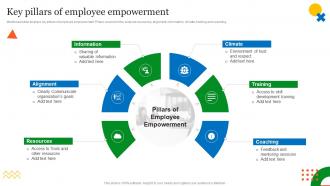
Mentioned slide displays key pillars of employee empowerment.Pillars covered in the slide are resources, alignment, information, climate, training and coaching.
People who downloaded this PowerPoint presentation also viewed the following :
Key Pillars Of Employee Empowerment QCP Templates Set 1 with all 6 slides:
Use our Key Pillars Of Employee Empowerment QCP Templates Set 1 to effectively help you save your valuable time. They are readymade to fit into any presentation structure.
FAQs for Key Pillars Of Employee Empowerment QCP
Key components of employee empowerment include decision-making authority, access to information, skill development opportunities, resource allocation control, and recognition systems. These elements work together by building trust, enhancing job satisfaction, and improving performance outcomes, with many organizations finding that empowered employees deliver greater innovation, faster problem-solving, and ultimately stronger competitive advantage.
Management effectively promotes empowerment culture through clear goal-setting, transparent communication, decision-making authority delegation, continuous feedback systems, and comprehensive skill development programs. These approaches enable organizations to enhance employee engagement, accelerate innovation, and improve operational efficiency, with many companies finding that empowered teams deliver superior customer experiences while reducing management overhead, ultimately creating sustainable competitive advantage.
Communication serves as the foundation for employee empowerment by ensuring transparent information sharing, establishing clear expectations, providing regular feedback, and creating open dialogue channels between management and staff. Through effective communication strategies, organizations enable employees to make informed decisions, understand their impact on business outcomes, and contribute meaningfully to strategic initiatives, ultimately delivering enhanced job satisfaction and improved organizational performance.
Empowered employees contribute to organizational performance by demonstrating higher productivity, enhanced innovation, improved decision-making speed, and greater accountability in their roles. Through increased autonomy and ownership, organizations like tech companies and financial institutions experience reduced turnover, faster problem resolution, and stronger customer satisfaction, ultimately delivering competitive advantage and sustainable growth.
Potential challenges include resistance to change from management and employees, lack of clear boundaries and guidelines, insufficient training and support systems, fear of losing control among supervisors, and inconsistent implementation across departments. While these obstacles can initially slow progress, many organizations find that addressing them through structured communication, comprehensive training programs, and gradual delegation ultimately delivers stronger employee engagement and improved operational efficiency.
Technology enhances employee empowerment in remote work environments by providing collaboration platforms, performance analytics, and self-service tools that enable autonomous decision-making and flexible workflows. Through cloud-based systems, project management software, and real-time communication tools, remote employees access resources independently, track their contributions transparently, and collaborate seamlessly across time zones, ultimately delivering greater job satisfaction and productivity.
Employee empowerment significantly enhances retention and job satisfaction by providing autonomy, decision-making authority, professional development opportunities, and meaningful work ownership. When organizations empower their workforce through flexible responsibilities, skill-building programs, and leadership involvement, employees experience greater engagement, career progression, and workplace fulfillment, ultimately reducing turnover while delivering improved productivity and organizational loyalty.
**INPUT**: What metrics can organizations use to measure the impact of employee empowerment? **OUTPUT**: Organizations can measure employee empowerment through engagement scores, retention rates, decision-making speed, innovation metrics, and customer satisfaction indices. These measurements enable companies to track productivity improvements, reduced turnover costs, and enhanced service quality, with many finding that empowered teams deliver faster problem resolution and ultimately stronger competitive advantage. [Word count: 50 words]
Training and development programs support employee empowerment by building critical skills, enhancing decision-making capabilities, and fostering leadership competencies across all organizational levels. Through targeted learning initiatives, companies enable employees to take ownership of projects, solve complex problems independently, and contribute strategic value, with many organizations finding that comprehensive development programs ultimately deliver increased innovation, improved performance, and stronger competitive advantage.
Leadership style significantly influences employee empowerment through decision-making delegation, trust-building, communication approaches, and autonomy levels provided to teams. Transformational leaders enhance empowerment by encouraging innovation and risk-taking, while micromanaging styles limit initiative, with many organizations finding that collaborative leadership approaches ultimately deliver higher engagement, faster problem-solving, and improved organizational performance.
Managers can encourage decision-making autonomy by clearly defining boundaries and expectations, delegating meaningful responsibilities, providing necessary resources and training, and creating psychological safety for calculated risks. Through regular coaching conversations and feedback loops, leaders in organizations like tech companies and consulting firms enhance employee engagement, accelerate innovation, and ultimately build more agile teams capable of responding quickly to market changes.
Successful employee empowerment case studies include Google's "20% time" for innovation projects, Zappos' holistic hiring for cultural fit, Southwest Airlines' frontline decision-making authority, and Patagonia's environmental activism alignment. These approaches streamline operations by enhancing creativity, improving customer experiences, and boosting retention rates, with many organizations finding that empowered employees deliver significantly higher productivity and innovation outcomes.
Employee empowerment naturally aligns with modern workplace trends by fostering autonomy, flexible decision-making, and trust-based management approaches that support remote work and personalized schedules. This strategic combination enables organizations to attract top talent, reduce turnover, and enhance productivity, with many companies finding that empowered employees deliver better results while maintaining healthier work-life integration.
Organizations can empower frontline employees through decision-making autonomy, comprehensive skills training, transparent communication channels, recognition programs, and resource accessibility. These strategies enhance employee engagement by reducing bureaucratic delays, building confidence through capability development, and fostering ownership mentality, with many retail and service organizations finding that empowered frontlines deliver faster customer resolutions and improved satisfaction rates.
Feedback mechanisms can be integrated through regular performance reviews, peer-to-peer feedback systems, anonymous suggestion platforms, real-time project assessments, and 360-degree evaluations. These approaches enhance empowerment by creating transparent communication channels, identifying skill development opportunities, and building trust between management and employees, ultimately delivering improved engagement and organizational performance.
-
SlideTeam provides PPTs on every single topic. Their templates suit my job very well. I am very grateful!
-
Superb! The innovative and inspiring template designs provide an edge to the presentation.