Lead management funnel example of ppt presentation
Try Before you Buy Download Free Sample Product
Audience
Editable
of Time
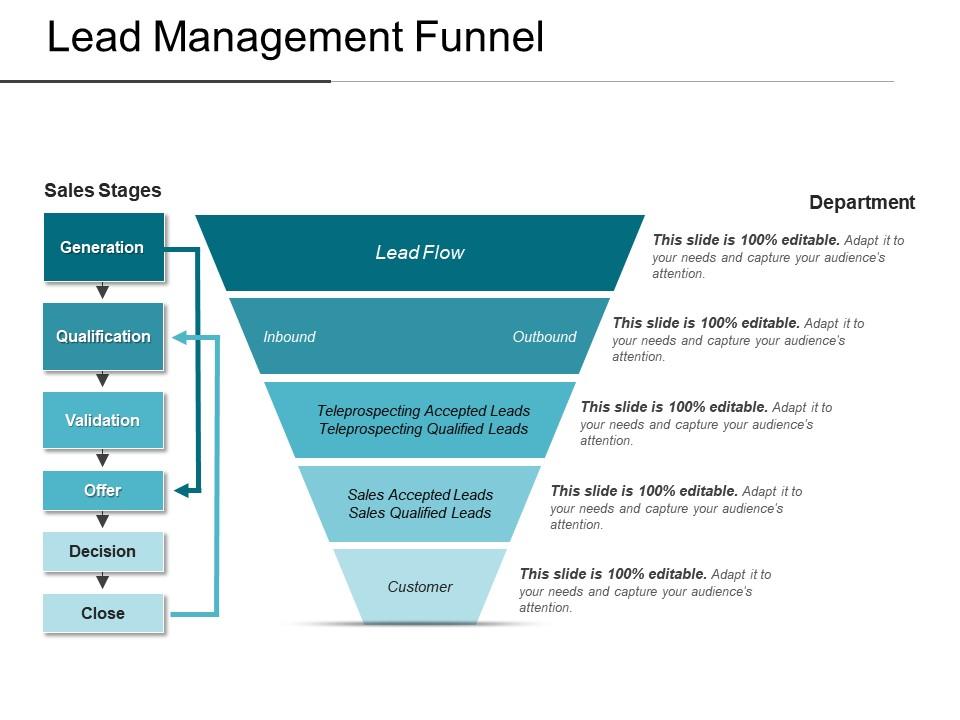
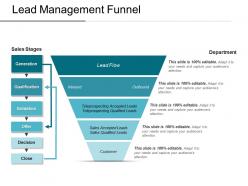
Convey your message uninterruptedly with our Lead Management Funnel PPT Presentation. Use this lead generation template for the screening or filtering process. There are many funnel templates including purchase funnel, sales funnel, marketing funnel out of which lead generation is one. Depicting the lead generation process using this PPT slide becomes quite easy for you. This is a 5 stage management funnel that shows how a stranger becomes a customer. Users can use this to understand the process and stages that a marketer goes through for turning the strangers to potential customers. This PPT slide can also be used for making awesome presentations on funnel analysis. With this funnel analysis template, you can easily analyze the sales and marketing concepts. The process or stages where the downfall is occurring can be easily demonstrated with this template. This way all the bottlenecks or the shortcomings can easily be eliminated. The topmost bar in this lead management funnel represents the lead you have and the bar at the bottom reflects the screened customers you
People who downloaded this PowerPoint presentation also viewed the following :
Lead management funnel example of ppt presentation with all 5 slides:
Our Lead Management Funnel Example Of Ppt Presentation will get you into your element. Your thoughts will be in their comfort zone.
FAQs for Lead management funnel example
The key stages of a lead management funnel include awareness, interest, consideration, intent, evaluation, and purchase, each representing progressively deeper engagement levels. These stages differ by prospect behavior and required nurturing approaches, with early stages focusing on brand visibility and education, while later stages emphasize personalized demonstrations, pricing discussions, and closing strategies, ultimately delivering higher conversion rates.
Businesses effectively qualify leads through targeted criteria at each stage, using lead scoring systems, behavioral tracking, demographic filters, budget verification, and decision-maker identification. Through strategic questioning and progressive profiling, organizations streamline their sales process, reduce conversion cycles, and improve resource allocation, with many finding that automated qualification tools ultimately deliver higher-quality prospects and increased revenue efficiency.
Automation streamlines lead management by capturing leads automatically, scoring prospects based on behavior, nurturing relationships through targeted campaigns, and routing qualified leads to sales teams. Through marketing automation platforms, businesses accelerate response times, reduce manual tasks, and maintain consistent engagement, with many organizations finding that automated workflows increase conversion rates while enabling sales teams to focus on closing high-value opportunities.
Data analytics optimizes lead management by identifying high-converting lead sources, tracking customer behavior patterns, predicting lead scoring accuracy, and measuring funnel conversion rates at each stage. Through predictive modeling and real-time dashboards, sales teams streamline resource allocation, personalize outreach timing, and eliminate bottlenecks, ultimately delivering higher conversion rates and improved ROI across campaigns.
Common lead funnel challenges include poor lead qualification, inconsistent follow-up processes, lack of integration between marketing and sales teams, inadequate tracking systems, and low conversion rates at critical stages. These obstacles can be overcome by implementing automated lead scoring systems, establishing clear handoff protocols between departments, utilizing CRM platforms for seamless tracking, and regularly analyzing funnel metrics, ultimately enabling organizations to streamline their sales processes and significantly improve conversion rates.
Personalized communication enhances lead conversion by delivering targeted messaging, addressing specific pain points, and building stronger relationships throughout the funnel journey. Through customized content, behavioral triggers, and segment-specific outreach, businesses accelerate prospects through conversion stages while reducing drop-off rates, with many organizations finding significantly improved engagement and higher-quality lead nurturing.
Essential lead management tools include CRM platforms, marketing automation software, lead scoring systems, email marketing tools, and analytics dashboards. These technologies streamline prospect tracking, automate nurturing campaigns, and prioritize high-value opportunities, with many sales organizations finding that integrated platforms deliver faster conversions, improved team productivity, and ultimately enhanced revenue growth.
Lead nurturing differs significantly across industries based on sales cycles, decision-making processes, and customer expectations within the funnel. Healthcare organizations focus on compliance and trust-building through educational content, while technology companies emphasize product demonstrations and technical specifications, and financial services prioritize regulatory transparency and risk mitigation, ultimately enabling each sector to deliver targeted experiences that accelerate conversions.
Key metrics include conversion rates at each funnel stage, lead quality scores, time-to-conversion, cost per lead, and customer lifetime value. These measurements enable organizations to identify bottlenecks, optimize resource allocation, and enhance targeting strategies, with many companies finding that tracking lead velocity and attribution sources ultimately delivers improved ROI and streamlined sales processes.
Content marketing integrates into lead management funnels through targeted blog posts, educational webinars, downloadable resources, email nurture sequences, and personalized content experiences that guide prospects through each stage. By delivering relevant content at awareness, consideration, and decision phases, organizations enhance lead qualification, accelerate conversion timelines, and ultimately improve sales productivity while building stronger customer relationships.
Lead scoring significantly impacts resource allocation by enabling sales teams to prioritize high-value prospects, direct efforts toward qualified leads, and minimize time spent on low-conversion opportunities. Through automated scoring systems, organizations streamline their sales processes, enhance team productivity, and optimize conversion rates, with many companies finding that strategic lead prioritization delivers faster deal closures and improved ROI.
CRM systems enhance lead management by centralizing lead data, automating follow-up sequences, and tracking interactions across multiple touchpoints throughout the sales funnel. These platforms enable sales teams to prioritize high-value prospects, streamline communication workflows, and monitor conversion rates, with many organizations finding that integrated CRM approaches ultimately deliver faster response times and higher close rates.
Re-engaging stalled mid-funnel leads requires targeted nurturing through personalized email sequences, retargeting campaigns, educational webinars, and direct outreach addressing specific pain points. These strategies work by delivering relevant content, social proof, and limited-time incentives, with many organizations finding that combining automated workflows with human touchpoints significantly increases conversion rates and shortens sales cycles.
Aligning marketing and sales teams is crucial for effective lead management, as it eliminates handoff friction, ensures consistent messaging, and creates seamless customer experiences throughout the funnel. This strategic alignment enables organizations to reduce lead conversion times, improve qualification accuracy, and maximize revenue potential, with many companies finding that coordinated teams deliver significantly higher close rates and customer satisfaction.
Businesses should maintain lead quality by implementing robust scoring systems, conducting regular data audits, establishing clear qualification criteria, utilizing automated nurturing workflows, and continuously tracking conversion metrics. These practices enable organizations to prioritize high-value prospects, eliminate outdated information, and streamline sales processes, with many companies finding that systematic lead maintenance increases conversion rates while reducing acquisition costs.
-
Best way of representation of the topic.
-
Much better than the original! Thanks for the quick turnaround.