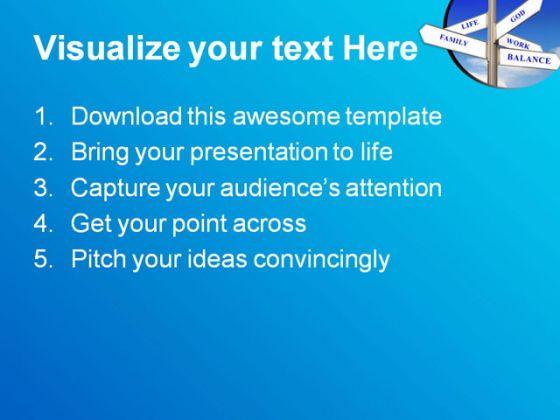
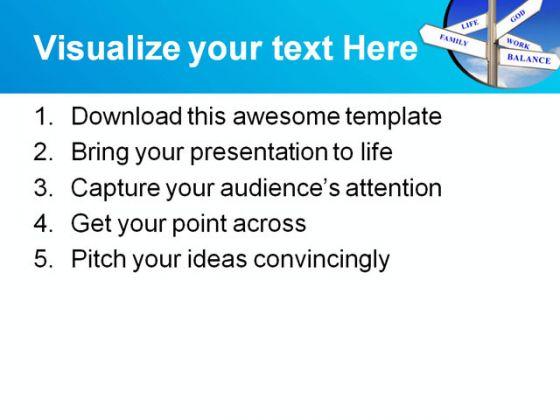
Life work and balance signpost metaphor powerpoint templates and powerpoint backgrounds 0911

Rating:
100%
Life work and balance signpost metaphor powerpoint templates and powerpoint backgrounds 0911
Slide 1 of 3
Favourites Favourites

Try Before you Buy Download Free Sample Product

Audience Impress Your
Audience
Editable 100%
Editable
Time Save Hours
of Time
The Biggest Sale is ending soon in
0
0
:
0
0
:
0
0
Rating:
100%
Microsoft PowerPoint Template and Background with work life balance signpost

People who downloaded this PowerPoint presentation also viewed the following :

FAQs for Life work and balance signpost metaphor powerpoint templates and

Successful work-life balance includes clear boundary setting, flexible scheduling, prioritized time management, regular self-care practices, and supportive workplace cultures. These components work together by enabling employees to manage professional responsibilities while maintaining personal well-being, with many organizations finding that balanced employees deliver higher productivity, reduced burnout, and ultimately stronger business performance.

Effective time management contributes to work-life balance by establishing clear boundaries, prioritizing high-impact tasks, and reducing time wasted on inefficient activities. Through strategic scheduling and delegation techniques, professionals streamline their workflows, minimize overtime requirements, and create dedicated space for personal commitments, ultimately delivering greater productivity and enhanced well-being.

Workplace flexibility enhances life-work balance by enabling remote work options, flexible scheduling, compressed workweeks, and outcome-based performance metrics rather than time-based attendance. These approaches streamline personal obligations while maintaining productivity, with many organizations finding that flexible policies reduce employee burnout, increase retention rates, and ultimately deliver improved job satisfaction and competitive talent acquisition advantages.

Organizations support work-life balance through flexible scheduling, remote work options, comprehensive wellness programs, mental health resources, and clear boundary-setting policies. These approaches enhance employee satisfaction, reduce turnover, and boost productivity, with many companies finding that strategic work-life initiatives ultimately deliver stronger retention rates and competitive talent advantages.

Neglecting work-life balance leads to employee burnout, decreased productivity, higher turnover rates, increased absenteeism, and reduced job satisfaction across organizations. For employers, this translates into elevated recruitment costs, diminished team performance, and compromised company culture, with many businesses finding that poor work-life balance ultimately undermines competitive advantage and long-term operational efficiency.

Employees can set boundaries by establishing clear work hours, turning off notifications after designated times, creating dedicated workspace areas, and communicating availability expectations with colleagues and supervisors. These strategies enable professionals to maintain separation between work and personal life, ultimately reducing burnout while enhancing productivity, with many organizations finding that employees with strong boundaries deliver higher quality work and sustained performance.

Effective wellness strategies include setting clear boundaries between work and personal time, scheduling regular exercise and mental health breaks, delegating tasks when possible, and utilizing time management techniques like priority matrices. These approaches streamline daily routines by reducing stress, enhancing productivity, and maintaining energy levels, with many professionals finding that consistent wellness practices ultimately deliver improved performance and sustainable career growth.

Technology presents both challenges and opportunities for work-life balance, creating constant connectivity while enabling flexible work arrangements, automation, and remote collaboration. While smartphones and emails can blur professional boundaries, strategic implementation of productivity tools, time management apps, and communication platforms ultimately delivers enhanced efficiency and location independence, with many organizations finding that thoughtful technology adoption streamlines workflows while preserving personal time.

Remote work presents both challenges and opportunities for work-life balance, enabling greater flexibility, reduced commuting stress, and personalized schedules, while also creating boundary issues between home and office spaces. Many professionals find that remote arrangements ultimately deliver improved family time and reduced burnout when structured effectively, though organizations increasingly recognize the need for clear policies supporting digital boundaries and sustainable remote practices.

Cultural perspectives significantly shape work-life balance concepts through varying attitudes toward hierarchy, collective versus individual priorities, and relationship between personal time and professional dedication. Countries like Denmark and Netherlands prioritize structured personal time and flexible scheduling, while nations such as Japan and South Korea traditionally emphasize longer work commitments, though many organizations are increasingly adopting more balanced approaches to attract global talent and enhance employee satisfaction.

Practical integration strategies include time-blocking personal activities, scheduling leisure like meetings, leveraging micro-moments between tasks, batch-processing work responsibilities, and establishing non-negotiable boundaries around personal time. These approaches streamline work-life harmony by protecting personal interests, reducing decision fatigue, and creating sustainable routines, with many professionals finding that strategic scheduling ultimately enhances both productivity and satisfaction.

Mindfulness practices enhance work-life balance by reducing stress, improving focus, and creating clearer boundaries between professional and personal time. Through techniques like meditation and mindful breathing, professionals streamline their mental processes, minimize overwhelm, and ultimately deliver better performance while maintaining personal well-being, with many organizations increasingly recognizing these benefits.

Signs of work-life balance struggles include chronic fatigue, increased irritability, declining job performance, neglecting personal relationships, and persistent stress-related health issues. These indicators often manifest simultaneously in professionals across industries like healthcare, finance, and technology, with many organizations finding that employees experiencing multiple symptoms require immediate intervention to prevent burnout and maintain productivity.

Managers can foster work-life balance by implementing flexible scheduling, setting clear boundaries around after-hours communication, and modeling healthy habits themselves. Through remote work options and result-focused performance metrics, organizations across sectors like healthcare and financial services enhance employee satisfaction, reduce turnover significantly, and ultimately deliver improved productivity while building stronger, more sustainable workplace cultures.

Communication enables transparent dialogue about workload capacity, personal boundaries, and realistic deadlines between employees and managers. Through regular check-ins and honest conversations about priorities, organizations can establish mutual understanding regarding availability, project timelines, and personal commitments, ultimately reducing stress and preventing burnout while maintaining productivity and professional relationships.

Ratings and Reviews

100% of 100
Write a review
Most Relevant Reviews
  1. 100%

    by Colby Coleman

    Good research work and creative work done on every template.
  2. 100%

    by Dave Shaw

    The Designed Graphic are very professional and classic.

2 Item(s)

per page: