

List of ideas for effective brainstorming process ppt images





Try Before you Buy Download Free Sample Product
 Impress Your
 Audience
 100%
100% Editable
 Save Hours
 of Time


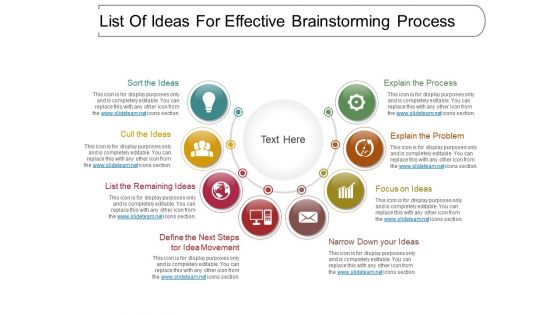
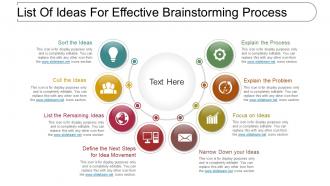
Browse through our list of ideas for effective brainstorming process PPT image design. Brainstorming is a technique for generating ideas to find solutions for a specific problem. This presentation template has been designed with an objective which is to assist the business professionals to think out of the box and come up with some creative and innovative ideas that can take business to the next level. People working in the corporate industry can make the best use of this PowerPoint diagram as it comes with some key aspects that are perfect to communicate the information effectively such as explain the process, explain the problem, focus on ideas, narrow down your ideas, define the next steps for ideas movement, list the remaining ideas, cull the ideas and sort the ideas. You can share these crucial aspects with your team. Besides this, you can deliver the information about different methods of brainstorming such as group passing technique, individual brainstorming etc. Moreover educational experts can use to make their students think creatively and find solutions and brainstorm for the ideas. Download it now. Next time you have an important presentation we're here to help. Our List Of Ideas For Effective Brainstorming Process Ppt Images are available 24/7.
People who downloaded this PowerPoint presentation also viewed the following :
List of ideas for effective brainstorming process ppt images with all 5 slides:
Develop an elegant attitude with our List Of Ideas For Effective Brainstorming Process Ppt Images. They will be drawn by your demeanour.

FAQs for List of ideas for effective brainstorming
Honestly, silent brainstorming is a game changer for remote sessions. Give everyone 5-10 minutes to write down ideas before anyone talks - it stops the loudest person from dominating the whole call. I'm obsessed with tools like Miro for this stuff. Round-robin sharing works well too, where you go around and everyone shares one idea at a time. The "brain dump then build" method is solid. Structure really matters since video calls can turn into chaos quickly. Oh, and definitely try that silent ideation thing first - you'll be surprised how much better the ideas get when people aren't just reacting to whoever spoke first.
Dude, visual stuff totally changes the game for brainstorming. Mind maps are clutch for showing how ideas connect. Whiteboards let everyone jump in real-time, and sticky notes - honestly my favorite - help sort everything into categories. People actually stay focused when there's something to look at instead of just sitting around talking. Oh, and it's perfect for people who learn better by doing things with their hands. Start with a picture or diagram in the middle of your whiteboard. Gives everyone something concrete to riff off, and you'll get way more creative ideas than just asking "so what do you think?"
Okay so diversity literally saves brainstorming sessions from being terrible. Mix up your team - different departments, experience levels, personality types. I'm telling you, homogeneous groups just create echo chambers where everyone nods along. You want the person who usually pushes back on your ideas? Invite them. Different backgrounds challenge assumptions in ways you'd never think of alone. Actually, some of my best sessions happened when we had that one contrarian who made everyone think harder. Short answer: if your whole team thinks alike, you're missing out on way better solutions.
Dude, time pressure is actually amazing for creativity! Your brain can't overthink when you're racing the clock - no time to second-guess or get stuck perfecting one idea. Honestly, I come up with my weirdest (best?) stuff when I'm slightly panicked about deadlines. Everyone jumps in faster too instead of just sitting there quietly. The pressure forces you past boring, obvious answers. Next brainstorm, set a 10-minute timer and see what happens. You'll be surprised how much more interesting the ideas get when people know they can't waste time.
When your team's stuck, shake things up. Have everyone sketch instead of just talking, or try the "worst idea possible" game - sounds dumb but it actually works and gets people laughing again. Physical changes help too. Move rooms, stand up, hell, go outside if you can. I love throwing random constraints at people like "you have 2 minutes, GO" or "what would Netflix do here?" The silent writing thing works surprisingly well too - no one talks, just writes ideas for 5 minutes. Honestly, anything that breaks whatever rut you're in will probably help.
Honestly, digital brainstorming is a game-changer. Everyone can throw ideas up simultaneously without the usual chaos of people interrupting each other. Miro and Mural are solid choices, though even Google Jamboard works fine for basic stuff. I've noticed our quieter team members actually speak up more in virtual sessions - weird but true. Figma's perfect if you're working on visual concepts too. Oh, and everything saves automatically, so when someone has that random genius idea at midnight, it doesn't disappear. Just grab a digital whiteboard and watch your team actually engage for once.
Honestly, mind mapping just clicks with how your brain actually works. Instead of forcing linear lists, you can see all these random connections pop up between ideas. It's way more fun than staring at a blank page too - I always end up discovering stuff I never would've thought of otherwise. Your team can jump in easier during group sessions since everything's visual. Just throw your main topic in the center and let ideas branch out however they want. Sometimes the weirdest connections turn into the best ones, you know?
So here's what works for me - alternate between generating ideas and actually evaluating them as you go. Don't save all the feedback for the end, that's brutal. Do quick rounds every 15-20 minutes where people rate stuff or toss out reactions. Dot voting is honestly genius for this - keeps things moving but weeds out the terrible ideas. Oh, and try rotating who plays devil's advocate so someone's always poking holes in assumptions. Just make sure it feels helpful, not like you're tearing people down. Mini feedback loops beat one massive critique session every time.
So structured brainstorming has rules - time limits, prompts, maybe everyone writes ideas down first before talking. Open-ended is just... whatever pops into your head gets said out loud. Here's the thing though - constraints actually make you MORE creative (I know, sounds backwards). Your brain has to work harder when it's boxed in. Plus structured methods help shy people contribute since there's usually a system for getting everyone involved. Open sessions are good for early exploration, but honestly? The loudest person often hijacks everything. I'd go structured when you need real solutions or fair participation.
Oh man, cultural stuff totally changes brainstorming dynamics. Americans will blurt out anything - even half-baked ideas. But people from collective cultures? They stay quiet to avoid looking stupid or disagreeing with the group. Plus hierarchy is huge - nobody's gonna contradict their manager sitting right there. Some teams need structure while others do better with messy, chaotic sessions. Actually had a coworker who'd never speak up until we started doing anonymous submissions. You gotta read your room and maybe split into smaller groups so everyone actually contributes instead of just the loudest voices.
Honestly, the biggest thing is making sure people don't feel judged for throwing out weird ideas. Set some basic rules upfront - no shutting down ideas during the brainstorm, try building off what others say instead. I've been in way too many meetings where one person just talks over everyone while the quiet folks never speak up. Try mixing it up with anonymous idea boards or breaking into smaller groups first. Oh, and don't always have the same person running it. Here's something that actually works - ask for the "terrible" ideas first. It's weird but it totally loosens everyone up.
Try a basic 1-5 scoring system for impact and how doable each idea actually is. Group the similar ones together so you're not being redundant. I'd focus on whatever solves your audience's biggest headaches first - that's usually where the money is anyway. Don't overthink it with some complicated framework. Score them right after brainstorming while it's all still fresh in your head. Pick your top 5-7 ideas. Run them by someone else before presenting. Also consider what you can actually pull off with your current resources and timeline.
First thing - get all those ideas written down before people forget them. I usually snap photos of whiteboards because someone always erases them too early. Group similar concepts together, then figure out which ones are actually doable vs pipe dreams. Book another meeting within the week while everyone's still hyped. Honestly, waiting longer than that is a mistake - the momentum just dies. Pick specific people to own each action item with real deadlines. Don't try executing everything at once though. Choose maybe 2-3 ideas to test first and see what happens.
Oh, role-playing is seriously underrated for brainstorming! You basically get people to step into different shoes - like "the picky customer" or "our biggest competitor." Suddenly they're thinking totally differently than usual. I've seen quiet team members get super bold when they're pretending to be someone else, which is honestly pretty entertaining. The whole point is breaking people out of their normal headspace. Different perspectives = way more creative solutions. Next time, try giving everyone specific roles to play. Even something random like "the person who hates change" can spark ideas you'd never get otherwise. Works surprisingly well.
Ugh, the worst thing is when that one person hijacks everything with their "well actually" comments every five seconds. Also don't shoot down ideas right away - let people get weird with it first, then judge later. Too many people in the room just creates chaos, honestly. I'd set a timer to keep things moving and make sure someone's writing stuff down because you'll forget half the good ideas otherwise. Oh and don't get stuck overthinking everything instead of just throwing out options. Keep it loose at first, then tighten up.
-
Designs have enough space to add content.
-
Illustrative design with editable content. Exceptional value for money. Highly pleased with the product.