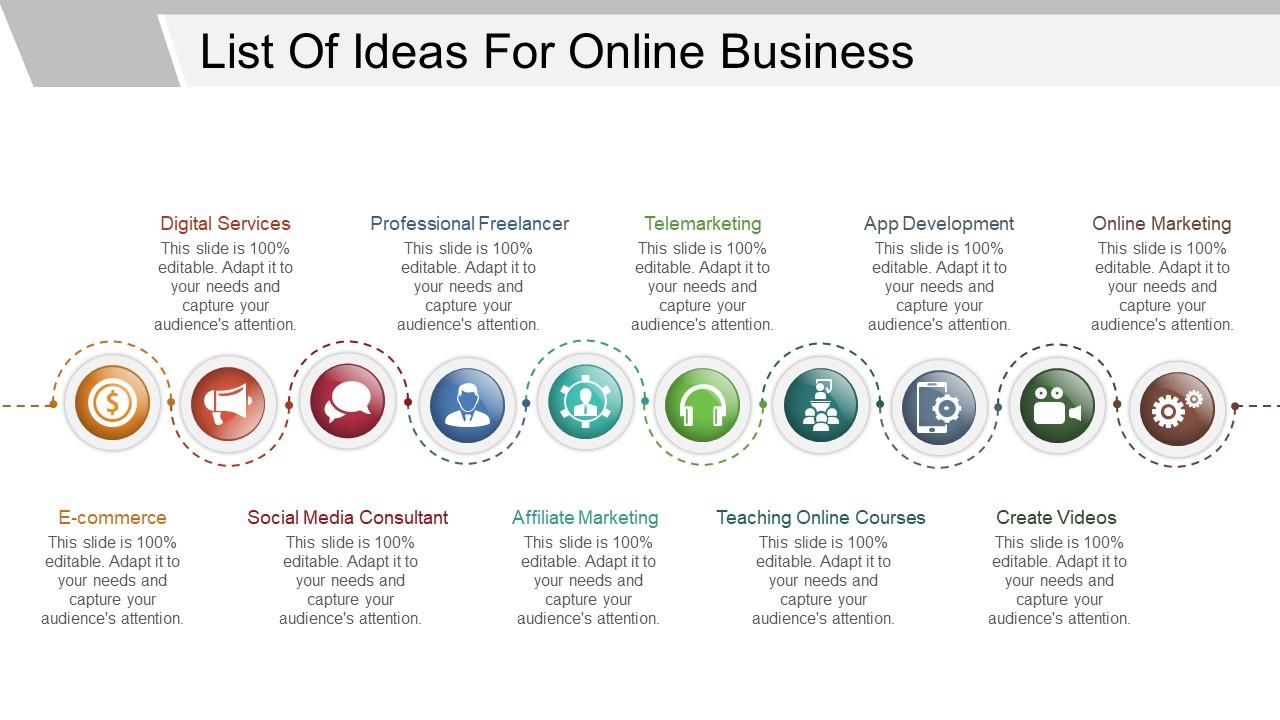
List of ideas for online business ppt infographics
Try Before you Buy Download Free Sample Product
Audience
Editable
of Time
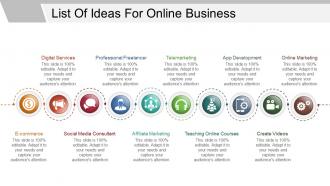
If you wish to keep a strong hold on your audience then we advise that you download and use this list of ideas for online business PPT infographics. This checklist PowerPoint presentation can be used to discuss a number of business-related processes like digital services, professional freelancer, telemarketing, app development, online marketing, E-commerce, social media consultant, affiliate marketing, teaching online coursing, create videos, etc. This timeline online business PPT presentation has been designed using the best of high resolution and premium quality slides which will furthermore raise the standard of your work. Our business experts, especially for business professionals like you who do not have time to sit and design the slides themselves, have designed our ideas and innovation PPT template. This multi-staged business template has been designed in such a manner that you will be able to save a lot of your precious time due to the fact that the slides are predesigned and ready to use. So simply hit the download button and make most of this moment. Buoy up spirits with our List Of Ideas For Online Business Ppt Infographics. Keep all the hopes afloat with your views.
People who downloaded this PowerPoint presentation also viewed the following :
List of ideas for online business ppt infographics with all 5 slides:
Our List Of Ideas For Online Business Ppt Infographics assure you an enthralling experience. You will have an exciting adventure.
FAQs for List of ideas for online
**INPUT**: What are the most profitable online business models for beginners? **OUTPUT**: Profitable online business models for beginners include affiliate marketing, dropshipping, digital product creation, online consulting, and content monetization through blogs or YouTube channels. These models streamline entry barriers by requiring minimal upfront investment, enabling scalable growth through automation and digital reach, with many entrepreneurs finding that combining multiple revenue streams ultimately delivers sustainable income and competitive market positioning. [Word count: 58 words]
Leveraging digital marketing involves utilizing SEO optimization, social media advertising, content marketing, email campaigns, and influencer partnerships to expand your online reach. These strategies enhance brand visibility, drive targeted traffic, and build customer relationships, with many e-commerce businesses, service providers, and digital startups finding that integrated campaigns deliver higher conversion rates and sustainable growth.
Dropshipping involves selling products directly to customers while handling order fulfillment through suppliers, whereas affiliate marketing focuses on promoting other companies' products for commission-based earnings. While dropshipping requires inventory management, customer service, and higher upfront investment, affiliate marketing emphasizes content creation and audience building, with many entrepreneurs finding that combining both approaches ultimately delivers diversified revenue streams and reduced business risk.
Shopify, WooCommerce, Square Online, BigCommerce, and Wix eCommerce are leading platforms for small businesses, offering varying levels of customization, pricing, and built-in features. These platforms streamline online store creation through user-friendly interfaces, integrated payment processing, and mobile optimization, with many retail entrepreneurs finding that choosing the right platform significantly reduces operational complexity while enhancing customer experiences.
Identifying a niche market involves analyzing your expertise, researching underserved audiences, evaluating competitor gaps, and validating demand through surveys or keyword research. Through market analysis tools and customer feedback, entrepreneurs can pinpoint profitable segments like specialized wellness products or B2B services, ultimately delivering targeted solutions that command premium pricing and stronger customer loyalty.
Social media serves as a powerful marketing engine for online businesses, enabling direct customer engagement, brand awareness building, targeted advertising, and community development around products or services. Through platforms like Instagram, Facebook, and LinkedIn, businesses streamline customer acquisition, enhance credibility through social proof, and ultimately deliver cost-effective marketing reach, with many entrepreneurs finding that consistent social presence significantly accelerates growth.
A compelling value proposition clearly articulates your unique benefits, target audience pain points, competitive differentiators, and measurable outcomes in concise, customer-focused language. Through strategic positioning and specific benefit statements, online service providers enhance customer acquisition, streamline messaging across marketing channels, and ultimately deliver higher conversion rates, with many businesses finding that clear value communication significantly accelerates growth.
Legal aspects include business registration, tax obligations, intellectual property protection, privacy policies, terms of service, and industry-specific compliance requirements. These considerations vary by location and business type, with many entrepreneurs finding that consulting legal professionals early streamlines operations, minimizes regulatory risks, and ultimately delivers stronger legal foundations and competitive protection.
SEO improves your online store's visibility by optimizing product descriptions, implementing strategic keyword targeting, enhancing site structure, and building quality backlinks. These techniques help search engines understand and rank your content higher, with many e-commerce businesses finding that proper SEO implementation delivers increased organic traffic, better conversion rates, and ultimately sustainable competitive advantage in crowded digital marketplaces.
Online business operations can be streamlined using customer relationship management (CRM) systems, inventory management software, automated email marketing platforms, project management tools, and accounting software. These technologies enhance efficiency by automating repetitive tasks, centralizing data management, and improving customer communications, with many e-commerce entrepreneurs finding that integrated solutions ultimately deliver faster order processing and improved customer experiences.
Creating an engaging customer experience requires intuitive navigation, personalized content, fast loading speeds, mobile optimization, and interactive elements like live chat or product recommendations. Through strategic design and user-focused features, businesses streamline customer journeys, reduce bounce rates, and increase conversion rates, with many e-commerce sites finding that personalized experiences ultimately deliver higher customer retention and competitive advantage.
**Best practices for pricing products in an online store include competitive analysis, value-based pricing, psychological pricing strategies, dynamic pricing models, and clear pricing transparency. These approaches enhance profitability by optimizing margins, improving customer perception, and maximizing conversions, with many e-commerce businesses finding that strategic pricing combinations ultimately deliver increased revenue and sustainable competitive advantage.** [Word count: 54]
Email marketing retains customers through personalized content, automated follow-ups, loyalty programs, segmented campaigns, and consistent value delivery. E-commerce businesses increasingly leverage behavioral triggers and targeted offers to enhance customer lifetime value, with many finding that strategic email sequences reduce churn while building stronger relationships, ultimately delivering improved retention rates and sustainable revenue growth.
Common pitfalls include inadequate market research, poor website design, insufficient marketing budgets, unrealistic revenue projections, and neglecting customer service systems. These challenges can derail even promising ventures, with many entrepreneurs finding that thorough planning, realistic financial modeling, and focusing on user experience from launch ultimately delivers sustainable growth and competitive advantage.
Analytics enable online businesses to make data-driven decisions through customer behavior tracking, conversion rate analysis, traffic source evaluation, and sales performance monitoring. By leveraging tools like Google Analytics, businesses can identify high-performing products, optimize marketing campaigns, and enhance user experiences, ultimately delivering improved ROI and competitive advantage in increasingly crowded digital markets.
-
Out of the box and creative design.
-
Great product with highly impressive and engaging designs.