

Market projection powerpoint presentation slides




Try Before you Buy Download Free Sample Product
 Impress Your
 Audience
 100%
100% Editable
 Save Hours
 of Time


Examine market at large. Showcase market survey results, market opportunities, market share, total market size, and more using content-ready Market Projection PowerPoint Presentation Slides. Project numbers, characteristics, and trends in your target market with the help of these professionally designed market forecast PPT templates. Illustrate the projected market growth using professionally designed excel linked data chart. This ready-made market projection complete PowerPoint presentation comprises of templates like key statistics, market survey result, market opportunity analysis, Ansoff’s matrix for market size determination, product opportunity evolution framework, bottoms up and top down approach for market forecasting, total market size PPT template, and more. Also, showcase market size and market forecast numbers using data driven charts. Incorporate these market projection PPT templates to develop strategic market focus. Once you have an enough information on market projection, you will be able to figure out market differences, competitive advantage, strengths and weaknesses of your company. Get access to this ready-made market projection PowerPoint slideshow to let your business balance its approach to marketing. Conduct market forecasting to learn about the future environment in which you may operate. Acquire amazing fortitude with our Market Projection Powerpoint Presentation Slides. You will feel extremely confident.
People who downloaded this PowerPoint presentation also viewed the following :
Content of this Powerpoint Presentation
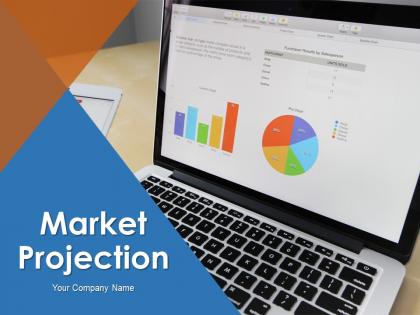
Slide 1: This slide showcases Market Projection. State Your Company Name and begins.
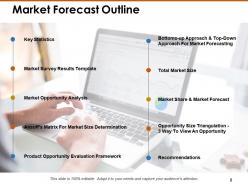
Slide 2: This slide presents Market Forecast Outline with these parameters- Key Statistics, Market Survey Results Template, Market Opportunity Analysis, Ansoff’s Matrix For Market Size Determination, Product Opportunity Evaluation Framework, Bottoms-up Approach & Top-Down Approach For Market Forecasting, Total Market Size, Market Share & Market Forecast, Opportunity Size Triangulation - 3 Way To View An Opportunity, Recommendations.
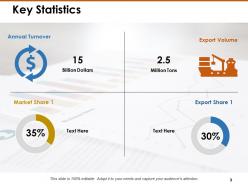
Slide 3: This slide presents Key Statistics with these categories- Annual Turnover, Market Share 1, Export Volume, Export Share 1.
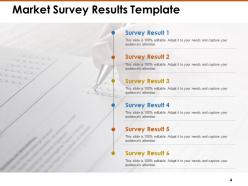
Slide 4: This slide shows Market Survey Results Template. You can further shows the survey results.
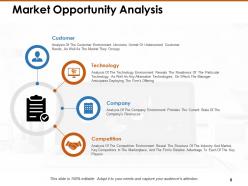
Slide 5: This slide presents Market Opportunity Analysis Customer, Technology, Company, Competition.
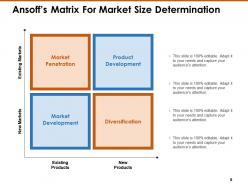
Slide 6: This slide presents Ansoff’s Matrix For Market Size Determination with these following factors- Existing Markets, New Markets, Existing Products, New Products, Market Penetration, Market Development, Diversification, Product Development.
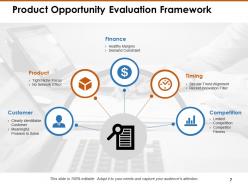
Slide 7: This slide showcases Product Opportunity Evaluation Framework and this further comprises of- Customer, Product, Finance, Timing, Competition.
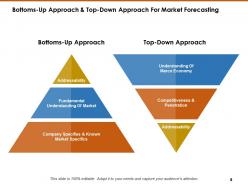
Slide 8: This slide presents Bottoms-Up Approach & Top-Down Approach For Market Forecasting with these two approaches- Bottoms-Up Approach, Top-Down Approach.
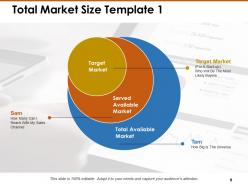
Slide 9: This slide showcases Total Market Size Template 1. You can use it to show the comparison of the taerget market.
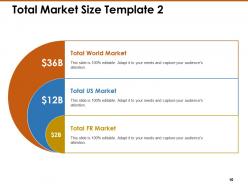
Slide 10: This slide presents Total Market Size Template 2. WIth template you can showcase the total world market and us market.
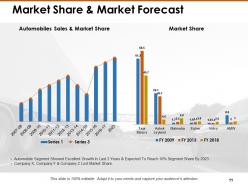
Slide 11: This slide showcases Market Share & Market Forecast. You can analyse the Market Share with this graph.
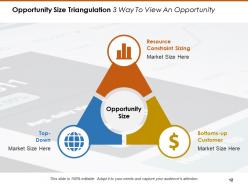
Slide 12: This slide is about Opportunity Size Triangulation 3 Way To View An Opportunity with these following factors- Opportunity Size, Resource Constraint Sizing, Market Size Here, Bottoms-up Customer, Market Size Here, Top-Down, Market Size Here.
Slide 13: This slide showcases Recommendations with five points.
Slide 14: This slide is about Market Projection Icons.
Slide 15: This slide is titled Additional Slides to move forward.
Slide 16: This is a Vision, Mission and Goals slide. State them here.
Slide 17: This is an Our Team slide with name, image & text boxes to put the required information.
Slide 18: This is an About Us slide showing Our Company, Value Client, and Premium services as examples.
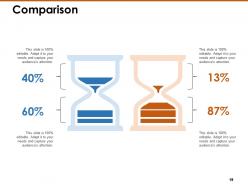
Slide 19: This slide showcases Comparison. You can use this for comparing the male and female.
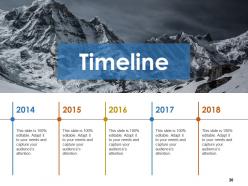
Slide 20: This is a Timelines slide to show- Plan, Budget, Schedule, Review.
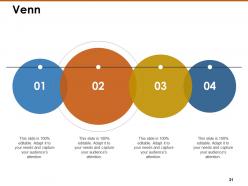
Slide 21: This slide displays a Venn diagram image.
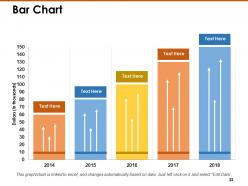
Slide 22: This slide presents a Bar graph in arrow form with text boxes.
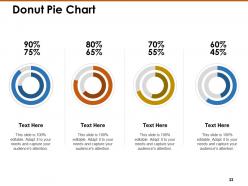
Slide 23: This slide showcases Donut Pie Chart. Add your information to comapare the product.
Slide 24: This is a Thank You slide with Address# street number, city, state, Contact Number, Email Address
Market projection powerpoint presentation slides with all 24 slides:
Establish control over emerging circumstances with our Market Projection Powerpoint Presentation Slides. Be able to act at the first instance.





FAQs for Market projection
Honestly, consumer spending and inflation are the big ones to watch. Employment data's huge too. Central bank stuff can totally flip everything overnight - those Fed meetings are no joke. Supply chain issues aren't as crazy as before, but they still pop up. Tech adoption rates matter more than people think. Oh, and geopolitical drama obviously. But here's what I'd actually track: consumer confidence surveys and Fed notes. Those usually give you the heads up before everything else catches on. Way better early indicators than most of the other noise out there.
Look, historical data is basically your cheat sheet - you're seeing what customers actually did instead of just winging it. I always tell people to grab at least 2-3 years if you can. You'll catch seasonal stuff, growth patterns, maybe how that weird supply chain mess in 2021 threw everything off. Sure, past stuff doesn't predict the future perfectly, but it beats shooting in the dark. Plot out those trends first, then add whatever assumptions you've got about what's coming. Way more solid than guessing.
Tech advances are literally what's moving markets right now. New stuff creates whole industries - like how smartphones destroyed cameras but gave us the entire app world. AI's changing healthcare and finance, clean energy is flipping the energy game. Things move crazy fast now! For your projections, you gotta spot which tech is going from buzzword to real deal. I always watch patent filings and where VCs are throwing money - oh, and regulatory stuff too. Those give you the heads up before markets actually shift. It's honestly become the best way to predict what's coming next.
Honestly, you gotta get out and actually talk to people - customers, suppliers, even competitors at industry events. I spend way too much time reading reports online when the real gold comes from those random conversations. Set up Google alerts for your space and check patent filings regularly. Social media trends are weirdly predictive too. Watch for regulatory changes since new rules always create opportunities. The magic happens when you spot gaps between what people say they want and what's actually out there. Block off time each week for trend analysis - sounds boring but it works. Most people miss the connections because they're not paying attention to multiple streams at once.
Honestly, consumer behavior is like your best predictor for market stuff. People's spending patterns basically show you what's gonna happen before it actually does. Way better than just staring at economic charts all day. Track both the hard data - what they're actually buying - and those sentiment surveys where people say how they're feeling. The real money is in catching those behavior shifts early, before everyone else notices. Like, consumers are literally what drives demand, so if you can spot when they start changing their habits... that's gold. Short bursts tell you immediate stuff, but longer trends? That's where the big picture lives.
Honestly, geopolitical stuff hits markets in weird ways you wouldn't expect. Defense stocks jump during conflicts, energy gets wild with sanctions - but tech? Trade wars absolutely destroy it (chip restrictions are brutal). Gold usually does well as the safe play. Markets tend to freak out first, then settle down once people actually think about it. Don't try predicting exactly what'll happen - you'll just stress yourself out. Instead, build a few different scenarios into whatever you're working on and adjust as things develop. Way more realistic than trying to be a fortune teller.
Honestly, I'd start with whatever data you already have - sales numbers, competitor stuff, basic trend analysis. Regression sounds fancy but moving averages work great too. Then talk to actual people through surveys or focus groups to figure out why those patterns exist. Secondary research like industry reports fills in gaps nicely. Oh, and scenario planning is clutch even though everyone skips it - super helpful for testing your assumptions when everything goes sideways. Mix your own research with existing sources. Don't overthink it though. Pick one method you're comfortable with first, then add more as you go.
Honestly, the best way is just stalking your competitors and seeing what they're actually pulling off. Check their growth numbers and market share shifts - that'll tell you if your projections are totally off base. Their investor decks are gold mines too, like they basically announce their next moves for free. Also watch who they're hiring and where they're expanding, since that shows you where the smart money thinks things are going. Oh and look for gaps they're missing - sometimes you'll spot something obvious they're ignoring. Use all that to reality-check your own numbers.
Yeah, overestimating market growth is a recipe for disaster. You end up hiring way too fast and blowing through cash like crazy. Your revenue targets become completely unrealistic, so suddenly your team looks like they're failing when they're actually doing fine. Investors start getting nervous, the board freaks out - honestly, I've seen this play out so many times. Then you're stuck doing layoffs which just destroys everyone's morale. Your pricing gets screwed up too because you're banking on demand that doesn't exist yet. Build in some conservative scenarios and test a few different growth assumptions. Trust me on this one.
Think of seasonality and cycles as your market's heartbeat - there's a natural rhythm to when things get busy or slow down. Holiday shopping, summer vacations, back-to-school season - these patterns hit every single year like clockwork. Then you've got those bigger economic waves that play out over several years. Honestly, fighting against these trends is just setting yourself up for frustration. Pull about 3-5 years of data and hunt for those repeating patterns. Just don't assume last year's exactly gonna match this year - industries shift, consumer habits change. But those underlying rhythms? They're gold for forecasting.
Honestly, just start with Excel or Google Sheets - their built-in forecasting stuff is pretty solid for basic trend analysis. Tableau's amazing for visualizations if you've got the budget. R or Python are crazy powerful for statistical work, but only if you're into coding. Bloomberg Terminal is like the holy grail but costs a fortune - totally not worth it unless you're working at Goldman or something. Oh, and Salesforce Analytics works well if you're already using their other tools. My take? Don't overthink it at first. Excel will handle way more than you'd expect, then you can always upgrade later when things get more complex.
Honestly, market projections are your best friend for staying ahead. Check out industry growth trends and how your customers are behaving differently - that's where the gold is. Most small businesses just react to stuff instead of seeing it coming (learned this the hard way). Build some 6-12 month forecasts using your customer data and whatever industry reports you can find. Then use those to figure out if you should hire more people, launch something new, or maybe expand into different markets. Just don't set it and forget it - markets move crazy fast these days so you'll need to update your projections regularly.
Honestly, there's a bunch of stuff to watch but the yield curve is probably the big one - when short-term rates flip above long-term ones, that's your classic "oh shit" moment. Consumer confidence and unemployment claims are solid indicators too. Corporate earnings obviously matter, and credit spreads widening between corporate bonds and treasuries basically means everyone's getting nervous about lending money. Manufacturing data and housing starts give you a heads up before things get ugly. I'd just set up some alerts for this stuff so you're not scrambling to figure it out when your portfolio's already tanking.
Honestly, it's all about how fast things change in your space. Tech companies? Good luck predicting beyond a year - something new drops and boom, your whole forecast is trash. Retail's way more chill though. You've got seasonal patterns, people still need basics like clothes and food. I can map that stuff out for like 2-3 years pretty reliably. The trick is matching your projection timeline to reality. If your industry moves at breakneck speed, update forecasts constantly. More stable sectors? Historical data actually means something, so you don't need to stress as much about constant revisions.
Honestly, the two big things that'll bite you are being too confident about your predictions and not being upfront about your assumptions. People treat forecasts like they're facts when they're really just educated guesses - I've watched so many teams crash and burn because of this. Make sure you're transparent about where your data comes from and what methods you used. Always give ranges instead of exact numbers, and definitely include confidence intervals. Oh, and watch out for any conflicts of interest that might mess with your analysis. Worst-case scenarios should be in every report too.
No Reviews