Market size and market share of the industry investor pitch presentation raise funds financial market
Try Before you Buy Download Free Sample Product
Audience
Editable
of Time
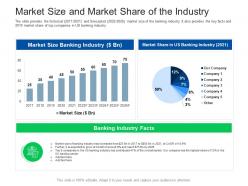
The slide provides the historical 2017 to 2021 and forecasted2022 to 2026 market size of the banking industry It also provides the key facts and 2019 market share of top companies in US banking industry
People who downloaded this PowerPoint presentation also viewed the following :
Market size and market share of the industry investor pitch presentation raise funds financial market with all 2 slides:
Use our Market Size And Market Share Of The Industry Investor Pitch Presentation Raise Funds Financial Market to effectively help you save your valuable time. They are readymade to fit into any presentation structure.
FAQs for Market size and market share of the industry investor pitch presentation raise
Market size estimation methodologies include top-down analysis, bottom-up calculations, value theory approaches, and demand-side forecasting models. These strategic approaches enable organizations to assess market opportunities by analyzing industry reports, customer segments, pricing structures, and competitive landscapes, with many businesses finding that combining multiple methodologies delivers more accurate market assessments and stronger competitive positioning.
Demographic trends significantly influence market size by affecting consumer demand patterns, purchasing power distribution, and product preferences across different population segments. An aging population expands healthcare and retirement services markets, while growing millennial cohorts drive technology adoption and sustainable products demand, with many organizations finding that aligning offerings with demographic shifts delivers competitive advantage and sustained growth opportunities.
**INPUT**: What factors should be considered when analyzing market share among competitors? **OUTPUT**: Market share analysis should consider revenue comparisons, customer base size, geographic presence, product portfolio breadth, and pricing strategies across direct competitors. These factors enable organizations to identify competitive positioning gaps, market opportunities, and strategic advantages, with many companies finding that comprehensive competitor analysis ultimately delivers enhanced market positioning and more targeted growth strategies. [Word count: 54 words]
Emerging technologies significantly expand market size in traditional industries by creating new revenue streams, enhancing operational efficiency, and enabling innovative service delivery models. Through AI, IoT, and automation, sectors like manufacturing, healthcare, and retail streamline processes, reduce costs, and deliver enhanced customer experiences, ultimately attracting new demographics and increasing overall market value.
Geographic segmentation reveals regional market variations, local consumer preferences, regulatory differences, distribution challenges, and competitive landscapes that significantly impact market sizing accuracy. This approach enables companies to identify high-potential regions, allocate resources strategically, and tailor market entry strategies, with many organizations finding that geographic insights deliver more precise forecasting and ultimately enhance competitive positioning in diverse markets.
Regulatory changes significantly reshape market dynamics by creating new compliance requirements, altering competitive landscapes, and shifting resource allocation priorities across affected sectors. Financial services, healthcare, and energy industries frequently experience dramatic market redistributions following regulatory updates, with compliant organizations gaining competitive advantages while non-compliant players face reduced market access, ultimately accelerating consolidation and innovation investments.
Key indicators include competitor revenue rankings, customer acquisition rates, product differentiation metrics, pricing strategies, and geographic market penetration across different segments. These metrics enable businesses to identify competitive gaps, benchmark performance against industry leaders, and develop strategic positioning initiatives, with many organizations finding that consistent monitoring of these indicators delivers enhanced market intelligence and sustainable competitive advantage.
Market size and share analysis aids strategic planning by identifying growth opportunities, assessing competitive positioning, informing resource allocation decisions, and evaluating market penetration potential. This analysis enables businesses to prioritize high-value segments, optimize product development strategies, and make data-driven expansion decisions, with many organizations finding that comprehensive market insights ultimately deliver improved ROI and sustainable competitive advantage.
Historical data limitations for market size projections include outdated consumer behaviors, technological disruptions, regulatory changes, economic shifts, and emerging competitive landscapes that weren't previously captured. While historical trends provide valuable baselines, many organizations find that combining past data with real-time market intelligence, predictive analytics, and scenario planning delivers more accurate forecasting, ultimately enabling better strategic positioning in increasingly dynamic markets.
Consumer preferences and behavior shifts directly reshape market size by creating new demand patterns, eliminating outdated segments, and driving category expansion or contraction across industries. These behavioral changes redistribute competitive share as companies adapt their offerings, with agile organizations in sectors like retail, technology, and food services gaining market position while slower competitors lose ground, ultimately rewarding businesses that anticipate and respond to evolving consumer needs.
Effective market analysis tools include Statista, IBISWorld, Nielsen, Euromonitor, and Google Analytics for data collection and insights. These platforms streamline research by providing comprehensive industry reports, competitor benchmarking, and consumer behavior analytics, with many organizations finding that combining multiple data sources delivers more accurate market assessments and strategic competitive advantage.
Economic conditions significantly influence market size by affecting consumer spending power, business investment levels, credit availability, and demand patterns across sectors. During economic downturns, sectors like luxury goods and discretionary spending contract, while essential services such as healthcare and utilities remain more stable, with many organizations finding that diversified portfolios help weather economic volatility.
Social media and digital marketing strategies shape market share by expanding customer reach, enhancing brand visibility, enabling targeted advertising, and facilitating real-time customer engagement. Through strategic social campaigns and data-driven digital approaches, companies across retail, hospitality, and consumer goods sectors streamline customer acquisition, build stronger brand loyalty, and ultimately capture greater market positioning while reducing traditional marketing costs.
Competitor analysis is crucial for accurate market share understanding, revealing positioning gaps, pricing strategies, customer segments, and growth opportunities that directly impact your market position. Through comprehensive competitive intelligence, organizations can identify underserved markets, optimize resource allocation, and develop strategic advantages, with many companies finding that regular competitor monitoring enables faster market response and ultimately delivers sustainable competitive positioning in increasingly dynamic business environments.
Netflix's pivot from DVDs to streaming based on digital market analysis, Amazon's expansion into cloud services after identifying the growing enterprise market, and Apple's iPhone development following mobile market size projections demonstrate successful strategic adjustments. These companies leveraged comprehensive market analysis to anticipate shifts, reallocate resources strategically, and capture emerging opportunities, ultimately delivering sustained competitive advantages and market leadership positions.
-
Graphics are very appealing to eyes.