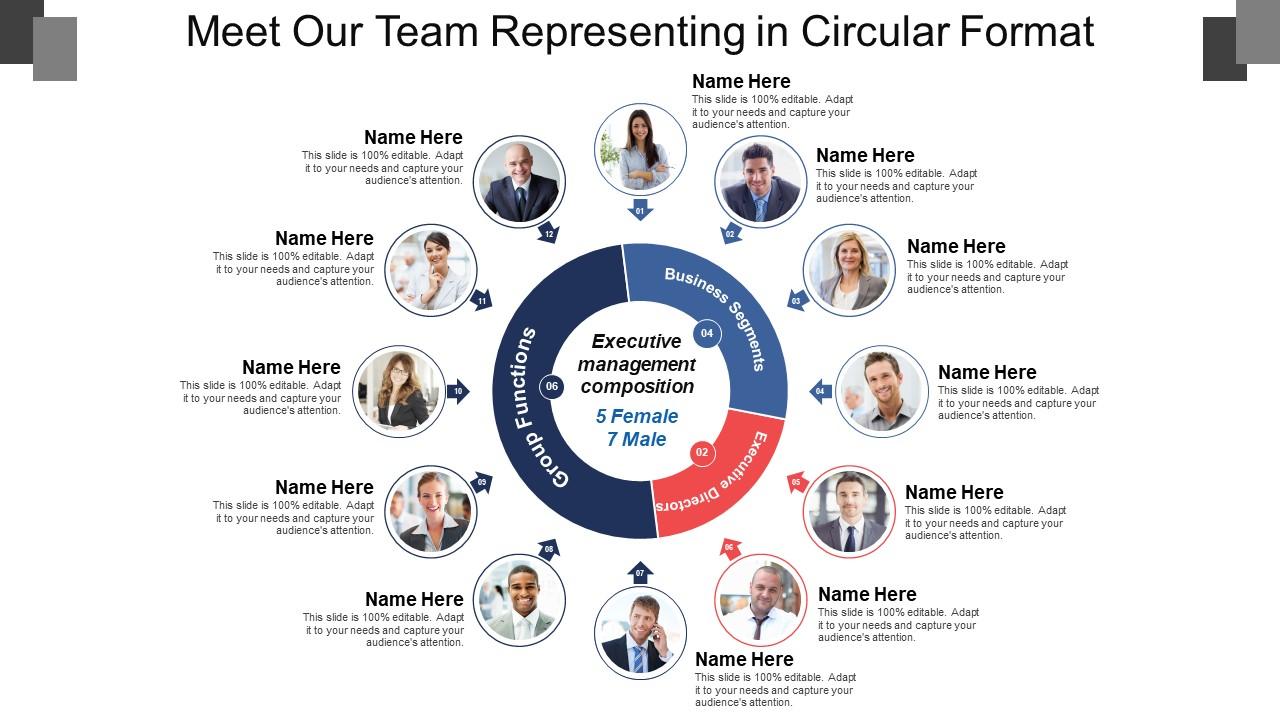
Meet our team representing in circular format
Try Before you Buy Download Free Sample Product
Audience
Editable
of Time
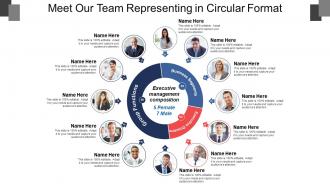
Let us present you our intensively prepared collection of ppt slides. Meet our team representing in circular format PPT template is here to represent your crew in an attractive manner. Filled with various business-related icons and catching colors, this PowerPoint image gives the employees a description in a circular format. Encrypted with images, we have divided the team into three sections, group functions, business segments and, executive director. Arrow icons are shown here to direct the employee to his relative area and to display information with ease and clarity. Captivating designs help you to catch your audience’s awareness of the concept of opinion, improves the accuracy and quality of the business processes. This PowerPoint presentation design will definitely assist you to make your viewers grasp the importance of taking the right approach for the development of your business in a simpler manner. Function freely with our Meet Our Team Representing In Circular Format. They will always be at your disposal.
People who downloaded this PowerPoint presentation also viewed the following :
Meet our team representing in circular format with all 6 slides:
Create an inviting environment with our Meet Our Team Representing In Circular Format. Give folks an incentive to attend.
FAQs for Meet our team representing
So Sarah's basically a spreadsheet genius - she finds patterns in data that would give me a headache just looking at. Mike's your guy for all the tech stuff, somehow turns our random ideas into things that actually work. Lisa does UX and thank god because without her we'd build stuff only developers could figure out. Then there's James keeping timelines on track when we inevitably get distracted by shiny new features. Honestly they're all pretty good about getting back to people quickly, so just hit up whoever covers what you need help with.
Dude, having different backgrounds on our team is like having cheat codes for creativity. Carlos brings these amazing storytelling tricks from Colombia, and Maya's whole minimalist thing comes from her time in Japan. Brainstorms get weird in the best way - someone always spots something the rest of us totally missed. We basically never get stuck because everyone sees problems differently. Actually saved our butts on this one project last month. Try asking your teammates how their background would tackle whatever you're working on. You'd be surprised what comes up.
So basically Sarah's our product strategy person - she calls the shots on roadmap stuff. Mike does all the technical architecture and code review work. Jessica handles user research and testing, which thank god because she's literally prevented us from making terrible decisions so many times. Alex keeps everyone organized with timelines and talks to stakeholders. I just do the actual coding and building stuff. Honestly, your best bet is hitting up whoever handles your specific thing directly, or if you're not sure, just throw it in our team channel and someone will grab it.
Honestly, just pick one thing and actually stick with it - like weekly check-ins or whatever works for your team. Make sure people feel safe asking dumb questions (trust me, they're usually not that dumb). I'd also nail down who's responsible for what upfront because that confusion always bites you later. Don't let meetings turn into those soul-crushing affairs where everyone zones out. Oh, and create some kind of system where problems surface early instead of festering. The trick isn't having perfect communication - it's being consistent with whatever approach you choose. Start small this week.
Honestly, we just talk it out first - get the people involved in a room with someone neutral to keep things civil. Sometimes folks just need to blow off steam before they can actually listen, you know? If that doesn't work, then we pull in the team lead. Our retrospectives help too since people can bring up issues before they turn into full-blown drama. The main thing is catching stuff early. Don't let it sit there and get worse - just deal with it directly but don't be a jerk about it.
Look, forget the job titles for a sec and figure out what people are actually good at. Who's your big picture person? Who crushes deadlines? Who catches mistakes before they blow up? Once you know that stuff, pair people up strategically - like don't stick two detail-obsessed people together when you need something done fast, trust me on that one. Knowledge sharing helps too. Maybe do a quick strengths thing in your next meeting where everyone just says what they're best at. Sounds cheesy but it works. You'll start seeing way better project combos after that.
So we're pretty much glued to Slack all day for messaging and quick stuff. Asana handles our project tracking. Google Workspace is where the magic happens though - I swear we practically live in Docs and Sheets. Weekly Zoom calls keep us synced on the big picture items. Sarah from IT will set you up with everything your first week and show you how we organize our folders and workflows. Oh, and definitely grab the mobile apps for Slack and Asana right away since you'll be using them nonstop.
Honestly, just start with clear deadlines and stick to them. I'd do weekly check-ins where everyone reports what they actually finished - makes it way less awkward to ask "so what happened with that thing?" Regular follow-up is everything. Most teams I've worked with just let stuff slide until it becomes this weird elephant in the room. Don't be that team. Make missing a deadline something you have to explain, not just shrug off. Oh and use your existing meetings for this - no need for extra stuff. Try accountability rounds next week and see how it goes.
So we do monthly team lunches where people actually talk about real stuff, not just work. Pretty nice change of pace. Quarterly we'll do escape rooms or bowling - honestly the bowling gets way too competitive but it's fun. There's also random coffee chats between departments and these Friday game sessions that always end up as pizza topping arguments (don't ask me why). Oh, and monthly retrospectives where you hear how everyone's actually doing. If you've got ideas for other stuff, just mention it at team meetings. They're pretty open to trying new things.
Honestly, it depends on what we're celebrating. Individual stuff usually gets you a shoutout in our team channel, maybe a gift card or free lunch. Team wins are more fun though - we'll grab drinks, order way too much pizza, or do a proper team lunch somewhere nice. There's this "wins wall" thing where people post their successes during the quarter (sounds cheesy but it actually works). The main thing is making it feel real, not forced. Oh and definitely call out teammates when they're killing it - that peer recognition hits different than manager praise. Short sentences work. Sometimes longer ones flow better when you're explaining the whole process.
So they do one-on-ones with managers where you can give feedback upward. Team retrospectives happen after big projects - those are pretty chill, just talking through what went well or sucked. The quarterly 360 reviews though? Those are intense but honestly super helpful since you get input from everyone around you. They also push real-time feedback but let's be real, that's awkward and inconsistent. Oh, and when you ask for feedback, be specific - like "how was my presentation flow?" Don't just say "any thoughts?" because you'll get useless answers.
Honestly, we've gotten pretty decent at handling changes. Our weekly sprint reviews help us reassess stuff and pivot fast when needed. We keep a flexible backlog - so when requirements shift, we just reprioritize without losing steam. I used to get way more stressed about this than I should've! Communication between stakeholders and devs is solid now, plus we do these mini check-ins every few days to catch changes early. The big thing is being upfront about how changes mess with timelines. When something shifts while you're working on it, just immediately drop it in the team channel so everyone can adjust together.
Oh nice timing - there's actually a leadership workshop next week you should jump on. We've got monthly ones of those, plus quarterly skill sessions and this online platform with tons of courses. Project management, communication, all that stuff. The lunch-and-learns are surprisingly good too (seriously, whoever does their catering knows what they're doing). If your team needs something specific, just ask - we'll bring in outside trainers for custom stuff. I'd hit up that workshop first since it's coming up, then see what else your people actually want from there.
Honestly, I used to just chase whatever seemed urgent and it was such a mess. What works way better is literally writing down your tasks next to your main goals - like physically on paper or whatever. Pick the stuff that actually moves you toward your quarterly targets first. Does this thing get us closer to where we want to be? If not, delegate it or just don't do it. I know it sounds obvious but it's weirdly hard to stick to. We do this as a team every week now and it keeps us from getting distracted by random busy work.
So basically we don't really do the whole traditional boss thing here - honestly, it's way better that way. Different people take the lead depending on what project we're working on and who knows the most about it. Sometimes you'll be running point, other times you're just supporting someone else's vision. The rotation happens pretty naturally based on expertise rather than some rigid hierarchy. Just stay flexible and don't be shy about jumping in with ideas, even when you're not technically the one leading. It's actually refreshing once you get used to it.
-
customer friendly slide
-
very interesting website
-
very interesting website
-
very interesting website
-
very interesting website

-
very interesting website
-
very interesting website
-
very interesting website
-
very interesting website