Monetary administration in healthcare powerpoint presentation slides
Try Before you Buy Download Free Sample Product
Audience
Editable
of Time
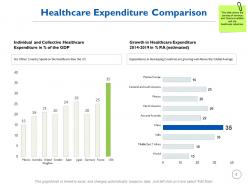
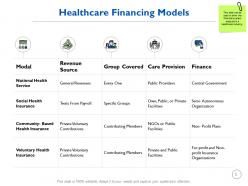
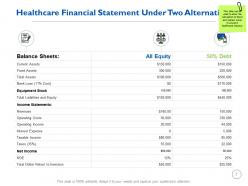
Introducing Monetary Administration In Healthcare PowerPoint Presentation Slides. With the help of this health economics PPT template, a hospital administrator can focus on the overall management and oversight of healthcare organizations. By using monetary policy in healthcare PowerPoint presentation slides, health firms can showcase the entire expenditures in both individual and collective manner. If you want to compare the total revenues in different states, then use health economics PPT visuals. There are various models present in this health services research PowerPoint presentation complete deck such as national health service, social health insurance, voluntarily, and community-based health insurance, etc. By using our professionally designed healthcare system financial analysis PPT template, you can maintain a balance sheet showcasing the current assets, equipment stocks, income statements, and net income. With the help of this healthcare expenditure comparison PowerPoint presentation deck, an administrator can identify the direct and indirect health costs. Therefore, download this ready-to-use monetary administration in healthcare PPT slides and design healthcare data appropriately.
People who downloaded this PowerPoint presentation also viewed the following :
Content of this Powerpoint Presentation
Slide 1: This slide introduces Monetary Administration in Healthcare. State Your Company Name and begin.
Slide 2: This slide shows Content of the presentation.
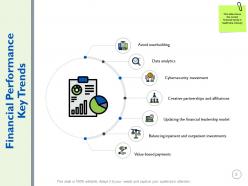
Slide 3: This slide presents Financial Performance Key Trends describing the current financial trends in healthcare industry.
Slide 4: This slide represents Healthcare Expenditure Comparison describing the sources of revenue and finance available with the healthcare industries.
Slide 5: This slide displays Healthcare Financing Models used to show the financial system analysis in a healthcare industry.
Slide 6: This slide showcases Healthcare System Financial Analysis comparing healthcare financial system on the basis of 2 alternatives i.e. equity and debt.
Slide 7: This slide shows Healthcare Financial Statement Under Two Alternatives i.e. direct and indirect costs.
Slide 8: This slide presents Direct and Indirect Healthcare Costs Calculation.
Slide 9: This slide displays Healthcare Industry Key Stats describing the general healthcare stats worldwide to give the user insights on healthcare industry.
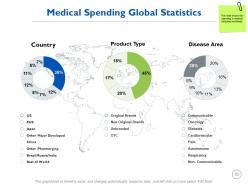
Slide 10: This slide represents Medical Spending Global Statistics of medical industries worldwide.
Slide 11: This slide showcases Healthcare Industry Revenue Cycle through which revenue is generated in healthcare industry.
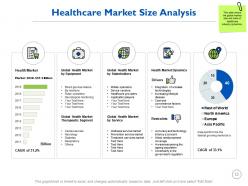
Slide 12: This slide shows Healthcare Market Size Analysis of healthcare industry dynamics.
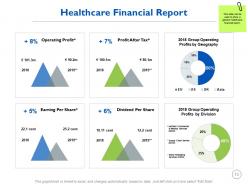
Slide 13: This slide presents Healthcare Financial Report.
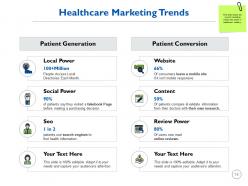
Slide 14: This slide displays Healthcare Marketing Trends that exists in healthcare industry.
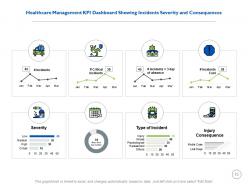
Slide 15: This slide represents Healthcare Management KPI Dashboard Showing Incidents Severity and Consequences.
Slide 16: This slide showcases Healthcare Management KPI Dashboard for Organizations.
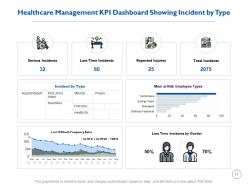
Slide 17: This slide shows Healthcare Management KPI Dashboard Showing Incident by Type.
Slide 18: This slide presents Healthcare Management KPI with Total and Pending Patient Cases.
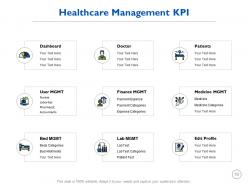
Slide 19: This slide displays Healthcare Management KPI with additional text boxes.
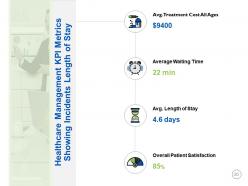
Slide 20: This slide represents Healthcare Management KPI Metrics Showing Incidents Length of Stay.
Slide 21: This slide showcases Healthcare Management KPI Metrics Showing Treatment Cost and Waiting Time.
Slide 22: This slide shows Monetary Administration in Healthcare Icons.
Slide 23: This slide reminds about a 15 minute coffee break.
Slide 24: This slide is titled as Additional Slides for moving forward.
Slide 25: This slide shows Clustered Column - Line with yearly comparison.
Slide 26: This slide displays Clustered Bar chart with data in percentage.
Slide 27: This is Our Mission slide with related imagery and text.
Slide 28: This is Our Team slide with names and designation.
Slide 29: This is About us slide to show company specifications etc.
Slide 30: This is a Comparison slide to state comparison between commodities, entities etc.
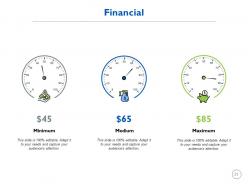
Slide 31: This is a Financial slide. Show your finance related stuff here.
Slide 32: This is a Quotes slide to convey message, beliefs etc.
Slide 33: This is a Location slide with maps to show data related with different locations.
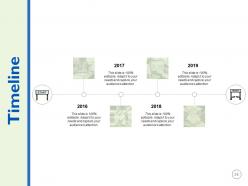
Slide 34: This is a Timeline slide to show information related with time period.
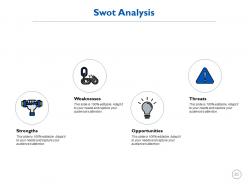
Slide 35: This slide shows Swot Analysis describing strengths, weaknesses, opportunities and threats.
Slide 36: This is Our Target slide. State your targets here.
Slide 37: This is a Puzzle slide with text boxes.
Slide 38: This is a Venn slide with additional text boxes to show information.
Slide 39: This is an Idea Bulb slide to state a new idea or highlight information, specifications etc.
Slide 40: This is a Thank You slide with address, contact numbers and email address.
Monetary administration in healthcare powerpoint presentation slides with all 40 slides:
Examine intimate details with our Monetary Administration In Healthcare Powerpoint Presentation Slides. Establish the closeness of the connection.
FAQs for Monetary administration in healthcare
Healthcare administrators face rising operational costs, complex insurance reimbursements, staffing shortages driving up labor expenses, regulatory compliance costs, and managing patient debt collections. These financial pressures are compounded by decreasing reimbursement rates and increasing patient volume demands, with many hospital systems finding that strategic cost management and revenue cycle optimization are essential for maintaining sustainable operations while delivering quality care.
Different reimbursement models significantly impact monetary administration through varying payment structures, documentation requirements, and revenue recognition processes. Fee-for-service models require detailed procedure tracking and coding, while value-based care emphasizes outcome measurements and risk management, with many healthcare organizations finding that capitation models streamline administrative processes but demand sophisticated population health analytics for financial sustainability.
Technology improves healthcare financial management through automated billing systems, AI-powered revenue cycle optimization, real-time expense tracking, predictive analytics for budget forecasting, and integrated ERP platforms. These solutions streamline administrative processes, reduce billing errors, and enhance cash flow visibility, with many hospitals finding that automated systems accelerate reimbursements while minimizing operational costs and compliance risks.
Budgeting serves as the foundation for healthcare monetary administration by enabling resource allocation planning, cost control mechanisms, revenue forecasting, compliance monitoring, and strategic financial decision-making. Through comprehensive budgeting frameworks, healthcare facilities streamline operational efficiency, minimize waste, and enhance patient care delivery, with many hospitals finding that systematic budget management ultimately delivers improved financial stability and competitive positioning in an increasingly complex healthcare landscape.
Healthcare administrators can optimize resource allocation by implementing data-driven budgeting, strategic staffing models, predictive analytics for demand forecasting, automated supply chain management, and performance-based departmental funding. These approaches streamline operations by reducing waste, improving staff utilization, and enhancing patient throughput, with many hospitals finding that integrated resource management systems deliver significant cost reductions while maintaining quality care standards.
Regulatory compliance significantly impacts healthcare monetary administration by requiring substantial investments in compliance infrastructure, staff training, and audit systems, while simultaneously reducing revenue through mandatory reporting requirements and penalty avoidance measures. However, effective compliance streamlines reimbursement processes, enhances operational transparency, and ultimately delivers competitive advantages, with many healthcare institutions finding that proactive compliance strategies reduce long-term costs.
Data analytics enhances healthcare financial decision-making by identifying cost reduction opportunities, predicting patient volume patterns, optimizing resource allocation, and analyzing revenue cycle performance. Through predictive modeling and real-time dashboards, hospitals and health systems streamline budget planning, reduce operational waste, and improve cash flow management, ultimately delivering better financial outcomes while maintaining quality patient care.
Best practices for managing cash flow in healthcare include automating billing processes, implementing real-time revenue cycle management, optimizing insurance claim processing, establishing patient payment plans, and maintaining accurate financial forecasting systems. These strategies streamline operations by reducing payment delays, minimizing administrative costs, and enhancing collection efficiency, with many healthcare organizations finding that integrated financial management ultimately delivers improved liquidity and operational stability.
Cost control measures in healthcare influence patient care outcomes by streamlining resource allocation, enhancing operational efficiency, and enabling strategic investments in quality improvement initiatives. While effective cost management can lead to better technology adoption and staff training, healthcare organizations must balance financial constraints with care quality, with many hospitals finding that targeted cost reductions ultimately deliver improved patient experiences and sustainable care delivery.
Value-based care fundamentally shifts monetary administration from volume-driven billing to outcome-focused reimbursement models, requiring enhanced cost tracking, quality metrics integration, and risk-sharing arrangements. Healthcare organizations must streamline administrative processes, invest in data analytics capabilities, and develop sophisticated financial forecasting systems, ultimately delivering improved patient outcomes while maintaining operational efficiency and competitive positioning in an increasingly performance-based reimbursement landscape.
Healthcare organizations can prepare for economic shifts by diversifying revenue streams, building financial reserves, implementing flexible budgeting models, and investing in cost-reduction technologies like automation and telemedicine. Through strategic financial planning and operational efficiency improvements, hospitals and health systems enhance their resilience against funding uncertainties, while digital health solutions and value-based care partnerships ultimately deliver sustainable competitive advantages in an increasingly volatile economic landscape.
Healthcare organizations can reduce administrative costs through automation of billing processes, streamlined patient registration systems, electronic health records integration, standardized documentation procedures, and consolidated vendor management. These strategies enhance operational efficiency by eliminating redundant workflows, reducing manual errors, and accelerating reimbursement cycles, with many hospitals finding that strategic technology investments ultimately deliver significant cost savings and improved resource allocation.
Integration of financial and clinical data supports better monetary administration by enabling real-time cost tracking, predictive resource planning, and evidence-based budget allocation across departments. This strategic combination allows healthcare organizations to identify cost-saving opportunities, optimize staffing patterns, and reduce unnecessary expenses, while many hospitals finding that integrated data systems ultimately deliver enhanced operational efficiency and improved financial transparency.
Successful healthcare organizations prioritize diversified revenue streams, robust cost control systems, strategic technology investments, and transparent financial reporting. These institutions demonstrate that combining operational efficiency with patient-centered care delivery creates sustainable competitive advantages, with many finding that proactive financial planning and data-driven decision-making ultimately enhance both fiscal health and patient outcomes.
Mergers and acquisitions impact healthcare financial stability by consolidating resources, reducing operational redundancies, and enhancing negotiating power with suppliers and insurers. While larger healthcare systems achieve economies of scale and improved capital access, integration challenges and cultural misalignment can strain finances, with many hospitals finding that strategic combinations ultimately deliver stronger market positions and sustainable growth.
No Reviews