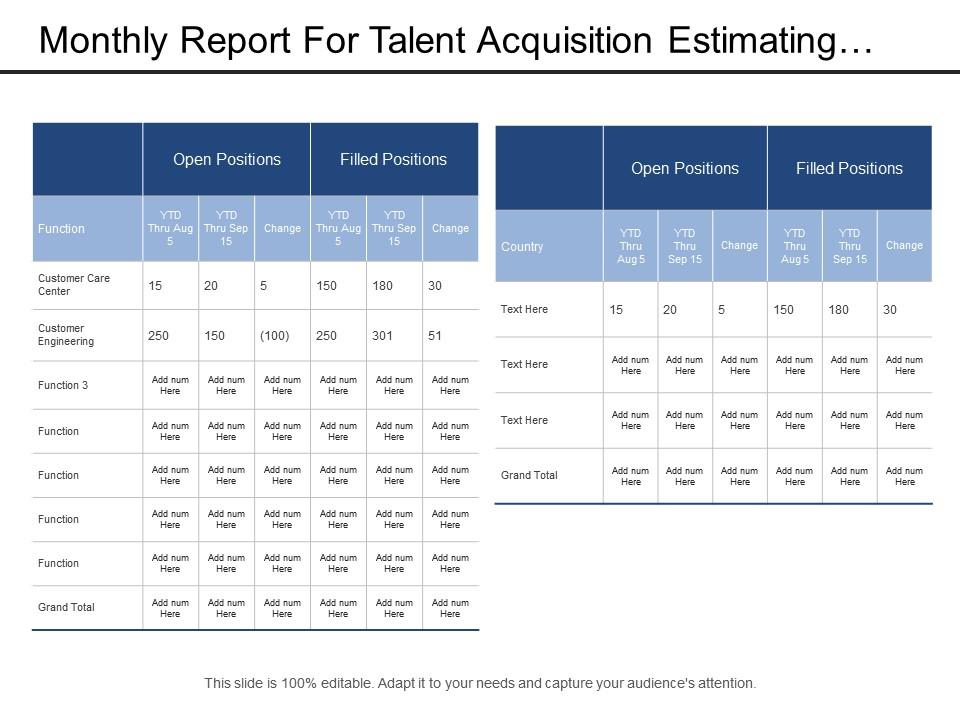
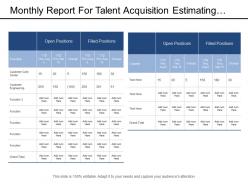
Monthly report for talent acquisition estimating open and filled positions by function and country
Try Before you Buy Download Free Sample Product
Audience
Editable
of Time
Create equal facilities for all with our Monthly Report For Talent Acquisition Estimating Open And Filled Positions By Function And Country. It will discourage any disparity.
People who downloaded this PowerPoint presentation also viewed the following :
Monthly report for talent acquisition estimating open and filled positions by function and country with all 5 slides:
A great deal is certain with our Monthly Report For Talent Acquisition Estimating Open And Filled Positions By Function And Country. Your ideas will find favor with them.
FAQs for Monthly report for talent acquisition estimating open and filled positions by
For recruiting metrics, start with the basics: time-to-fill, cost-per-hire, and quality of hire. Source effectiveness shows you which channels actually work (spoiler: it's usually not the expensive job boards). Track your offer acceptance rates and interview-to-hire ratios too - honestly, that last one will tell you if your screening is totally broken. Don't skip candidate satisfaction scores and diversity metrics either. Oh, and hiring manager satisfaction matters more than people think. Set up a monthly dashboard so you can catch problems early instead of scrambling later.
Honestly, once you start using data for hiring, it's like having superpowers. Track your time-to-hire first - that metric alone will show you where things are dragging. Then look at which job boards actually bring in decent candidates (spoiler: it's probably not the expensive ones). You can spot exactly where people bail out of your process too. I'd focus on source effectiveness as your second metric - saves you tons of wasted budget. The prediction stuff is cool for planning ahead, but start simple. Those two metrics will give you enough insights to completely flip your hiring game around.
Your company's reputation as a workplace is huge for getting good people. Candidates will definitely stalk your Glassdoor and social media - it's just what they do now. Strong employer branding makes you stand out instead of blending in with every other "we're a family" company out there. You'll attract people who actually care about what you're doing, not just whoever needs a job. Quality applicants get excited about your mission and vibe. Start with authentic stuff on LinkedIn and get your happy employees talking about why they like it there. Honestly, word of mouth from real employees beats any fancy recruitment campaign.
Honestly, the talent shortage is brutal right now. Everyone's fighting over the same skilled people, and candidates know they've got options. Remote work made it worse in some ways - sure, you can hire from anywhere, but so can everyone else. I swear good people get multiple offers within like 48 hours now. Your interview process has to be super streamlined or you'll lose them. Speed matters more than it used to. Find someone decent? Move fast before they're gone.
So you'll want to look at your whole hiring pipeline - application sources, who's getting interviews, offer acceptance rates, all that stuff. Break it down by demographics like gender and ethnicity. The really telling part is comparing who applies versus who actually gets hired. Time-to-hire differences between groups can be super revealing too, plus retention after they start. Honestly, I'd set up some kind of automated dashboard because waiting for quarterly reports is painful. Start small though - pick like 3-4 key metrics first, then add more once you've got those figured out.
Check out ATS platforms like Greenhouse or Workday first - they automatically track time-to-fill and source effectiveness. Most companies already have these systems but totally ignore the reporting features. For deeper stuff, throw your ATS data into Tableau or Google Analytics if you're measuring career page performance. LinkedIn Talent Insights works great for benchmarking against the market too. Pick maybe 5-6 key metrics and actually stick with them instead of getting lost in endless spreadsheets (been there). Start by seeing what reporting you can already access - you might already have more than you think.
Honestly, candidate feedback is gold for catching where your hiring process sucks before you lose great people. Survey them within 48 hours while everything's still fresh in their minds. Multiple people griping about slow responses or confusing interviews? That's your smoking gun right there. I've watched companies tank amazing candidates just because their application portal was garbage - like, basic stuff that's totally fixable. Track things like how happy they were with communication and the interview experience. Then actually do something about it instead of just collecting data for no reason.
Honestly, social media can totally make or break your hiring game. Candidates are 100% creeping on your company's Instagram and LinkedIn before they even apply - I do it too, don't we all? Your employer brand gets boosted or completely trashed by what employees post and how your company pages look. LinkedIn outreach is gold for finding passive candidates who aren't actively job hunting. But if your social presence is inconsistent or looks dead, you're shooting yourself in the foot. Keep those profiles updated and make sure your messaging actually matches what you're trying to attract talent-wise.
Track what actually matters - time-to-fill, cost-per-hire, source effectiveness, and candidate quality scores. Your dashboard needs to tell the story in 30 seconds max. I've seen too many that look fancy but are basically useless! Keep it visual without going overboard. Real-time updates are clutch if you can swing it. Break everything down by department, role level, and hiring manager. Oh, and don't forget pipeline health metrics - they'll save your butt by showing future hiring problems before they explode. Set up alerts when things go sideways. That's honestly where you'll see the biggest impact.
Yeah, it's wild how different each industry gets about this stuff. Tech companies are totally obsessed with time-to-fill metrics and candidate experience scores - probably because everyone's fighting over the same developers. Healthcare's all about compliance tracking and how long credential checks take, which honestly makes sense with all their regulations. Manufacturing cares way more about safety training completion and whether people stick around past 90 days. Retail though? They're laser-focused on seasonal hiring numbers and turnover during crazy busy periods. I'd definitely compare yourself to similar companies in your space rather than random industries.
Honestly, remote work changed everything about hiring. Geography doesn't matter anymore, so you can find amazing people anywhere - but guess what? Every other company figured this out too. Competition is brutal now. Salaries keep climbing because talent has options. Your job descriptions need to actually sell your remote culture, not just mention it exists. Candidates care way more about work-life balance and whether your team knows how to collaborate digitally. Oh, and definitely look at your onboarding process - if it sucks remotely, good luck keeping people.
Track performance ratings, retention, and how fast people get promoted over 2-3 years - that's your bread and butter. Also check how quickly new hires hit their stride and actually meet expectations. Internal mobility matters tons (seriously, losing good people because they feel trapped is the worst). Engagement scores and 360 feedback round things out nicely. Here's the kicker though - compare all this stuff across different recruiting channels. You might find that referrals absolutely crush job board hires long-term, which should flip your whole strategy.
Honestly, AI screening tools are everywhere now - saves so much time but sometimes filters out good people too. Skills-based hiring is finally catching on instead of that whole "must have degree" thing. Remote work changed everything for recruitment strategies. Your application process better be smooth or candidates will just bounce. I've seen it happen constantly. Internal mobility and employee referrals are where it's at since hiring externally costs a fortune these days. Oh, and you've got to actually show up where people spend time online - LinkedIn's not enough anymore. Being adaptable with your approach makes all the difference.
Honestly, it's way easier than most people think. Start with basic stuff - cost per applicant, which job boards actually work, conversion rates from different channels. Your career page traffic and social media engagement give you solid numbers too. Track how long it takes to fill roles and rate candidate quality by source. I swear, even the "fluffy" employer branding stuff has real data behind it if you look. Create a simple spreadsheet showing what you spent versus actual hires from each channel. Then you've got proof of what's working and can fight for budget on the good channels instead of wasting money everywhere.
Dude, leadership buy-in makes or breaks talent acquisition. When your C-suite actually shows up - defining priorities, fast-tracking competitive offers, personally meeting top candidates - you'll close so many more hires. Candidates can totally tell when leadership doesn't give a damn, and honestly? That's an instant turnoff for anyone worth hiring. Plus these leaders need to rep your company brand everywhere. Companies with engaged executives hire 40% faster too (saw that stat recently). Bottom line: get regular FaceTime with your leadership team and loop them in on your biggest hires. It's night and day difference.
-
Top Quality presentations that are easily editable.
-
Unique research projects to present in meeting.