


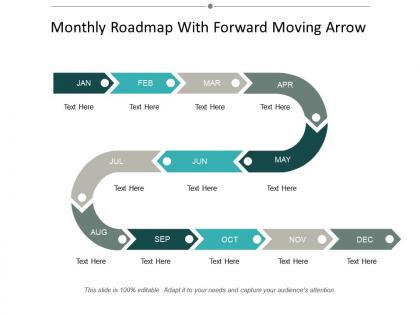
Monthly roadmap with forward moving arrow




Try Before you Buy Download Free Sample Product
 Impress Your
 Audience
 100%
100% Editable
 Save Hours
 of Time


Download curved roadmap journey PowerPoint slide with awesome timelines and slide designs for solving multiple purposes. The presenter can use the roadmap timeline template in presentation related to product development, product management, and market pathway that require to show a timeline. The monthly roadmap with milestones template incorporates top-notch PowerPoint slides vectors. You can use this monthly timeline PPT slide for planning which varies from basic level to advanced level along with that you can represent roadmaps and milestones. This PowerPoint slide design consists of continuous road shapes which represent the path that an entrepreneur finds along the journey to success. Apart from defining the path, the monthly roadmap path template also represents start or beginning along with end of the path. The monthly timeline slide for PowerPoint helps to highlight the business achievements in the specific month. The roadmap example slide is useful for mapping new areas for growth opportunities, testing new ideas, tracking competitors as well as keeping up with the latest technologies. An innovative roadmap slide is a very useful tool for users who want to represent strategic roadmap. Extract a favorable deal with our Monthly Roadmap With Forward Moving Arrow. Formulate a contract that is to your advantage.
People who downloaded this PowerPoint presentation also viewed the following :
Monthly roadmap with forward moving arrow with all 5 slides:
Our Monthly Roadmap With Forward Moving Arrow are extremely helpful. They are created to give every assistance.


FAQs for Monthly roadmap with
So for your roadmap template, definitely include a clear timeline with major milestones and goals for each phase. Resource requirements and key deliverables are crucial too. Dependencies between tasks? Super important - that's honestly where most projects crash and burn. I'd also throw in success metrics and who's responsible for what, plus some risk callouts. Oh, and leave room for updates because these things change like every other week. Keep it visual rather than a wall of text - nobody wants to read through paragraphs of project details. Start simple and add more complexity later if you need it.
Dude, nobody wants to stare at a wall of text when they're trying to understand your project timeline. Color-coding different workstreams is a game changer - plus icons for milestones and progress bars so people can actually see where you're at. I swear, half the roadmaps I've seen could cure insomnia. Gantt charts work great, or even basic swim lanes if you want to keep it simple. The whole point is making it scannable. Someone should get the gist in like 10 seconds, not have to decode your novel-length bullet points.
Honestly, the worst mistake is getting way too detailed from the start. You'll just be updating dates constantly and everyone stops trusting you. Focus on big milestones instead of every little task. Oh, and definitely don't create it alone in your office - I've watched so many crash and burn because nobody asked stakeholders what they actually wanted. Priorities will shift (they always do), so build in buffer time. When things change, tell people right away instead of hoping nobody notices. Think of it as a GPS that recalculates, not some contract written in blood.
Honestly, your timeline is what makes people actually care about your roadmap. Clear dates let everyone plan around your stuff and see how it affects their own work. But vague timelines? Total engagement killer - nobody knows what's happening when. The timeline creates real accountability too. It turns your roadmap from some pie-in-the-sky wishlist into something concrete people can get behind. Just don't be that person who sets unrealistic dates then never updates them. I've seen that tank trust so fast. Keep dates realistic and give people a heads up when things change.
Honestly, it's all about knowing your audience. Executives want the big picture stuff - strategic themes, business wins, major milestones. They couldn't care less about sprint details or technical dependencies. Your team needs the exact opposite though - give them specific timelines, feature breakdowns, resource needs, how their piece fits the puzzle. I always do this layered thing where execs see "Q2: Mobile Enhancement" but the team gets the actual user stories and deadlines underneath. Both versions should connect to the same goals obviously. Works way better than trying to cram everything into one roadmap that satisfies nobody.
Look, you can't build a decent roadmap without knowing where the market's actually going. Research helps you figure out what customers really struggle with and what trends are coming up. Plus you'll see what competitors are doing wrong - honestly that's sometimes more valuable than what they're doing right. Don't just do research once and call it good though. Check your assumptions regularly because things change fast. I've seen too many roadmaps that looked great on paper but totally missed the mark because they were based on outdated info. It's like building a house on sand if you skip this step.
Set up regular touchpoints to grab feedback - surveys, support tickets, user interviews, that kind of thing. Most teams honestly suck at this part. Don't just listen to whoever yells loudest though. Prioritize based on how often you hear something, plus business impact and whether it actually fits your strategy. Here's the part people forget - close the loop! Tell users what you did with their input. Builds trust and you'll get way better feedback next time. Do quarterly reviews where you map the big user requests against your current roadmap. Then adjust. It's pretty straightforward but works.
First thing - explain why stuff is changing before you touch the roadmap itself. Document what's shifting and the business reasons, then get your stakeholders involved in reprioritizing features. Trust me, this saves you from so much drama later. Update it in phases, not one massive overhaul. Show clear before/after views and call out what's moving up or down. Set realistic timelines (I know, easier said than done). Don't just email the updated doc and pray people read it. Schedule a quick walkthrough with affected teams instead.
So roadmaps totally depend on your industry's vibe. Tech moves fast - you're pushing updates every few weeks, maybe months max. Healthcare? Completely different beast. Those roadmaps stretch for years because regulatory stuff is brutal and you can't mess around with patient safety. Education follows academic calendars, so think semesters and funding cycles. What drives your timeline matters too. Market pressure vs compliance requirements vs academic schedules - they're all different animals. My advice? Figure out your industry's natural pace first, then work backwards from there.
For interactive roadmaps, Miro and Mural are honestly my go-to picks - super collaborative and I always get carried away with the color schemes lol. Prezi's great if you want that zoomable, clickable wow factor. PowerPoint actually works better than you'd think with morph transitions. Canva has decent templates when you're in a rush. Oh, and Genially's pretty solid too for engaging presentations. Just don't pick something too fancy if your audience isn't tech-savvy - learned that the hard way once.
Pick specific achievements that actually matter - product launches, big feature drops, important deadlines. Don't just list random tasks. Use diamonds or colored stars on your timeline because plain black dots look boring honestly. Each milestone needs a clear title, date, and short description of what "done" actually means. Keep descriptions brief but specific enough so anyone can understand what success looks like. Oh and stick to 5-7 major ones per quarter max. More than that and your roadmap turns into a cluttered mess that nobody wants to look at.
Look at Tesla's Master Plan presentations - they basically mapped out going from luxury to mass market EVs and completely changed how investors saw them. Jobs did something similar at Apple, using roadmaps to pivot from computers to mobile (which was genius honestly). Microsoft pulled this off too with their cloud-first strategy, helping them ditch legacy software for Azure. The thing is, none of these were just feature lists. They told stories about where markets were heading and how they'd win. So figure out your narrative first, then build the roadmap around that story. Makes way more sense than doing it backwards.
Dude, roadmaps are so much better when you tell a story instead of just listing features. Like, don't just write "Q2: mobile app launch" - explain the why behind it. Maybe customer feedback showed this was a massive pain point they kept complaining about. People actually remember stories way better than bullet points anyway (our brains are weird like that). Structure it like a journey - past, present, future. Each milestone becomes a chapter building toward your bigger vision. Oh, and always start with a real customer problem, then let your roadmap solve it. Makes everything click.
Pick 3-5 metrics that actually matter for your project - delivery dates, budget stuff, user adoption if people are gonna use it. I like mixing in some early warning signs too, like how fast your team's moving or whether stakeholders seem happy. Those help catch problems before they blow up. Honestly, most people track way too much and then can't see the forest for the trees. Focus on both "did we hit our goal?" and "did we build what we said we would?" Start with what success looks like, then figure out how to measure it. Way easier than drowning in spreadsheets later.
Oh man, this bit me so hard when I started working internationally. Teams in high-context cultures will read between your lines and think deadlines are flexible when you meant them as hard stops. Meanwhile, direct communication cultures take everything literally - no wiggle room. Time's weird too. Some places treat deadlines more like... suggestions? Our Berlin team taught me that one the hard way. When you say "we're behind," some teams panic while others just shrug. Best bet? Be ridiculously explicit in your roadmaps. Visual timelines help tons, and always circle back to make sure everyone actually gets what you meant about timing and priorities.
No Reviews