Narrative structure of sales presentation with credibility
Try Before you Buy Download Free Sample Product
Audience
Editable
of Time
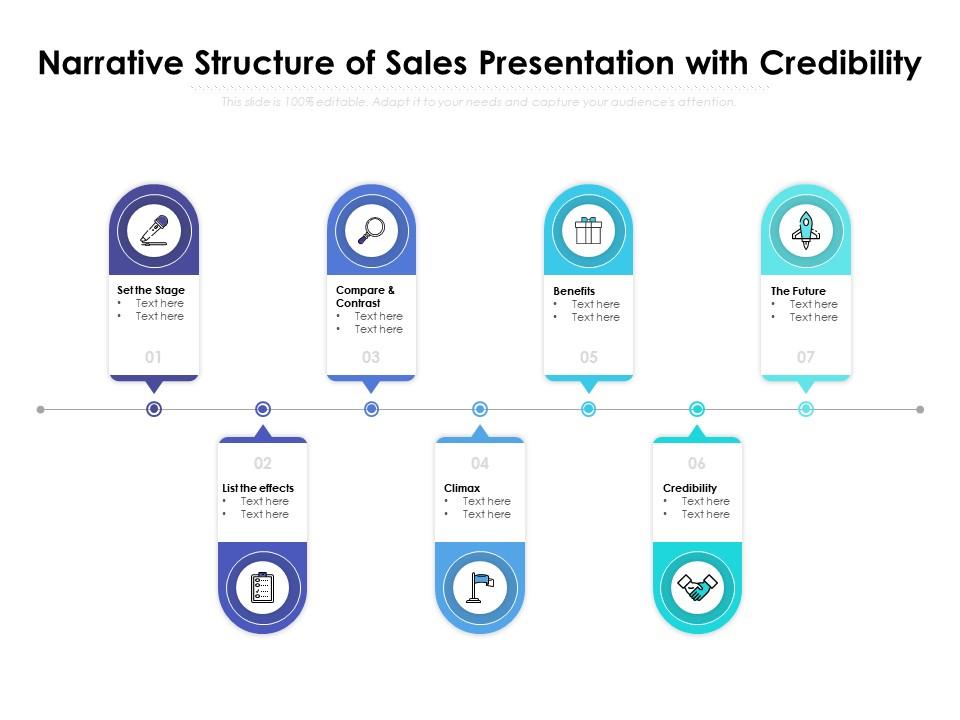
Conduct a brief yet informative session with our Narrative Structure of Sales Presentation with Credibility PPT slide. With this PowerPoint format, you can present your marketing and sales storyboard smoothly. You can use this sales playbook script PowerPoint template to showcase the seven steps needed to portray your ideas. Get your audience excited about your product or service through this sales storytelling PPT slide. You can incorporate this graphical template to develop a credible and lucrative sales strategy. This sales framework PowerPoint presentation template helps you highlight your point of view during important business pitch meetings. This flexible template will empower your team to bring in more revenue. It will also help you navigate the challenges in selling your product and growing your customer base. You can align your sales process with this descriptive PPT theme. So download this illustrative sales PPT template to put forth a convincing point.
People who downloaded this PowerPoint presentation also viewed the following :
Narrative structure of sales presentation with credibility with all 2 slides:
Use our Narrative Structure Of Sales Presentation With Credibility to effectively help you save your valuable time. They are readymade to fit into any presentation structure.
FAQs for Narrative structure of sales
Effective sales presentation narratives include problem identification, solution positioning, value demonstration, proof points, and compelling calls-to-action. These elements work together by establishing audience pain points, presenting targeted solutions, and quantifying benefits through case studies and testimonials, with many sales teams finding that structured storytelling ultimately delivers higher conversion rates and stronger client relationships.
Storytelling enhances sales presentation persuasiveness by creating emotional connections, making complex concepts relatable, and building trust through authentic narratives. Stories help prospects visualize success scenarios, overcome objections through relatable challenges, and remember key messages longer, with many sales professionals finding that narrative-driven presentations increase engagement and ultimately deliver higher conversion rates.
Understanding the audience is fundamental to structuring effective sales presentation narratives, as it determines messaging hierarchy, pain point emphasis, decision-maker focus, and communication style throughout the entire flow. Through audience analysis, sales professionals can strategically sequence content that resonates with specific stakeholder concerns, whether addressing technical teams seeking detailed specifications or executives prioritizing ROI outcomes, ultimately delivering presentations that accelerate decision-making and enhance conversion rates.
A problem-solution framework integrates into sales narratives by establishing the customer's pain points, quantifying their impact, and positioning your solution as the strategic resolution. This structure guides prospects through understanding their challenges, envisioning consequences of inaction, and recognizing your offering's value, ultimately creating compelling urgency while building trust through systematic problem-solving methodology.
Techniques for creating emotional connection include storytelling with relatable customer scenarios, using vivid language that paints clear outcomes, incorporating social proof through testimonials, and presenting problems that resonate with audience pain points. These approaches enable presenters to move beyond features and specifications, ultimately transforming technical discussions into compelling narratives that drive decision-making and foster trust.
Data and statistics strengthen sales narratives by serving as evidence points within compelling stories, transforming abstract claims into credible proof through case studies, benchmark comparisons, and outcome metrics. When woven strategically throughout customer success stories, these elements validate value propositions while maintaining emotional connection, with many sales teams finding that narrative-embedded data increases prospect trust and accelerates decision-making more effectively than standalone statistics.
Best practices for incorporating visuals into sales presentations include aligning graphics with storyline progression, using data visualization to support key arguments, implementing consistent design themes, strategically placing client testimonials or case studies, and ensuring slides complement rather than compete with spoken narrative. These approaches streamline message delivery by enhancing comprehension, maintaining audience engagement, and reinforcing critical points, with many sales teams finding that strategic visual integration ultimately delivers higher conversion rates and more memorable client interactions.
Effective sales presentation openings capture attention through compelling statistics, thought-provoking questions, relevant customer success stories, bold problem statements, or surprising industry insights that directly relate to your audience's challenges. These approaches immediately engage prospects by addressing their pain points, establishing credibility through data or testimonials, and creating curiosity about your solution, ultimately setting the foundation for a persuasive narrative that resonates with their business priorities.
Effective closing strategies include summarizing key narrative benefits, creating urgency through limited-time opportunities, asking for specific commitments, addressing final objections, and providing clear next steps. These approaches reinforce your story's value proposition by connecting emotional engagement with logical business outcomes, while direct calls-to-action help potential clients visualize partnership benefits, ultimately transforming narrative momentum into concrete purchasing decisions.
Customer journeys can be illustrated through problem-awareness-solution-outcome storytelling that mirrors prospects' actual experiences, incorporating specific pain points, decision criteria, and implementation challenges they face. By showcasing similar companies navigating comparable situations, from initial frustration through evaluation processes to measurable results, sales teams create authentic connections that resonate with buyers' current circumstances, ultimately building trust and accelerating purchase decisions.
**INPUT**: What parts of a sales presentation should be prioritized when crafting the narrative? **OUTPUT**: Priority elements include problem identification, solution alignment, value proposition, evidence validation, and clear next steps. These components work together by establishing credibility through specific pain points, demonstrating measurable outcomes, and providing concrete proof points, with many organizations finding that structured narratives increase conversion rates while streamlining complex sales cycles. *[Word count: 53 words]*
Feedback from previous presentations refines narrative structure by identifying which story elements resonated most, where audience engagement dropped, and which value propositions prompted action. Through systematic analysis of client responses, objections raised, and conversion outcomes, sales teams can restructure their narratives to emphasize compelling segments, streamline complex sections, and enhance persuasive flow, ultimately delivering more targeted messaging and higher close rates.
Common pitfalls include leading with features instead of customer benefits, creating overly complex storylines, failing to address specific pain points, neglecting to include clear call-to-actions, and rushing through the problem-solution connection. These structural missteps often result in confused prospects, weakened value propositions, and missed closing opportunities, with many sales teams finding that streamlined, customer-centric narratives significantly improve conversion rates and engagement.
A unique value proposition should be woven throughout presentations by establishing it early in the opening, reinforcing it through each key section with supporting evidence, and connecting every feature to specific customer benefits. Successful sales teams integrate their UVP into problem statements, solution demonstrations, and closing arguments, ensuring consistent messaging that differentiates from competitors while addressing client pain points and delivering measurable business outcomes.
Humor and anecdotes can be integrated through opening ice-breakers that relate to customer challenges, relevant industry stories that illustrate product benefits, and light moments that ease tension during complex discussions. These narrative elements enhance audience engagement, build rapport with prospects, and make technical concepts more memorable, with many sales professionals finding that strategic storytelling increases presentation retention and ultimately drives stronger closing rates.
No Reviews