

Nestle Market Segmentation And Growth Strategies Powerpoint Presentation Slides Strategy CD V





Try Before you Buy Download Free Sample Product
 Impress Your
Audience
 100%
Editable
 Save Hours
of Time


Grab our Nestle Market Segmentation and Growth Strategies, which analyzes the companys current business strategies and researches internal and external business environments. It addresses not only brand positioning strategies but also multiple diversification strategies of Nestle corporation. Our Business Overview showcases Nestles overview, products offered, partners, etc. It gives insights into the mission and vision statement with a brief history and the companys evolution. Additionally, our Market Positioning PPT covers the slides about external environment analysis, which includes PESTLE analysis, industry analysis with Porters five forces model, and competitors analysis based on market share and financial performance. It further provides insights into the internal environmental research of Nestle SA, which includes shareholding structure, organization structure, culture, SWOT analysis, etc. Moreover, our Nestle Products module includes brand positioning strategy, market segmentation, BCG matrix analysis, etc. It also caters to slides about the corporate level process and diversification strategies, global expansion, mergers, acquisitions, etc. Lastly, our Business Level Strategy Template exhibits information about Nestles multiple strategic pillars and sustainability initiatives and the businesss financial statements, like income statements, balance sheets, and enterprise valuation. Get instant access.
People who downloaded this PowerPoint presentation also viewed the following :
Content of this Powerpoint Presentation
Slide 1: This slide introduces Nestle Strategic Management Report. Commence by stating Your Company Name.
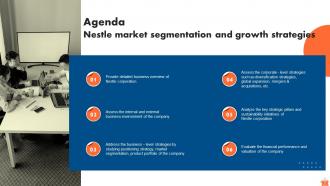
Slide 2: This slide depicts the Agenda of the presentation.
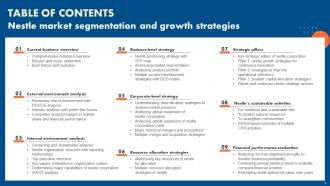
Slide 3: This slide includes the Table of contents.
Slide 4: This slide highlights the Title for the Topics to be covered further.
Slide 5: This slide provides glimpse about comprehensive summary of Nestle corporation to provide current and background information.
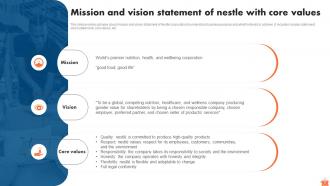
Slide 6: This slide showcases the Mission and vision statement of nestle with core values.
Slide 7: This slide provides glimpse about history of Nestle corporation to understand its evolution and growth over time.
Slide 8: This slide displays the Heading for the Contents to be covered in the following template.
Slide 9: This slide talks about Reviewing macro environment with PESTLE analysis.
Slide 10: This slide reveals the Industry analysis with porter five forces.
Slide 11: This slide shows the competitor analysis of Nestle corporation to understand its competitive landscape and explore opportunities.
Slide 12: This slide mentions the Title for the Ideas to be discussed in the next template.
Slide 13: This slide deals with the Ownership and shareholder analysis of nestle corporation.
Slide 14: This slide illustrates the Nestle organization structure with reporting relationships.
Slide 15: This slide portrays the Top executive directors of nestle corporation.
Slide 16: This slide highlights the Key values embedded in organization culture of nestle.
Slide 17: This slide provides glimpse about resources and capabilities of Nestle corporation to analyze its tangible and intangible assets.
Slide 18: This slide talks about Understanding business environment with SWOT analysis.
Slide 19: This slide indicates the Heading for the Ideas to be covered in the upcoming template.
Slide 20: This slide talks about the Nestle positioning strategy with STP map.
Slide 21: This slide emphasizes on Assessing market segmentation of nestle corporation.
Slide 22: This slide provides a glimpse about multiple product brands offered by Nestle SA that showcases a range of products.
Slide 23: This slide illustrates the Multiple product development strategies with BCG matrix.
Slide 24: This slide presents the Title for the Contents to be discussed further.
Slide 25: This slide focuses on Understanding diversification strategies to assess market presence.
Slide 26: This slide showcases Analyzing global expansion of nestle corporation.
Slide 27: This slide continues Analyzing global expansion of nestle corporation.
Slide 28: This slide exhibits the Major historical mergers and acquisitions of nestle.
Slide 29: This slide depicts the Multiple merger and acquisition strategies of nestle.
Slide 30: This slide mentions about the Heading for the Topics to be covered in the following template.
Slide 31: This slide provides glimpse about multiple resources of Nestle corporation that showcases the business capabilities and assets.
Slide 32: This slide represents the Multiple resource allocation strategies of nestle.
Slide 33: This slide highlights the Title for the Contents to be discussed further.
Slide 34: This slide provides glimpse about strategic pillars adopted by Nestle that forms the core of its business agenda.
Slide 35: This slide states different strategies adopted by Nestle for consistent organic growth by continuous innovation.
Slide 36: This slide provides glimpse about different strategies adopted by Nestle for better operational efficiency and productivity.
Slide 37: This slide mentions the different strategies adopted by Nestle for capital allocation to induce long term business growth.
Slide 38: This slide shows the different customer focused actions of Nestle for better future of planet and humans.
Slide 39: This slide depicts the Heading for the Topics to be covered next.
Slide 40: This slide provides glimpse about different sustainable activities initiated by Nestle corporation to enhance people’s lives.
Slide 41: This slide talks about the Nestle CSR activities to protect natural resources.
Slide 42: This slide provides glimpse about different sustainable activities initiated by Nestle corporation to boost communities.
Slide 43: This slide illustrates the Performance summary of multiple CSR activities.
Slide 44: This slide mentions about the Title for the Topics to be discussed further.
Slide 45: This slide deals with Analyzing income statement annually to monitor business profitability.
Slide 46: This slide provides glimpse about year over year annual balance sheet to assess the financial position of Nestle SA.
Slide 47: This slide showcases year over year business valuation to assess enterprise value of Nestle SA.
Slide 48: This is the Icons slide containing all the Icons used in the plan.
Slide 49: This slide is used for depicting some Additional information.
Slide 50: This slide incorporates the company's mission, Vision, and Goal.
Slide 51: This is the About Us slide. State your organization-related information here.
Slide 52: This is Meet our team slide for stating the team-related information.
Slide 53: This is Our target slide for showcasing the firm's targets.
Slide 54: This is the Idea Generation slide for encouraging fresh ideas.
Slide 55: This slide elucidates the Venn diagram.
Slide 56: This is the Quotes slide for motivation.
Slide 57: This is the Puzzle slide with related imagery.
Slide 58: This slide indicates the Pie chart.
Slide 59: This is the Column chart slide.
Slide 60: This slide displays the organizational Timeline.
Slide 61: This is the Thank You slide for acknowledgement.
Nestle Market Segmentation And Growth Strategies Powerpoint Presentation Slides Strategy CD V with all 66 slides:
Use our Nestle Market Segmentation And Growth Strategies Powerpoint Presentation Slides Strategy CD V to effectively help you save your valuable time. They are readymade to fit into any presentation structure.









FAQs for Nestle Market Segmentation And Growth Strategies Powerpoint Presentation Slides
So Nestlé basically goes after four big groups - babies/kids with formula and baby food, health nuts buying protein bars, coffee addicts (Nescafé, Starbucks stuff), and pet owners through Purina. Pretty clever honestly, they've got you covered from cradle to... well, your dog I guess lol. Each group wants totally different things so they switch up their marketing and packaging. Growth-wise, they're really pushing into emerging markets where these segments are blowing up. Oh and here's the thing - they don't do generic campaigns. Instead they position completely differently for each segment, which is way smarter than trying to please everyone at once.
So Nestlé's approach is pretty clever - they slice up their market using age, income, and family stuff all together. Baby food targets new parents, protein bars go after young professionals, heart-healthy products for older folks. Their pricing follows the same logic too. Premium chocolates for people with money, but they keep basic cereals cheap. College kids obviously need different things than retirees, which sounds obvious but companies mess this up all the time. What's cool is they don't just pick one factor - they layer everything to build these super specific customer profiles. That's the strategy trick right there.
So Nestlé's really good at psychographic stuff - basically they target your lifestyle and values instead of just age/income. Like they'll go after "health-conscious parents wanting organic" rather than "women 25-40." Makes total sense when you think about it. Two people making the same salary could have completely different food priorities, right? That's why their organic baby food and fancy coffee ads always feel like they're selling you a whole vibe. I swear half their marketing is just lifestyle porn at this point, but it works.
So Nestlé's pretty smart about this - they completely switch up their approach for different groups. Health nuts get all the clean ingredient stuff on fitness apps and wellness sites. Parents? They hit them with convenience messaging on social media, usually right around dinner time when everyone's losing their minds lol. The fancy segments see those polished ads in upscale mags talking about quality and tradition. Budget families get the value angle through regular TV and grocery displays. Honestly, it's kinda wild how they flip their entire tone depending on who they're after.
So Nestlé basically maps out where to sell based on geography, but it's way more strategic than you'd think. In developed countries, they hit urban areas hard with solid distribution networks. Emerging markets like India? They're all about getting into rural areas instead. The whole supply chain shifts depending on local infrastructure - cities get modern retail channels while smaller towns stick with traditional mom-and-pop shops. Makes total sense when you consider how different these places actually are. Bottom line: match your distribution to what's actually there, not just where the most people live.
Nestlé's gotten really smart about watching how people actually use their stuff instead of just guessing based on age or whatever. They track things like how often you buy coffee or when you switch brands. Their Nescafé app gives heavy drinkers better deals, and the baby formula thing sends different tips based on feeding times - which honestly makes total sense. They've got subscription boxes for pet food too, all based on your habits. The whole thing is pretty clever because they're rewarding what you actually do, not just assuming stuff about you. You should totally look at your customers' real behavior patterns instead of basic demographics.
Nestlé's basically mastered emerging markets by getting super local. They make tiny, cheap pack sizes for people watching every penny. Green tea Kit-Kats in Asia? Brilliant move. Instead of just dumping global products everywhere, they actually reformulate stuff to match what people want. Building factories locally cuts costs big time, plus they've got these crazy distribution networks that reach rural spots where there's barely any real stores. Oh, and they're smart about buying up local brands instead of always pushing their own. Their whole "popularly positioned products" thing is worth checking out - it's basically making fancy brands affordable for everyone.
So Nestlé basically spreads their bets across tons of different stuff - baby food, coffee, bottled water, pet food, frozen dinners. Pretty genius actually. When coffee sales tank, maybe their pet care division is killing it. Different products hit different people too, so they're not relying on just one group of customers. Plus they can use the same trucks and warehouses for everything, which saves money I guess. If one market crashes, they've got like five others keeping them afloat. You should totally think about this for your thing - don't put everything in one category.
So Nestlé basically watches market share growth in their target segments, plus customer lifetime value and how well they're penetrating different demographics. Revenue per segment matters too, obviously. They get super detailed about measuring consumer sentiment and purchase frequency - like, do people actually care about their positioning or nah? Brand performance against local competitors is huge for them. Honestly, the tracking can get overwhelming though. My advice? Pick maybe 2-3 metrics that actually connect to what you're trying to achieve with segmentation. Don't go crazy trying to measure everything at once.
Nestlé's pretty smart about this - they keep the big brand names the same everywhere but totally switch up everything else. Like you'll find KitKat globally, but in Japan they've got matcha flavor which is honestly genius. Each market gets broken down by income, what people actually want, local competition, all that stuff. Then they adjust the recipes, pricing, marketing - whatever works locally. It's brilliant because you still get that brand recognition boost worldwide but you're actually hitting what your customers want in each place. Oh and next time you're planning market entry, definitely think about keeping your brand strong while customizing the actual product experience.
Honestly, Nestlé nailed it with millennials by going all-in on digital stuff. Their KitKat campaign blew up on TikTok, which was genius. They partnered with smaller influencers on Instagram instead of big celebrities - way more authentic that way. Plus they created nutrition apps and really pushed their sustainability angle hard because millennials actually give a damn about the environment. Oh, and they added AR filters to make their products more interactive. The biggest takeaway? They stopped just selling products and started having real conversations about health, personalization, and values that matter to people.
Honestly, Nestlé's getting really clever with this sustainability thing. They're not just slapping "eco-friendly" on everything - they're building whole product lines around it. Look at their plant-based stuff targeting younger consumers, or how they market sustainable coffee to people who care about ethical sourcing. Smart move, because these groups will actually pay more for products that align with their values. The margins are way better too, which I'm sure their shareholders love. Instead of generic green messaging, they're tailoring sustainability claims to justify premium prices across different segments. It's kind of brilliant marketing when you think about it.
Honestly, Nestlé's main headache is adapting products for every single market without losing their brand identity. Japanese KitKat flavors would flop hard in Germany, right? Sourcing ingredients gets messy since availability and costs change everywhere. Then there's the regulatory nightmare - different food laws, cultural taboos about certain ingredients. I'd say their smartest move is hiring solid regional teams who actually get the local culture. Market research helps too, though that's probably obvious. The tricky part? Don't customize so much that you dilute what makes your brand recognizable globally.
So Nestlé basically ditched those old-school demographic groups for super specific micro-segments using real-time data. Their apps now track everything - what you buy, your diet preferences, health goals, the whole deal. It's actually pretty impressive how they create these shifting customer groups based on where you are in life and how you interact with them online. Going direct-to-consumer was huge because they don't have to rely on whatever scraps retailers give them anymore. They build way better customer profiles now. For your project, I'd focus on behavioral data over demographics - that's where the real insights are hiding.
So basically all that competition makes Nestlé get super targeted with who they're going after. They'll slice up markets into tiny pieces - like going hard after health-focused millennials with plant stuff, then turn around and chase premium coffee people. Smart move honestly. All these smaller brands breathing down their neck means they have to innovate way faster, or just buy out the competition instead of building everything themselves. Oh and here's the thing - they use their massive size to jump into a bunch of different niches at once. That's where they really beat everyone else.
-
Thrilled to see several customizable templates catering various verticals and industries.
-
The website is jam-packed with fantastic and creative templates for a variety of business concepts. They are easy to use and customize.