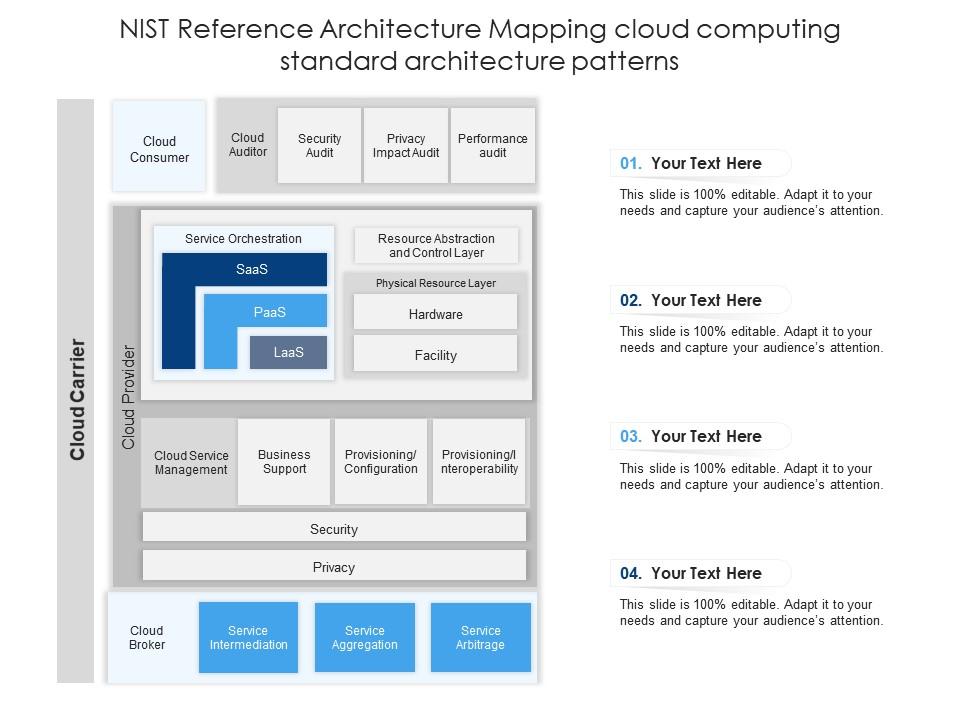
Nist reference architecture mapping cloud computing standard architecture patterns ppt diagram
Try Before you Buy Download Free Sample Product
Audience
Editable
of Time
Showcase your technical expertise by introducing this attention-grabbing PowerPoint template. Titled NIST Reference Architecture Mapping Cloud Computing Standard Architecture Patterns Ppt Diagram, this is a one-stop solution to elaborate the topic of cloud computing. IT professionals can employ this content-ready template for project meetings and presentations to discuss the advantages and disadvantages of cloud computing. You can align this professionally designed PPT template with your subject matter and conduct a productive meeting with your colleagues. You can also use this PowerPoint template to discuss case studies on cloud design patterns. Significant topics related to cloud architecture and applications can be addressed with the help of this modern presentation. Furthermore, this presentation is versatile and can be easily modified as per the business requirements. So, if you want to leave a great impression without the painstaking efforts of designing the slides from scratch, this PPT template is a must. Hit the download button and grab this creative set now.
People who downloaded this PowerPoint presentation also viewed the following :
Nist reference architecture mapping cloud computing standard architecture patterns ppt diagram with all 2 slides:
Use our NIST Reference Architecture Mapping Cloud Computing Standard Architecture Patterns Ppt Diagram to effectively help you save your valuable time. They are readymade to fit into any presentation structure.
FAQs for Nist reference architecture mapping cloud computing standard architecture
The NIST Cloud Computing Reference Architecture includes five key actors: cloud consumer, cloud provider, cloud carrier, cloud auditor, and cloud broker, along with their interconnecting relationships and data flows. These components work together to establish standardized cloud service delivery, enhance interoperability across different platforms, and streamline vendor management processes, ultimately delivering greater operational efficiency and strategic flexibility for organizations navigating increasingly complex multi-cloud environments.
The NIST Cloud Computing Reference Architecture addresses security and compliance through comprehensive frameworks that define security controls, data protection protocols, risk management strategies, and regulatory alignment mechanisms. These frameworks enable organizations across sectors like healthcare, financial services, and government to implement standardized security measures, ensure consistent compliance monitoring, and maintain regulatory requirements, ultimately delivering enhanced data protection and operational transparency while minimizing compliance risks.
Organizations can leverage NIST architecture for cloud migration by utilizing its standardized frameworks for security controls, service models assessment, deployment strategies, and risk management protocols. Through this structured approach, businesses streamline their migration planning, ensure regulatory compliance, minimize security vulnerabilities, and optimize resource allocation, with many enterprises finding that systematic implementation delivers faster deployment timelines and enhanced operational efficiency.
The NIST framework positions IaaS, PaaS, and SaaS as foundational service layers that enable scalable cloud deployment strategies, with each model delivering different levels of infrastructure control, development flexibility, and application accessibility. These service models streamline organizational cloud adoption by allowing businesses to select optimal combinations based on technical requirements and operational needs, ultimately delivering cost efficiency and strategic resource allocation across diverse enterprise environments.
The NIST architecture supports interoperability through standardized interfaces, common data formats, portable application programming interfaces, and unified service management protocols. These frameworks enable organizations to seamlessly integrate multi-cloud environments, avoid vendor lock-in, and maintain consistent operations across different platforms, with many enterprises finding that standardized architectures significantly reduce integration costs while enhancing operational flexibility.
NIST recommends establishing comprehensive governance frameworks, implementing automated resource provisioning and deprovisioning, maintaining detailed cost tracking and optimization protocols, and ensuring robust security controls across all cloud layers. These practices enable organizations to streamline operational efficiency, minimize resource waste, and enhance security posture, with many enterprises finding that strategic resource management ultimately delivers significant cost reductions and improved service reliability.
The NIST Cloud Computing Reference Architecture adapts to hybrid environments by integrating on-premises infrastructure with public cloud services through standardized interfaces, security protocols, and data management frameworks. Organizations across sectors like healthcare and financial services leverage this approach to maintain regulatory compliance while accessing scalable cloud resources, ultimately delivering operational flexibility and cost optimization without compromising security requirements.
The NIST framework identifies five key stakeholders: cloud consumers who use cloud services, cloud providers who deliver infrastructure and platforms, cloud auditors who assess security and compliance, cloud brokers who manage service relationships, and cloud carriers who provide connectivity. These stakeholders collaborate to ensure secure, compliant cloud environments by establishing clear governance structures, maintaining operational standards, and enabling seamless service delivery, with many organizations finding that this structured approach significantly enhances their cloud adoption success.
The NIST architecture enhances scalability through standardized service models, deployment frameworks, and resource orchestration capabilities that enable dynamic capacity adjustment. By providing clear guidelines for horizontal scaling, automated provisioning, and multi-tenant environments, organizations across sectors like healthcare and finance achieve seamless expansion while maintaining performance consistency and cost efficiency.
NIST proposes methodologies including security assessment frameworks, compliance verification processes, performance benchmarking standards, risk evaluation matrices, and service level agreement validation protocols. These comprehensive evaluation approaches enable organizations to systematically assess provider capabilities, security postures, and operational reliability, with many enterprises finding that structured NIST-based evaluations streamline vendor selection while ensuring regulatory compliance.
The NIST framework facilitates risk management through standardized security controls, comprehensive risk assessment methodologies, and continuous monitoring protocols. These guidelines enable organizations to systematically identify vulnerabilities, implement appropriate safeguards, and maintain compliance standards, with financial institutions and healthcare providers finding that structured risk frameworks ultimately deliver enhanced security postures and regulatory confidence.
Organizations can leverage NIST architecture to enhance disaster recovery through standardized cloud service models, deployment strategies, and comprehensive security frameworks that ensure rapid data restoration and business continuity. By implementing NIST's multi-layered approach, companies across sectors like banking, healthcare, and manufacturing streamline recovery processes, minimize downtime costs, and maintain operational resilience, ultimately delivering faster restoration times and competitive advantage during critical incidents.
NIST recommends performance metrics including availability, reliability, response time, throughput, scalability, and resource utilization rates for comprehensive cloud service assessment. These metrics enable organizations to evaluate service level agreements, optimize resource allocation, and ensure operational efficiency, with many enterprises finding that systematic performance monitoring ultimately delivers cost reduction and enhanced customer experiences.
The NIST Cloud Computing Reference Architecture promotes efficient resource allocation by standardizing cloud service delivery models, defining clear roles between providers and consumers, and establishing consistent security frameworks. Through standardized interfaces and governance structures, organizations can optimize workload distribution, minimize redundant infrastructure investments, and streamline vendor management processes, ultimately delivering cost-effective scalability and operational efficiency.
Organizations face integration complexity with legacy systems, resource constraints for comprehensive implementation, and skills gaps in cloud architecture expertise when applying NIST frameworks. While these challenges require strategic planning and investment, many enterprises find that phased adoption approaches, targeted training programs, and partnering with cloud specialists enable successful deployment, ultimately delivering enhanced security posture and operational efficiency.
-
Nice and innovative design.