Objective Of Corporate Communication Strategy Corporate Communication Strategy
Try Before you Buy Download Free Sample Product
Audience
Editable
of Time
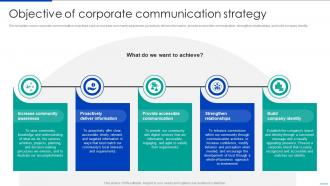
This template covers corporate communication objectives such as increase community awareness, proactively deliver information, provide accessible communication, strengthen relationships, and build company identity.
People who downloaded this PowerPoint presentation also viewed the following :
Objective Of Corporate Communication Strategy Corporate Communication Strategy with all 6 slides:
Use our Objective Of Corporate Communication Strategy Corporate Communication Strategy to effectively help you save your valuable time. They are readymade to fit into any presentation structure.
FAQs for Objective Of Corporate Communication Strategy
Okay so here's the thing - you need to be super specific about what you want people to actually DO after your presentation. Like, don't just say "inform them about sales." Say "get them to approve the new pricing strategy." Make it measurable too so you know if it worked. Oh and be realistic - you're not gonna revolutionize their entire worldview in 20 minutes lol. I always write mine as one clear sentence with action words like "decide" or "understand" before I even touch slides. Honestly it's like having a GPS for your whole presentation. Otherwise you'll just ramble about whatever pops into your head.
Look, people tune out fast when they can't figure out what you're offering them. Your objective needs to be so obvious that someone hears it once and gets it immediately. I mean, we're all scrolling through endless content - nobody's got time to decode your message. When it's crystal clear, people instantly know if it applies to them or solves their problem. That mental "oh, this is for me" moment? That's pure gold. Skip the fancy language and make it simple enough that your audience could repeat your main point back to you in one sentence. Trust me, clarity beats cleverness every time.
Okay so think of clear objectives like a GPS for your presentation. You won't go off on random tangents when you're nervous. Write down 2-3 specific things you want people to remember - like "they'll understand our Q3 budget priorities" instead of just "budget stuff." Then check if each slide actually helps with those goals. I used to throw in slides that looked impressive but totally confused everyone lol. The measurable part matters because you need to know what success looks like beforehand, not just wing it.
Look, nobody gives a damn about your cool features unless they're solving actual problems. Map everything back to what your company's already tracking - revenue goals, cost cuts, whatever they're obsessing over this quarter. Before you even touch those slides, ask yourself "how does this help us hit our numbers?" That's literally all leadership cares about. Frame your whole thing around outcomes that move the needle: customer retention, market share, operational stuff. I learned this the hard way after presenting amazing tech that went nowhere because it didn't connect to business goals. Focus on quarterly targets and you'll actually get people's attention.
Start with your main point right off the bat, then back it up with maybe 2-3 solid details. Skip the fluff words like "facilitate" - just say what you mean. I'm obsessed with bullet points (probably too much honestly) but they really do work. Short sentences hit harder than long rambling ones. Here's what I do: read your objective out loud. If it sounds like something from a corporate handbook, scrap it and try again. Oh, and test it on someone who has zero clue about your project. If they immediately get what you're going for, you've got it right.
Dude, you've gotta think about who you're presenting to. Japanese audiences want subtle, relationship-building stuff - not your typical American "here's my big goal" approach. Germans? They want hard data and zero fluff. I bombed SO hard in Seoul once because I didn't realize Korean culture values group success over individual wins. Also, if you're dealing with hierarchical cultures, acknowledge the chain of command in your objectives or you'll look clueless. Basically just research their communication style first. Don't assume what works for you works everywhere - learned that one the expensive way!
Start by figuring out who you're actually talking to. Beginners need simple language and more background context. Experts? Skip the basics and dive into technical stuff. Also think about their job - executives want to know business impact, but the people actually doing the work need specific goals they can measure. I've honestly seen way too many objectives that try to please everyone and end up being completely useless. Don't forget timeframes matter too. Some folks need quick wins, others are thinking long-term. Test different versions with real people before you lock anything in.
Honestly, visuals are a game-changer for making your goals actually stick. Charts and diagrams beat walls of text every time - our brains just eat that stuff up way faster. Progress bars work great for showing milestones. Timelines help with deadlines. Even basic icons next to each objective make a huge difference. I've noticed people zone out with bullet points, but throw in an infographic? They're suddenly paying attention. Breaking down those complex goals into visual chunks makes everything feel less overwhelming. Trust me, pair each goal with some kind of image and you'll see the difference immediately.
Honestly, the worst thing you can do is be super vague with your goals. Like saying "inform people about our product" - okay, but what does that even mean? I see people try to squeeze way too many objectives into one presentation all the time. It's a mess. Also don't mix up what you're *doing* with what you want to achieve. "Show 10 slides" isn't a real objective, that's just busy work. You need to get specific about what you want people thinking or feeling when you're done. Maybe write that stuff down first before you even touch PowerPoint - saves you so much headache later.
Honestly, getting feedback on your presentation goals is a game-changer. You'll finally know if your main points actually stuck or if people left totally confused. I always ask "what was the key takeaway?" in my follow-up surveys – the answers are brutal but so helpful. Like, you might think you nailed explaining the main concept, but then half the audience completely missed it. Those patterns show you exactly what needs fixing. Maybe your structure's off, or you're cramming too much into the time you have. It's way better than just guessing what worked, you know?
SMART goals are clutch for this - you know, Specific, Measurable, all that stuff. There's also this "So What?" trick where you keep asking yourself "so what?" until you hit the real reason you're presenting. Sounds dumb but it works. Oh, and I love the "Know, Feel, Do" thing - what do you want people to know, feel, and actually DO after? That last part's key since most presentations just... exist without any real purpose. Just pick one method and actually write it down before you touch PowerPoint. Trust me on that.
Oh absolutely! Check in with yourself every 10-15 minutes during your presentation. Your audience's vibe changes constantly - what worked at the beginning might be totally missing the mark later. I've watched so many presentations crash because people refused to pivot from their original plan. Super stubborn move, honestly. Pay attention to their questions and reactions. Are they getting it? Do they look bored? Then adjust your focus on the fly. Quick mental check: "Am I still giving them what they actually need right now?" Staying flexible will save you from completely losing them halfway through.
Honestly, the best way is figuring out your success metrics *before* you present - otherwise you're just shooting in the dark afterward. For info-heavy talks, try comprehension surveys or quick follow-up quizzes to see what actually stuck. Persuasion goals? Track the real stuff - sign-ups, purchases, whatever action you wanted. Don't sleep on engagement metrics either. How many questions did you get? Were people actually participating or just staring at their phones? I always think surveys are kinda cheesy but they're surprisingly helpful when you actually use them. Body language tells you a lot too, though that's harder to quantify.
Think of your objectives like a story where your audience is the main character. What problem are they dealing with? That's your conflict. Your objective becomes their quest to fix it. Then paint what winning looks like at the end. Way better than boring bullet points, trust me. Get specific with examples they'll relate to. Don't just say "boost efficiency 20%" - talk about Sarah who's stuck doing mind-numbing data entry for hours. Show how your plan gives her time back. I always start with "imagine if..." because people can't help but picture it. Gets them hooked immediately.
Honestly, getting your team on the same page first makes such a huge difference. You'll avoid those cringe moments where one person says something that completely contradicts what someone else just presented. The audience always knows when you're not aligned - it's painful to watch. I learned this the hard way on a project last year, ugh. Spend like 20 minutes upfront just talking through what you're all trying to achieve. Sounds obvious but most people skip it and jump straight into making slides. Trust me, it saves you from looking like strangers who got thrown together.
-
These stunning templates can help you create a presentation like a pro.Â
-
Designs have enough space to add content.