

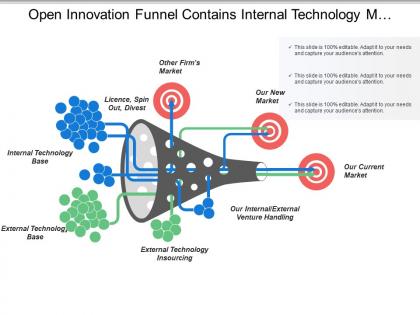
Open innovation funnel contains internal technology market venture handling




Try Before you Buy Download Free Sample Product
 Impress Your
 Audience
 100%
100% Editable
 Save Hours
 of Time


Establish firmer control with our Open Innovation Funnel Contains Internal Technology Market Venture Handling. They help consolidate your gains.
People who downloaded this PowerPoint presentation also viewed the following :
Open innovation funnel contains internal technology market venture handling with all 5 slides:
Each of our Open Innovation Funnel Contains Internal Technology Market Venture Handling is designed with intense focus. It is invariably interesting.




FAQs for Open innovation funnel contains internal technology
The key stages of the open innovation funnel include ideation and external sourcing, evaluation and screening, concept development, prototyping and testing, and commercialization and market launch. These stages streamline innovation by systematically filtering external ideas, fostering collaborative development, and accelerating time-to-market, with many organizations finding that this structured approach delivers enhanced product portfolios and competitive advantage.
Organizations effectively identify external sources of innovation through strategic partnerships with universities and research institutions, startup incubators and accelerators, industry conferences, online innovation platforms, and customer co-creation initiatives. These approaches streamline discovery by leveraging diverse networks, crowdsourcing capabilities, and systematic scouting programs, ultimately delivering fresh perspectives and breakthrough solutions while enabling faster market responsiveness.
Collaboration serves as the cornerstone of effective open innovation funnels, enabling organizations to leverage external partnerships, crowdsourcing platforms, academic institutions, and startup ecosystems to accelerate idea generation and validation. Through strategic collaboration, companies streamline knowledge transfer, reduce development costs, and access diverse expertise, with many enterprises finding that collaborative networks ultimately deliver faster time-to-market and sustainable competitive advantages.
Companies manage intellectual property rights in open innovation through clear contractual frameworks, joint IP agreements, licensing structures, and defined ownership protocols from project inception. These strategic approaches enable organizations to protect core assets while fostering collaboration, with many technology firms and pharmaceutical companies finding that transparent IP governance ultimately delivers faster innovation cycles and shared competitive advantages.
Tools and platforms facilitating open innovation include crowdsourcing platforms like InnoCentive, innovation management software such as Spigit, collaboration hubs like IdeaScale, hackathon platforms, and partnership portals. These technologies streamline idea collection, evaluation, and implementation by connecting organizations with external innovators, automating workflow processes, and enabling real-time collaboration, ultimately delivering faster innovation cycles and enhanced competitive advantage.
Companies can measure open innovation success through key performance indicators including number of external partnerships formed, innovation pipeline velocity, time-to-market reduction, and revenue from collaborative projects. These metrics enable organizations to track tangible outcomes like cost savings, accelerated product development, and market expansion, with many finding that successful initiatives deliver measurable competitive advantages within 12-18 months.
Common challenges include managing intellectual property risks, coordinating diverse external partnerships, filtering overwhelming idea volumes, aligning innovation timelines with business cycles, and integrating external solutions with internal processes. Organizations often struggle with cultural resistance to outside ideas, resource allocation across multiple innovation streams, and maintaining quality control, while many find that establishing clear governance frameworks and dedicated innovation teams significantly improves success rates.
Organizations ensure alignment through strategic screening frameworks, clear innovation criteria, and cross-functional evaluation teams that assess external ideas against core business objectives, market priorities, and operational capabilities. Many companies establish dedicated innovation committees that include R&D, strategy, and business unit leaders, enabling seamless integration while maintaining strategic focus and competitive advantage.
Strategies include innovation challenges with rewards, dedicated time for creative projects, cross-functional collaboration platforms, idea submission systems, and leadership recognition programs. These approaches enhance employee engagement by fostering creative ownership, providing clear pathways for contribution, and demonstrating organizational value for innovation, with many companies finding that structured participation frameworks significantly increase both idea quality and employee satisfaction.
Open innovation significantly accelerates product development timelines by leveraging external expertise, reducing internal R&D bottlenecks, and enabling parallel development processes across multiple partners. Through strategic collaboration with startups, universities, and suppliers, organizations streamline concept-to-market cycles, minimize resource constraints, and access specialized capabilities, ultimately delivering faster product launches while maintaining competitive advantage in increasingly dynamic markets.
Organizations should track conversion rates at each funnel stage, time-to-market acceleration, cost per innovation, external partner engagement levels, and revenue generated from collaborative projects. These metrics enable companies to assess pipeline efficiency, resource allocation effectiveness, and partnership ROI, with many enterprises finding that tracking both quantitative outcomes and qualitative relationship strength ultimately delivers strategic insights for optimizing their innovation ecosystem.
Startups can leverage the open innovation funnel by collaborating with external partners, accessing specialized expertise, sharing development costs, and integrating complementary technologies throughout their growth phases. This strategic approach enables rapid market entry, reduces resource constraints, and accelerates product development, with many tech startups finding that partnerships deliver faster scaling and competitive positioning than isolated development efforts.
Technology, pharmaceuticals, automotive, consumer goods, and energy sectors are most conducive to open innovation practices due to their complex R&D requirements and rapid market evolution. These industries benefit from external partnerships, startup collaborations, and crowdsourcing initiatives, with companies like Procter & Gamble and pharmaceutical giants finding that open innovation accelerates product development while reducing costs and enhancing competitive advantage.
Open innovation creates sustainable competitive advantages by accessing diverse external expertise, accelerating time-to-market, and reducing R&D costs while spreading risk across multiple partners. This approach enables organizations to continuously refresh their innovation pipeline, adapt quickly to market changes, and leverage global talent pools, with many technology companies finding that collaborative innovation delivers faster breakthrough solutions and stronger market positioning than traditional internal development alone.
Best practices include establishing clear evaluation criteria, creating cross-functional transition teams, developing structured pilot programs, implementing robust intellectual property protocols, and maintaining continuous stakeholder communication throughout the process. These approaches streamline the handoff by minimizing information loss, accelerating decision-making timelines, and ensuring seamless integration, with many organizations finding that dedicated innovation managers significantly enhance success rates and reduce implementation friction.
-
Innovative and attractive designs.
-
Presentation Design is very nice, good work with the content as well.