

Organization structure department improving logistics management operations




Try Before you Buy Download Free Sample Product
 Impress Your
 Audience
 100%
100% Editable
 Save Hours
 of Time


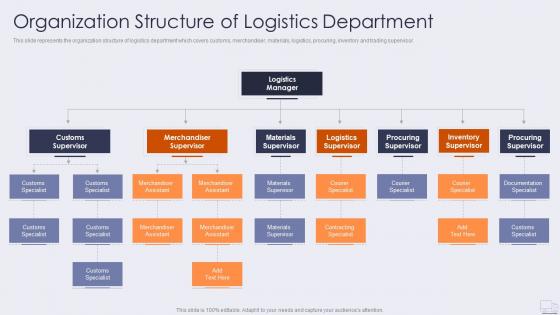
This slide represents the organization structure of logistics department which covers customs, merchandiser, materials, logistics, procuring, inventory and trading supervisor.
People who downloaded this PowerPoint presentation also viewed the following :
Content of this Powerpoint Presentation
Every company's busy logistics division aims to streamline its operations for increased productivity. Imagine a logistics department that is so effective that all packages arrive on time, all resources are used to their full potential, and all procedures run without a hitch. Within a logistics department, every action matters, right from placing an order to making the quickest delivery as it has a direct correlation to customer satisfaction. Thanks to this department's organizational structure that coordinates and ensures the smooth functioning of these crucial responsibilities to land happy customers that can now vouch for your service. Now, imagine this organizational chart as being pinned to the notice board or accessed as a file in Google Drive so that it labels all the professionals holding the fort of this logistics department! How beneficial would that be? That’s what this presentation template is all about.
Download our customizable template for a scrum organization chart for enterprise agility!!
Our team has prepared a PowerPoint slide to streamline the process, improve efficiency, and enhance overall performance. With this organizational structure of the logistics department PowerPoint template, you can transform the way you communicate your strategies and succeed in achieving goals as a team.
Template 1: Organization Structure of Logistics Department
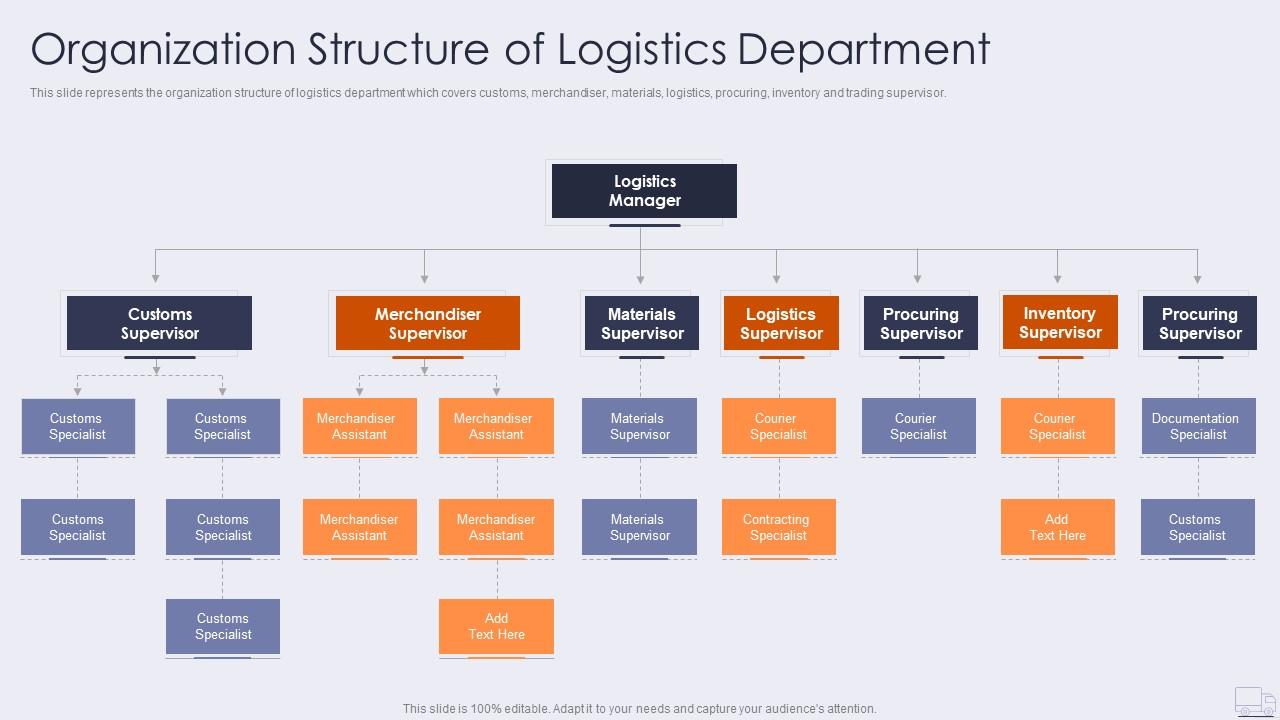
Label the organizational structure of your logistics department with this PPT Flowchart. Highlight the key professionals important for the department’s effective functioning and cooperation. The major role is of the leadership group, which oversees the strategic direction and is made up of logistics directors and managers. This flowchart can also identify executives handling distribution, warehousing, transportation, and inventory management and their position in the hierarchy for easy identification.
Logistics in Synchronization: The Ultimate Goal
There you have it. Synchronize the roles and responsibilities of your company’s logistics department with this organization chart at your service. Help team members recognize each other’s position in the hierarchy and guide those outside the department in approaching the correct personnel of the logistics team. Contribute to team coordination and communication today by investing in this PPT Layout.
P.S. Explore our PPT slides for types of organization structures and Org chart PPT presentation slides!!!
Organization structure department improving logistics management operations with all 6 slides:
Use our Organization Structure Department Improving Logistics Management Operations to effectively help you save your valuable time. They are readymade to fit into any presentation structure.





FAQs for Organization structure department improving
So you've got four main things to nail down: transportation management, warehouse ops, inventory control, and demand forecasting. Those are basically your foundation. Then you need decent supplier relationships and some kind of tech system that connects everything - honestly, this part's where most companies mess up because they let departments work in isolation. Returns management is huge too (learned that one the hard way). Map out how info moves between each area first, then figure out where things are getting stuck. The whole thing falls apart if these systems can't communicate with each other.
Look, tech integration basically automates all that manual stuff you're probably sick of doing. Real-time tracking becomes automatic. Route optimization happens without you thinking about it. I've seen companies catch delays before customers even know there's a problem - pretty cool honestly. When your warehouse system talks directly to shipping platforms, errors drop big time. Data shows you where money's being wasted too. The analytics piece is huge for spotting bottlenecks you'd never notice otherwise. Start by checking what systems you have now and figure out where the gaps are costing you.
Dude, partnerships in supply chain are game-changers. Instead of doing everything yourself, you're sharing resources and data with suppliers, carriers, whoever makes sense. Better coordination, less duplicate work, and you get visibility across the whole network. Your partners usually know shortcuts you haven't discovered yet - that's been my experience anyway. The trick is finding people who actually communicate and have tech that plays nice with yours. Oh, and sometimes even competitors can be partners, which sounds weird but works. Map out your biggest headaches first, then find partners who solve those exact problems.
Dude, analytics is a game-changer for logistics. No more flying blind with your decisions. You'll actually see patterns that would take forever to notice manually - like when demand's about to spike or where your routes are wasting fuel. Plus your trucks can basically tell you "hey, I need maintenance" before they break down (which honestly still blows my mind). The money you'll save just from catching hidden inefficiencies is crazy. Don't go overboard though - start with something like route optimization first. Prove it works, then expand from there.
Dude, the regulatory stuff alone will make your head spin - every country has different rules and customs headaches. Costs go crazy at first because you need local warehouses and partners everywhere. Predicting demand is brutal since people buy totally differently in each market, and currency swings can kill your profits in like a day. Some places have terrible infrastructure so your packages take forever or show up damaged. Oh, and honestly? Pick maybe 2-3 similar countries to start with. Test everything there before you go nuts trying to be everywhere at once.
Your layout basically controls how smoothly everything runs - bad design creates jams everywhere. You'll want receiving, storage, picking, and shipping positioned so stuff moves in order without doubling back. High-volume items should sit closest to your packing stations. Cross-docking needs clear paths between incoming and outgoing docks. Honestly, it's like organizing a kitchen - you wouldn't stick the fridge on the opposite side from the stove, would you? Map out your actual workflow first, then build the space around that instead of cramming operations into whatever layout you inherited.
Honestly, you'll need solid analytical skills since you're always figuring out optimal routes and inventory levels. Communication is massive - you're talking to suppliers, drivers, warehouse folks, customers all day. Problem-solving under pressure? Absolutely critical because trust me, stuff breaks down constantly in this field. Get comfortable with warehouse management systems and transportation software too. Oh, and juggling multiple shipments with crazy deadlines means your project management better be on point. The good logistics people I've worked with can zoom out to see the whole picture while still catching small details. I'd say pick one area first, get really good at it, then branch out.
Ok so there's basically three things you want to hit: transportation, warehousing, and packaging. Route optimization is huge - like, consolidate shipments and plan smarter routes. Saves fuel AND money, which is pretty sweet. For warehouses, LED lighting is an easy win, plus energy management systems if you can swing it. Solar panels too if you're feeling ambitious. Packaging-wise, find suppliers with recyclable stuff and don't go crazy with oversized boxes (I swear some companies think everything needs to ship in a refrigerator box). The trick is making this stuff standard practice, not just random green initiatives you forget about.
Think of centralized like Amazon - everything runs through massive warehouses and corporate decides it all. Way cheaper and more consistent, but takes forever when something goes wrong. Decentralized is more like having local stores everywhere. Costs way more to operate, but they can actually fix your problem fast since someone's right there who gets it. Honestly most companies just mix both now. Pick centralized for the boring stuff that doesn't change much, then go local for anything customer-facing. Really depends on what you're selling though - like, nobody needs decentralized screws, you know?
Honestly, AI is just gutting middle management in logistics right now. All that route planning and inventory stuff managers used to do? Automated. So you're left with these flatter companies where decisions come straight from the top. But here's what's wild - they're actually moving faster this way. Warehouses run themselves with automated sorting, and executives can pivot quickly using all that predictive data. Way more centralized but somehow more nimble too. My advice? Figure out what you could automate tomorrow, because this shift is happening whether you jump on it or not. The org chart changes will catch up either way.
Track your costs first - transportation per unit, warehousing, inventory carrying costs. Then hit the service stuff: on-time delivery, order accuracy, customer satisfaction. Warehouse throughput and vehicle utilization are solid too, though honestly those might be overkill at first. I'd probably just pick 3-4 metrics max because you don't want to get buried in spreadsheets every week. Focus on whatever connects to your actual business goals. Oh, and track them monthly so you can actually see patterns - weekly gets chaotic fast.
Honestly, don't treat risk management like some separate thing you do once a quarter. Map out where stuff can go wrong - suppliers flaking, trucks breaking down, warehouse drama, weather being weather. Then figure out backup plans for each scenario. That snowstorm last winter taught me this lesson the expensive way! Your team should regularly check these risks and keep backup supplier relationships warm. Real-time visibility helps too - you can't fix what you can't see. The trick is making it automatic. Build risk checks into your normal routines so people actually do it instead of just talking about it.
So customer demand pretty much drives your whole logistics setup. When you've got high, steady volume, centralized warehouses work great - economies of scale and all that. Scattered or unpredictable demand though? You'll need warehouses closer to customers, which honestly gets messy fast. Seasonal stuff is the worst because you're always tweaking staffing and capacity. My advice: map out where your actual orders come from first. Then design your network around those patterns instead of trying to force some cookie-cutter system. Way better than guessing and hoping it works out.
So here's the deal - regulations basically run the show when you're planning logistics. You've gotta think about driver hours, hazmat rules, customs paperwork, all that stuff before you even touch efficiency. Route planning? Totally shaped by what's legal in each area. Same with picking carriers and warehouse spots. I learned this the hard way watching a company get slammed with fines because they didn't check compliance first. It's annoying but skipping it will destroy your budget with penalties and delays. My rule now: always verify the legal requirements before changing anything operational. Trust me on this one.
So start with ABC analysis - basically rank your high-value stuff first. Set up automatic reorder points using real demand data, not just guessing. Do cycle counts regularly instead of those brutal once-a-year inventory sessions (seriously, your team will hate those). Look at your historical data to predict what you'll actually need. Get sales and procurement talking to each other more. Track things like inventory turnover and what it's costing you to hold everything. Oh, and clean up your data first - I know it's boring but everything falls apart without good numbers.
-
Awesome presentation, really professional and easy to edit.
-
Topic best represented with attractive design.