Our vision and mission ppt professional slideshow
Try Before you Buy Download Free Sample Product
Audience
Editable
of Time
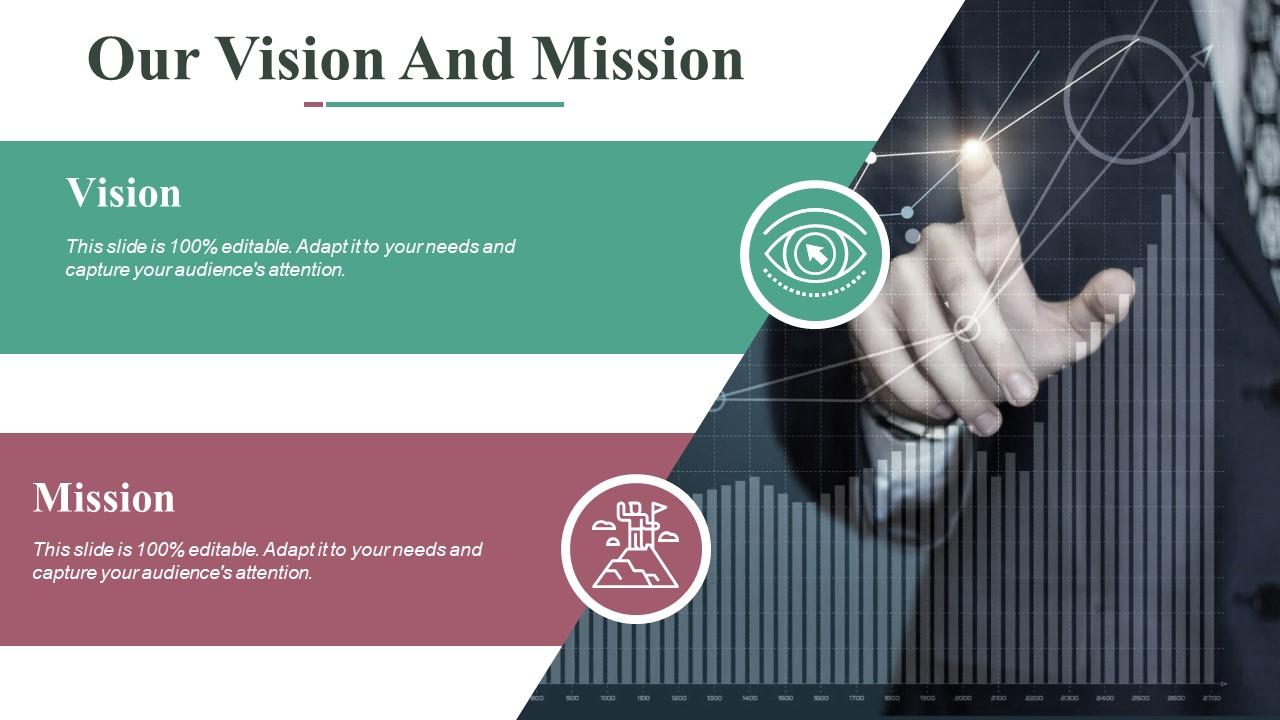
Vision and mission statements define your business purpose. Keeping this view point in mind our team of designers have crafted this our vision and mission PPT professional PowerPoint template. Matching icons with image and text boxes has been used while designing this our vision and mission Presentation visual. Your team can make full use of our vision and mission Presentation slideshow for improving the day to day business functions and processes. Our vision and mission PowerPoint slideshow can help in uplifting your team and managers so that they can focus on their future goals and targets. Vision statements guide decision making, they inform customers about what the business stands for and what they can expect as a customer. Mission statements serve as a guide for all of the company's decision-making. Shareholders, leaders and employees are generally the target of the mission. Insert the slide now and modify as per your need. Display a fine balance with our Our Vision And Mission Ppt Professional Slideshow. Decide after considering all arguments.
People who downloaded this PowerPoint presentation also viewed the following :
Our vision and mission ppt professional slideshow with all 5 slides:
Elaborate on the benefits of exploration with our Our Vision And Mission Ppt Professional Slideshow. Focus on the contribution of intrepid individuals.
FAQs for Our vision and mission
Think about where you want to be in 5-10 years and make it inspiring. Keep it short though - like one or two sentences max, otherwise you'll lose people. Make it specific enough that your team can actually picture it, but don't box yourself in completely. The good ones get employees pumped up and show customers what you're working toward. Oh, and definitely run it by your team first - if they don't get excited about it, back to the drawing board. Your vision should reflect what makes you different and your core values. I've seen too many generic ones that could apply to literally any company.
Okay so basically your values are like the "how" and your mission is the "what" - they need to work together. If innovation matters to you, that forward-thinking vibe should show up in your mission too. Here's what I'd do: grab your current mission statement and put your values list right next to it. See the gaps? That's where you bridge things. Every word should connect back to something you actually care about. Like, if you can't trace a phrase back to your values, maybe it doesn't belong there. Does that make sense? It's honestly pretty straightforward once you map it out.
Okay so mission vs vision - I always think of it like this: mission is what you're doing right now, vision is where you're headed. Your mission answers "what do we actually do today?" It's super concrete - like how you help customers or what problem you solve. Vision is more like "where do we want to end up?" That's your big picture dream. Most companies I've seen totally blur these together and end up with generic fluff that says nothing. Don't do that lol. Just keep mission grounded in reality and let vision be aspirational. Mission = present, vision = future. Pretty straightforward once you think about it that way.
Look, most companies do this every 3-5 years or when big stuff happens - new markets, leadership shake-ups, whatever. I've totally seen places ignore theirs for like a decade then act shocked when everyone's checked out. Does yours still feel real? Can people actually use it to make decisions? Then you're good. But if it reads like generic corporate nonsense or doesn't match where you're going, time for an update. Oh and do a quick quarterly gut-check - "does this still make sense?" Easy way to catch drift early.
So your vision and mission statements are basically like your company's personality guide. They show people what matters and how to act at work. But here's the thing - most places just stick them on a wall and call it a day. That's useless. You've gotta actually bring them up in meetings, use them when you're hiring, and reference them during reviews. When done right, they attract the right people and help everyone make better decisions. Short version: they're only as good as how much you actually use them day-to-day.
Make it about them, not some abstract company BS. Connect their actual job to the bigger picture - show how what they do matters. Skip the buzzwords (seriously, "synergistic excellence" makes people's eyes roll). Tell real stories instead. Put it everywhere - walls, meetings, reviews. But here's the thing that actually matters: your managers have to live it. If leadership's just going through the motions, everyone sees that fake stuff immediately. Keep hammering the message consistently. All-hands meetings help too. Basically make it feel real instead of corporate decoration nobody cares about.
Your vision and mission are like having a GPS for big decisions - they stop you from getting distracted by every cool idea that pops up. I've seen so many companies chase random opportunities just because they seemed profitable. Test everything against these statements first. Does this new strategy actually fit what we're trying to become? Your mission covers why you exist right now, vision is where you're headed. Honestly, if something doesn't support either one, just skip it. They're basically filters that'll save you from wasting time on stuff that doesn't matter.
Honestly, people just breeze right past big text blocks these days. Visuals actually stick in your head though. Try infographics for breaking down concepts, or use icons for your core values. Some companies do cool timeline graphics showing their journey - that stuff works way better than paragraphs. Just make sure the visuals aren't there for decoration, you know? They should actually help explain your points. Oh, and definitely test it with your team first to see if they understand it quicker than reading would be.
The worst thing you can do? Write something vague like "we want to be the best." Best at what exactly? Also please stop with the buzzword overload - I've seen mission statements that sound like they were written by a corporate robot having a fever dream. Don't make it a novel either. If your team can't remember it, what's the point? Oh, and trying to make everyone happy usually means you end up saying nothing meaningful. Make sure it actually reflects what you do. Test it out - have people repeat it back to you in their own words.
Your vision and mission statements are honestly like having a roadmap that everyone can actually follow. They help investors, employees, and customers figure out if they're on the same page as you. When people can see where you're going and why you exist, they get emotionally invested - which is huge for buy-in. The trick is making sure your statements aren't just corporate fluff (we've all seen those). Keep referring back to them when you make decisions. Oh, and they need to actually match what you do day-to-day, otherwise people will see right through it.
So you basically need to track stuff both inside and outside your company. Employee engagement scores, retention rates - and honestly, quiz people on your actual mission statement because it's wild how many employees have zero clue what it is. For external stuff, check customer loyalty and brand perception surveys. Social media sentiment tells you a lot too. Don't just do random one-off surveys though. Get your baseline numbers this quarter, then track every six months. The consistency is what actually matters here.
Honestly, I'd say every 2-3 years or whenever your industry gets turned upside down. Netflix is a perfect example - they stuck with entertainment as their core mission but ditched the whole DVD thing for streaming when they had to. Don't completely gut it though, that's overkill. Check if your customers want different things now compared to when you wrote it originally. Maybe your wording sounds outdated or you need broader scope for new opportunities. Keep your "why" but tweak the "how." Set up quarterly team check-ins so you'll catch when something feels off before it becomes a real problem.
Honestly, most mission statements end up being fancy wall decorations that nobody remembers. Make yours actually matter by bringing it up in meetings - like literally asking "does this fit our mission?" when deciding stuff. Connect it to performance reviews and daily work too. I've worked places where people couldn't even tell you what the company mission was if you asked! Train your managers to tie regular tasks back to the bigger picture. Oh, and celebrate wins that show your values in action. Maybe start small - pick one project and map out how it serves your mission. That'll prove it's not just corporate BS.
Dude, forget those dusty mission statement posters nobody reads. Apps and digital dashboards actually work way better for keeping your vision visible. I'd pick maybe 2-3 tools your team uses every day - like Slack or whatever internal system you have - and just weave it into those naturally. Quick video messages hit different too. The cool part? You can actually track if people are absorbing it through surveys and pulse checks. Most companies skip that step completely, which is wild to me. Email campaigns work for reinforcement, but honestly the key is just being consistent wherever your people already spend their time.
Look at Disney - they actually live by "making people happy" in everything from how they train staff to designing rides. Patagonia's so committed to their environmental thing that they literally tell customers not to buy stuff unless you really need it (kinda crazy but I respect it). Tesla went way beyond just cars because of their whole sustainable transport vision - now they're doing solar panels and batteries too. The companies that really get it don't just hang their mission statement on the wall and call it a day. They use it to make actual decisions. Next time you're shopping, notice how brands act versus what they claim - you'll see who's legit pretty quickly.
-
Best Representation of topics, really appreciable.
-
Awesome presentation, really professional and easy to edit.