

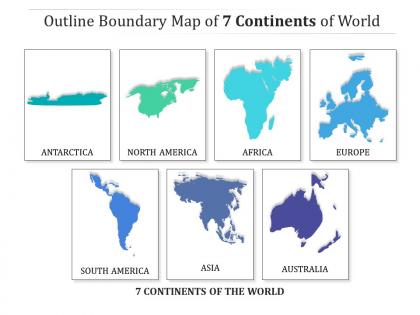
Outline boundary map of 7 continents of world




Try Before you Buy Download Free Sample Product
 Impress Your
 Audience
 100%
100% Editable
 Save Hours
 of Time


Our Outline Boundary Map Of 7 Continents Of World are topically designed to provide an attractive backdrop to any subject. Use them to look like a presentation pro.
People who downloaded this PowerPoint presentation also viewed the following :
Outline boundary map of 7 continents of world with all 2 slides:
Use our Outline Boundary Map Of 7 Continents Of World to effectively help you save your valuable time. They are readymade to fit into any presentation structure.
FAQs for Outline boundary map of 7
Okay so basically each continent has its own shape that's pretty easy to recognize. Africa's got that narrow bottom part, and South America looks like an upside-down triangle. North America is way broader up top - you can usually spot the Great Lakes area too. Europe and Asia are technically connected (which is kinda weird when you think about it), but Europe has all those jagged coastlines. Australia's obviously the island one. Antarctica just sits there at the bottom looking like a white mess. My advice? Look at the overall shape first, then check for stuff like peninsulas to double-check which one you're looking at.
Maps used to be hilariously wrong - like those medieval ones with Jerusalem at the center and only three continents. Coastlines were basically guesswork back then. The Mercator projection from 1569 stuck around forever but makes Greenland look massive compared to Africa, which is wild when you realize how wrong that is. New continents kept popping up on maps as people explored more - Australia, Antarctica, you name it. Different projection methods now show way more accurate sizes and relationships between continents. Honestly, just check what projection your world map uses next time. It'll totally change how you see everything.
So there's basically three main ones you'll run into: Mercator, Robinson, and Equal Area. Mercator's perfect for navigation since it keeps shapes accurate, but wow does it mess up sizes - like Greenland looks huge when it's tiny compared to Africa. Robinson's kind of the middle ground option, which is probably why most atlases use it. Then Equal Area keeps continent sizes right but makes everything look weird and stretched out. Honestly though, every world map sucks in some way because you're basically trying to wrap a basketball with a piece of paper. Just pick whatever works best for what you need it for.
Yeah, geography definitely shapes continental boundaries but it gets pretty messy. The Ural Mountains split Europe from Asia, which makes sense. Then you've got the Suez Canal artificially cutting Africa from Asia. Ocean boundaries seem straightforward until you hit Australia vs. Oceania - all those Pacific islands make it confusing as hell. Here's the weird part though: political stuff often trumps geography. Russia technically spans two continents but we still think of it as European culturally. Honestly, if you're mapping geopolitical anything, double-check whether you're using geographic, cultural, or political definitions because they don't line up.
So basically, continents are like huge weather machines. They block air currents, redirect them, create totally different patterns everywhere. Mountains like the Himalayas? They literally act as walls that stop weather systems cold. Then you've got how land heats up and cools down so differently from water - that's what gives you monsoons and crazy temperature changes between seasons. Oh, and continental positioning is why some places end up as deserts while others become rainforests. The Sahara messes with weather patterns for thousands of miles downwind, which is honestly kind of insane when you think about it. Start with the continent layout if you're trying to figure out any region's weather.
Yeah, definitely use a world map as your starting point! Geographic isolation is basically why we have such crazy different species everywhere - like Australia's weird marsupials vs Africa's totally different animals. Mountains, oceans, and climate zones all shaped how things evolved over millions of years. You'll spot the major hotspots right away: Amazon, Madagascar, Southeast Asia. Honestly, once you overlay a biodiversity map with a regular continents map, the patterns just click. It's wild how much geography explains where species ended up.
So basically, Asia has like 60% of all people but way less wealth per person - it's kinda crazy when you think about it. Europe and North America? They consume WAY more resources than their population size would suggest. Meanwhile Africa's population is exploding but their infrastructure can't handle distributing stuff effectively. Trade policies and climate talks get super messy because having more people doesn't equal having more power globally. Honestly made me realize how backwards some things are. This uneven spread affects literally every supply chain decision you'll see.
Oh man, the language thing is crazy when you look at it globally. Africa's got like 2,000+ languages - that's insane. Asia's probably the most diverse overall though, with everything from Mandarin to Hindi to Arabic scripts. Europe's more clustered around those big families like Romance and Germanic. The Americas are interesting because you see all this colonial influence mixed with indigenous stuff, though honestly a lot of native languages got wiped out which sucks. Australia and Oceania have their own unique Aboriginal cultures plus Pacific Islander traditions. Definitely look up communication styles before diving into any global project - trust me on that one.
So basically, tectonic plates are like giant puzzle pieces that won't stay put. They're constantly bumping into each other and creating mountain ranges - the Himalayas are a perfect example. Sometimes they drift apart instead, which is how Africa and South America ended up on opposite sides of the Atlantic. It's honestly mind-blowing that Antarctica used to be this lush, tropical place before it wandered down south. The continents are still moving too, just super slowly at like 2-10 cm per year. That's why fossil records match up in weird places across oceans.
So trade routes basically show you how continents actually connect - they always took the easiest path possible. The Silk Road went straight across that huge Eurasian landmass. Ships sailed around Africa instead of crossing the Sahara (obviously). The Mediterranean became super important because Europe, Asia, and Africa almost meet there. Pacific traders used island chains and ocean currents like natural highways - pretty smart if you ask me. Next time you're looking at a world map, just trace those old routes. They're literally the most efficient ways to get between continents geographically.
Honestly, world maps are great for teaching geography basics. Kids love the visual stuff way more than boring textbook paragraphs - makes sense, right? You can cover everything from simple continent names to complex topics like climate patterns and migration routes. The cross-curricular possibilities are endless too. History, science, social studies - it all connects through geography. My advice? Get a huge wall map that students can actually touch and point to. Way better than those tiny textbook versions. Makes the whole thing more interactive and keeps them engaged.
Honestly, interactive maps are a game changer for exploring continents. You can layer different data sets - population, climate, economics - and actually see how they connect. Way better than staring at some boring static map. The coolest part? You'll zoom from the big picture down to specific regions, use sliders to compare different time periods, or just click around for detailed stats. I always start with population overlays since they're usually the most surprising - really shows you how people actually live across different continents. Plus there's something oddly satisfying about toggling between all the layers.
Dude, just look at any map from the 70s vs now - it's crazy how much gray concrete has taken over. Cities have basically eaten up farmland and forests, especially along coasts and rivers. North America and Asia got hit the hardest. You can literally trace highways spreading out like veins from major cities, chopping up ecosystems. I was looking at satellite pics of Phoenix last week and couldn't believe how much desert it swallowed. Transportation networks completely changed how water flows too. Pull up Google Earth sometime and compare historical imagery - the sprawl will genuinely shock you.
Okay so satellite images are basically like getting the live feed of what's actually happening on continents right now. Traditional maps? They're good for borders and city names, but they can't show you real-time weather or how cities are expanding. With satellites you see deforestation, seasonal changes, all that stuff as it's happening. Honestly the detail from space is pretty insane these days. Maps are still useful for navigation obviously, but if you want the full picture of how continental geography actually looks and changes, satellites win hands down. Try using both together - way better results.
Honestly, those continent maps are pretty clutch for environmental stuff. You can track how climate change hits different regions and see migration paths for endangered animals. The pollution tracking between continents is wild too - really shows how connected everything is. I use them all the time to spot biodiversity hotspots and figure out where countries need to work together on conservation. Like, deforestation in South America totally screws with global carbon levels. Interactive ones are way better though - you can layer all the environmental data on top instead of just staring at basic geography.
No Reviews