Partner relationship management optimizing sales using pipeline management funnel
Try Before you Buy Download Free Sample Product
Audience
Editable
of Time
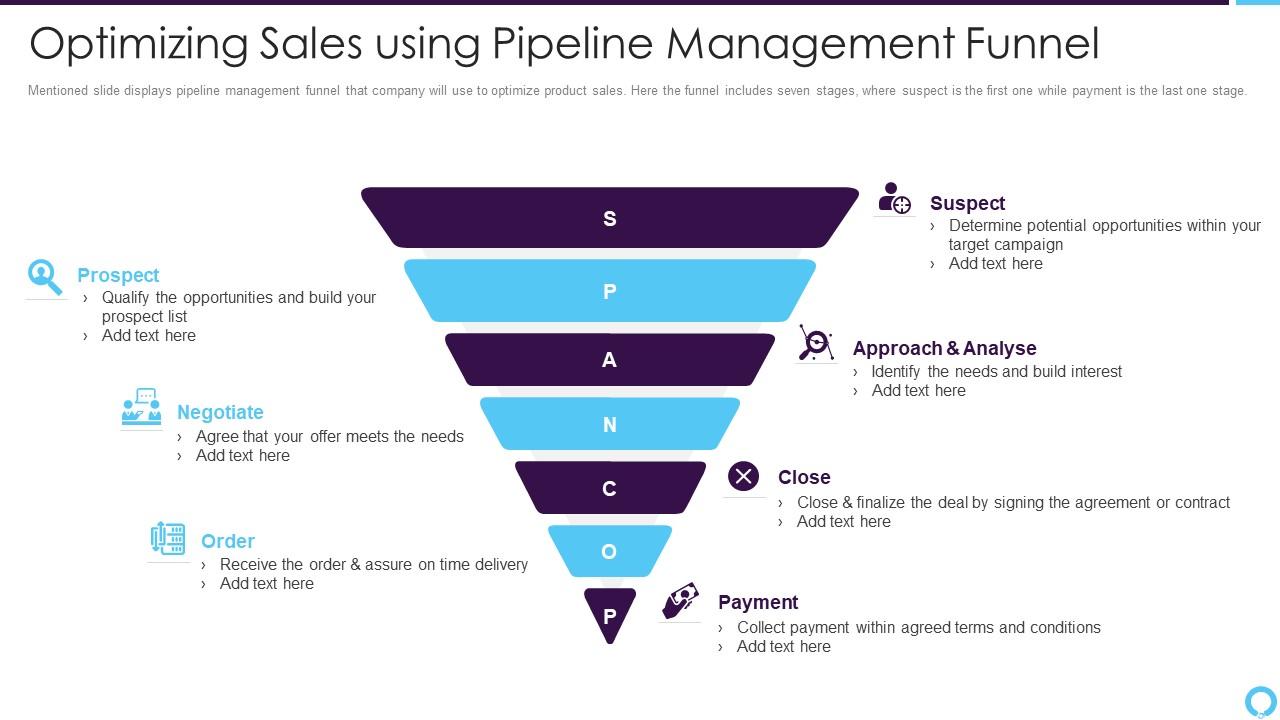
Mentioned slide displays pipeline management funnel that company will use to optimize product sales. Here the funnel includes seven stages, where suspect is the first one while payment is the last one stage.
People who downloaded this PowerPoint presentation also viewed the following :
Partner relationship management optimizing sales using pipeline management funnel with all 6 slides:
Use our Partner Relationship Management Optimizing Sales Using Pipeline Management Funnel to effectively help you save your valuable time. They are readymade to fit into any presentation structure.
FAQs for Partner relationship management optimizing sales using
Effective PRM strategies include partner onboarding and training, performance tracking and analytics, communication platforms, resource sharing systems, and incentive management programs. These components work together by streamlining collaboration, enhancing partner enablement, and providing real-time visibility into partnership performance, with many organizations finding that integrated PRM approaches deliver stronger partner engagement and accelerated revenue growth.
Organizations measure PRM success through partner engagement metrics, sales performance indicators, channel revenue growth, partner satisfaction scores, and time-to-productivity for new partners. Through comprehensive analytics dashboards, companies track partner certification rates, deal registration volumes, and joint marketing campaign effectiveness, while monitoring support ticket resolution times and partner portal usage, ultimately delivering improved channel performance and stronger strategic partnerships.
Technology revolutionizes Partner Relationship Management by automating communications, centralizing partner data, streamlining onboarding processes, and providing real-time performance analytics. These digital solutions enable organizations to deliver personalized partner experiences, accelerate deal registrations, and enhance collaboration across multiple channels, ultimately strengthening partnerships while reducing operational costs and improving revenue visibility.
PRM systems facilitate better communication by providing centralized messaging platforms, real-time collaboration tools, automated notifications, shared document repositories, and integrated feedback mechanisms. Through these streamlined channels, organizations enhance partner engagement, reduce response times, and improve project coordination, with many businesses finding that consistent communication ultimately delivers stronger partnerships and accelerated market expansion.
Companies should establish clear communication protocols, provide comprehensive training materials, define mutual expectations and goals, implement structured milestone tracking, and assign dedicated relationship managers. Through systematic onboarding processes, organizations streamline partner integration, accelerate time-to-market for joint initiatives, and minimize operational friction, with many finding that early investment in structured onboarding ultimately delivers stronger partnerships and improved collaborative outcomes.
Organizations ensure alignment of goals and objectives with their partners through regular strategic planning sessions, collaborative goal-setting frameworks, shared performance metrics, and transparent communication channels. These approaches streamline partnership effectiveness by establishing mutual accountability, creating unified roadmaps, and enabling continuous feedback loops, with many companies finding that structured alignment processes ultimately deliver enhanced operational efficiency and competitive advantage in increasingly complex market environments.
Companies face challenges including inconsistent communication, misaligned goals, lack of visibility into partner performance, inadequate onboarding processes, and conflicting priorities across different partnership tiers. These obstacles can be overcome through centralized partner portals, regular performance reviews, clear SLA frameworks, and automated communication workflows, with many organizations finding that strategic partner relationship management platforms ultimately streamline collaboration and enhance mutual profitability.
Partner Relationship Management enhances customer satisfaction by ensuring consistent service delivery, streamlined support processes, and expanded solution offerings across all partner touchpoints. Through effective PRM systems, organizations deliver faster problem resolution, improved product availability, and seamless customer experiences, with many businesses finding that stronger partner relationships ultimately translate into higher customer retention and increased loyalty.
Effective partner metrics include revenue contribution, lead generation quality, sales conversion rates, time-to-market acceleration, and customer satisfaction scores from joint initiatives. These performance indicators streamline relationship management by identifying top contributors, optimizing resource allocation, and enhancing collaboration strategies, with many organizations finding that comprehensive tracking ultimately delivers stronger partnerships and competitive advantage.
Businesses can leverage data analytics to enhance PRM strategies by analyzing partner performance metrics, identifying collaboration patterns, predicting partnership opportunities, and optimizing resource allocation across relationships. Through advanced analytics platforms, organizations streamline partner onboarding, enhance communication effectiveness, and deliver targeted support programs, with many companies finding that data-driven insights ultimately accelerate partnership growth and competitive advantage.
Partner Relationship Management focuses on managing business-to-business partnerships, joint ventures, and channel relationships, while traditional Customer Relationship Management centers on direct customer interactions and sales processes. PRM emphasizes collaborative revenue generation, shared resources, and mutual business outcomes, whereas CRM prioritizes customer acquisition, retention, and service delivery, with many organizations finding that PRM requires deeper strategic alignment.
Companies create and sustain partner engagement through PRM by providing comprehensive training resources, real-time performance analytics, collaborative communication tools, and streamlined onboarding processes. These platforms enable partners to access marketing materials, track sales progress, and receive ongoing support, with many organizations finding that integrated PRM systems ultimately deliver stronger partner loyalty and increased revenue growth.
Training and support serve as foundational pillars in successful PRM programs, encompassing partner onboarding, product education, sales enablement, technical certification, and ongoing skill development. These comprehensive programs enhance partner competency, accelerate time-to-market, and strengthen channel relationships, with many organizations finding that well-trained partners generate significantly higher revenue and customer satisfaction rates.
Partner feedback can be effectively gathered through regular surveys, dedicated partner portals, quarterly business reviews, direct account management touchpoints, and automated feedback loops within PRM systems. These mechanisms enable organizations to systematically collect insights on program effectiveness, support quality, and market opportunities, while implementing changes that strengthen relationships, optimize processes, and ultimately drive mutual growth and competitive advantage.
Businesses can resolve partner conflicts through open communication channels, structured mediation processes, clearly defined escalation procedures, regular performance reviews, and mutually agreed dispute resolution frameworks. These strategies enhance relationship transparency and trust, with many organizations in sectors like technology partnerships and retail alliances finding that proactive conflict management ultimately delivers stronger collaborations and sustained competitive advantage.
-
Great designs, really helpful.
-
Great product with effective design. Helped a lot in our corporate presentations. Easy to edit and stunning visuals.