


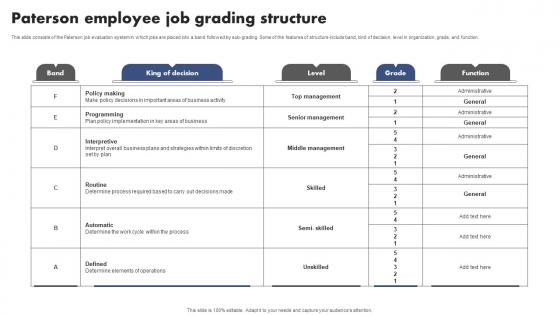
Paterson Employee Job Grading Structure




Try Before you Buy Download Free Sample Product
 Impress Your
 Audience
 100%
100% Editable
 Save Hours
 of Time


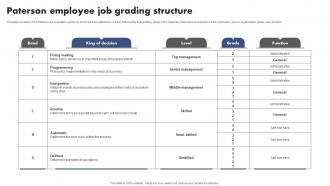
This slide consists of the Paterson job evaluation system in which jobs are placed into a band followed by sub grading. Some of the features of structure include band, kind of decision, level in organization, grade, and function.
People who downloaded this PowerPoint presentation also viewed the following :
Paterson Employee Job Grading Structure with all 6 slides:
Use our Paterson Employee Job Grading Structure to effectively help you save your valuable time. They are readymade to fit into any presentation structure.





FAQs for Paterson Employee
So there's a few big things they look at - skill level and how much responsibility you have are the main ones. Education requirements matter too, plus how much experience they want and whether you're making big decisions. Honestly, some places still factor in working conditions but that's mostly just manufacturing jobs these days. Budget oversight is huge - if you're managing money, that bumps you up. Same with supervising people or needing really specialized knowledge. My advice? Figure out what actually drives value at your company first, then build around that. Every place is different.
So job grading basically sets up consistent rules for how you evaluate different roles - like looking at skills needed, responsibilities, decision-making power, that kind of stuff. Way better than just winging it or playing favorites. You know how some people are just really good at asking for raises? This stops that from being the main factor. Similar jobs get similar pay no matter who's doing them, which helps close those annoying gender and racial pay gaps. Honestly, I'd start by looking at what you've got now and seeing where things don't make sense. It's pretty eye-opening usually.
So there's a few main ways companies do this. Point-factor systems are probably your best bet - you score jobs on things like skill level, responsibility, working conditions. Makes it feel less arbitrary when people complain later (and trust me, they will). Job ranking is simpler but kinda crude - just ranking positions from lowest to highest. Then there's job classification where you slot roles into predetermined grades. Some places do factor comparison or market-based stuff too. Honestly? Start with point-factor if you're building from scratch. It's flexible and you can actually defend your decisions.
Honestly, job grading is huge for motivation - it's all about whether people think they're being treated fairly. Clear, consistent systems work great because employees actually understand their path forward. But man, when it's confusing or feels random? People check out fast. Your team wants to know where they stand, period. Plus it helps with internal equity - you don't want someone doing the same work as their colleague but getting paid way less. Just make sure everyone gets how the system works and actually review it sometimes to catch any weird gaps.
Honestly, the hardest part is convincing managers their jobs aren't as unique as they think - most roles have way more overlap than people realize. Documentation becomes a nightmare because you're asking departments to write down what they actually do, not the fantasy version. Pay gaps will smack you in the face once everything's laid out clearly. Politics get messy fast when someone's "senior" title doesn't match their grade. Oh, and the upfront time investment is brutal. Start with just one department first. Trust me on this - work out all the problems before going company-wide or you'll hate your life.
Most places do it once a year, but honestly? That's way too slow if roles are changing fast or people keep quitting. I'd set up those annual calendar reminders but also jump in mid-year when something feels weird. Market shifts, big org changes, role evolution - all good reasons to revisit grades early. Start with wherever you're bleeding talent first, that'll give you the biggest bang. Sometimes I feel like HR moves at glacial speed with this stuff, but retention issues don't wait for your review cycle. Quick benchmark checks can save you from getting totally out of sync with what people actually make elsewhere.
Honestly, get some HR software that does job evaluation - it'll save you so much time. Instead of building spreadsheets all day, these platforms automatically pull compensation data and compare it to market rates. Most have AI features that suggest grade levels based on what the role actually does. The best part? No more random bias creeping into decisions. I mean, we've all been there with inconsistent grading. Start with basic HRIS software that has evaluation modules built in. Way more defensible than whatever manual process you're probably using now, and it standardizes everything.
So job grading is basically your company's way of mapping out career paths. Think of it like levels in a video game - each grade has different responsibilities and pay ranges. You can see exactly what you need to hit to move up from where you are now. Managers use these grades to decide on promotions (and honestly, it keeps people from trying to skip like three levels). For you, it means you'll know what skills or experience to focus on. Definitely worth checking out your company's framework to see what the next tier looks like for your specific role.
Your job description is literally everything when it comes to grading. Evaluators base their scoring on what's written there - problem-solving requirements, accountability levels, all of it. I can't tell you how many times I've seen grades get totally screwed because someone submitted an outdated or super vague JD. Before you send it off, really look at whether it captures the actual day-to-day work. Does it show the decision-making authority? The complexity? Required skills? Because if the grading panel can't see what the role actually involves from reading it, you're gonna get a grade that doesn't match reality.
Honestly, job grading is a game changer for keeping people around. You can actually show employees where they stand and what comes next - way better than leaving them guessing. People love having a clear path forward, you know? Plus recruiting gets easier because you'll know exactly what to offer without throwing random numbers around. The transparency part is huge though. Don't keep your grading system secret or people will just assume you're playing favorites. When everyone understands how promotions and pay work, everything runs smoother.
Dude, misclassification is no joke - you can get absolutely hammered on wage and hour stuff. Companies I know have paid out millions in back overtime when they wrongly called people exempt. Honestly, the lawsuits pile up fast. You'll also deal with discrimination claims if your classifications look sketchy across different groups. Don't forget about benefits eligibility issues and workers' comp problems too. My advice? Document everything about why you classified someone a certain way. Have legal review the tricky cases - trust me on this one.
Just be totally upfront about everything from day one. Post your grading framework somewhere everyone can see it - the factors, point system, who makes decisions, all of it. The whole secretive thing? Yeah, that just makes people paranoid and starts office gossip. Keep docs accessible and actually tell people when stuff changes. Set up an appeals process too so they can fight grades they think are BS. Oh, and train your managers properly - they need to explain this stuff clearly when people ask questions. That conversation is honestly make-or-break for the whole transparency thing.
So job grading is basically ranking positions with numbers - like Grade 5 or Level 8. It's super detailed and focuses on hierarchy. Job classification groups similar roles together into families, like "Administrative Support" or "Engineering." Way broader approach. Grading's better when you need precise pay scales. Classification helps with career paths and org structure. Some companies mix both systems though, which honestly gets messy fast. If you're building something new, figure out what you need first. Want detailed pay differences? Go grading. Need clearer job families? Classification's your friend.
Look, the market basically drags your pay grades around whether you like it or not. Software engineers jump 20% overnight? Your Grade 5 people suddenly need to be Grade 7 or they're gone. Talent shortages, economic weirdness, industry shifts - it all messes with your carefully planned grade bands. Companies I know have torn apart their whole grading system after hemorrhaging people to competitors. Pretty brutal honestly. You've gotta keep checking what everyone else pays, especially for those hot roles. When the market moves fast, you better move with it or you'll be hiring nobody.
Honestly, just put everything out there from the start - no one likes surprises with this stuff. Write up something simple explaining the grades, salary ranges, what gets you promoted. Host those Q&A sessions because otherwise people will literally corner you by the coffee machine (learned that one the hard way). Your managers need to actually understand the system too, not just you. Oh, and make a quick reference sheet employees can check whenever. Short sentences work better than walls of text. Update everyone when things change - don't let them find out through gossip.
-
Great quality product.
-
“I really like the convenient operation and professionalism I saw on the SlideTeam website. I want to express my regards and appreciation to the team.”