Payroll Process Flowchart Diagram Of Company

Rating:
80%
Payroll Process Flowchart Diagram Of Company Payroll Process Flowchart Diagram Of Company
Slide 1 of 6

or

Favourites Favourites

Try Before you Buy Download Free Sample Product

Audience Impress Your
Audience
Editable 100%
Editable
Time Save Hours
of Time
The Biggest Sale is ending soon in
0
0
:
0
0
:
0
0
Rating:
80%
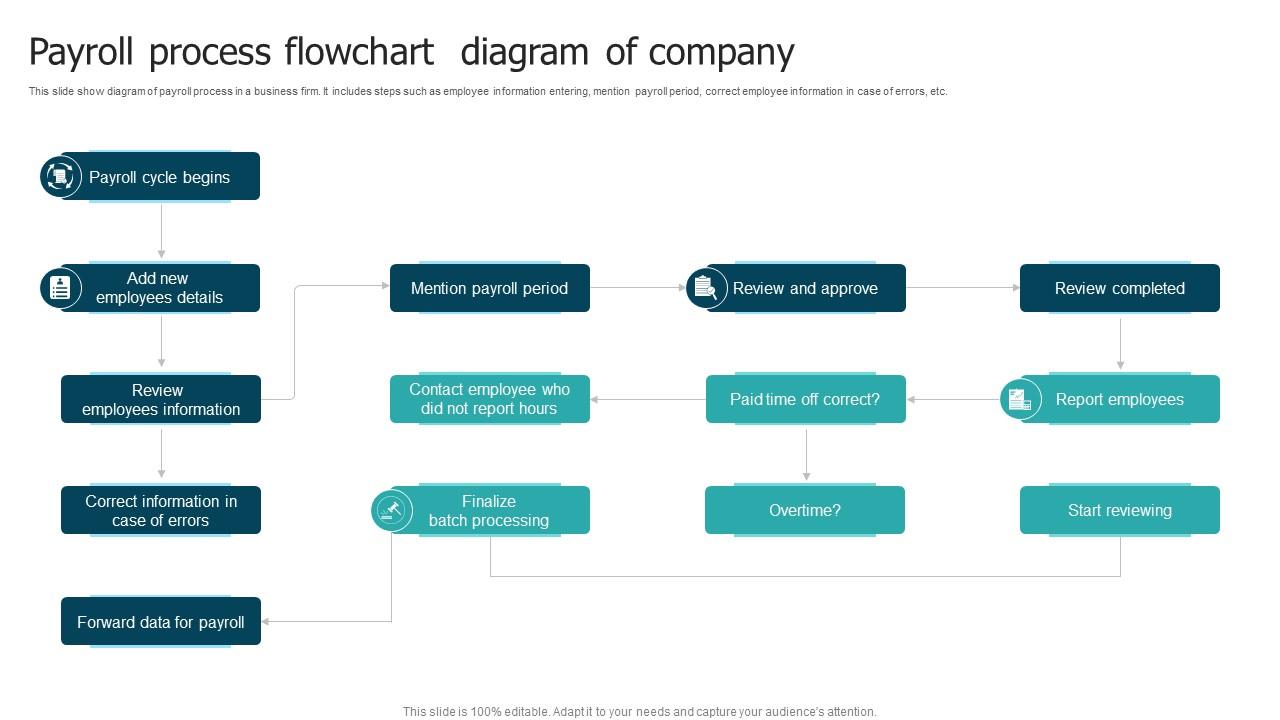
This slide show diagram of payroll process in a business firm. It includes steps such as employee information entering, mention payroll period, correct employee information in case of errors, etc. Introducing our premium set of slides with Payroll Process Flowchart Diagram Of Company. Ellicudate the five stages and present information using this PPT slide. This is a completely adaptable PowerPoint template design that can be used to interpret topics like Payroll Period, Review, Employees Information Data. So download instantly and tailor it with your information.

FAQs for Payroll Process Flowchart

A comprehensive payroll process flowchart should include employee data collection, time tracking verification, gross pay calculation, deductions processing, tax withholdings, and final payment distribution. These components work together by streamlining administrative workflows, ensuring compliance accuracy, and minimizing processing errors, with many organizations finding that well-structured flowcharts reduce payroll cycle times while enhancing transparency across departments.

A well-structured payroll process flowchart enhances organizational efficiency by standardizing workflows, reducing manual errors, and streamlining compliance procedures. Through clear visual documentation, HR teams accelerate processing times, minimize costly mistakes, and ensure consistent regulatory adherence, with many organizations finding that structured payroll systems ultimately deliver faster employee payments and improved operational transparency.

Software tools for payroll process flowcharts include Microsoft Visio, Lucidchart, Draw.io, SmartDraw, and Creately, each offering specialized templates and HR-focused symbols. These platforms streamline documentation by providing drag-and-drop functionality, real-time collaboration, and integration capabilities, with many organizations finding that visual process mapping enhances compliance tracking and operational efficiency.

Payroll process flowcharts should be reviewed quarterly and updated whenever regulatory changes, system upgrades, or organizational restructuring occurs. Regular reviews enable organizations to maintain compliance with evolving tax laws, streamline operational efficiency, and minimize processing errors, with many companies finding that proactive updates reduce audit risks and enhance payroll accuracy.

Common challenges include ensuring regulatory compliance across jurisdictions, integrating multiple data sources, accommodating diverse employee types, managing approval workflows, and handling exception scenarios like overtime calculations. These complexities require careful mapping of interconnected processes, with many organizations finding that balancing comprehensive coverage with visual clarity presents ongoing difficulties, ultimately demanding iterative refinement to achieve both accuracy and usability.

Business structures significantly influence payroll flowcharts through varying compliance requirements, tax obligations, employee classifications, and reporting procedures, with corporations requiring more complex approval hierarchies than sole proprietorships. These structural differences streamline workflows by determining deduction calculations, benefits administration, and regulatory documentation, ultimately enabling organizations to customize their payroll processes for operational efficiency and compliance accuracy.

Compliance and regulatory considerations can be integrated by incorporating tax calculation checkpoints, labor law verification steps, audit trail documentation, and regulatory reporting milestones throughout each payroll stage. These compliance touchpoints streamline adherence to federal, state, and local requirements while automating regulatory updates, ultimately reducing compliance risks and enabling organizations to maintain accurate records while delivering efficient payroll operations.

Technology streamlines payroll processes by automating data collection, calculations, tax computations, and compliance reporting while reducing manual errors and processing time. Through integrated HRIS systems, cloud-based platforms, and automated workflows, organizations enhance accuracy, ensure regulatory compliance, and deliver faster payroll services, with many companies finding that digital transformation ultimately reduces costs and improves employee satisfaction.

Visual elements enhance payroll process flowchart clarity through color coding for different process stages, standardized symbols for actions and decisions, clear directional arrows, and consistent formatting throughout. These design choices streamline stakeholder understanding by minimizing interpretation time, reducing training requirements, and enabling quick identification of bottlenecks, ultimately delivering improved operational efficiency and faster onboarding across HR and finance teams.

**INPUT**: What training or resources are recommended to help employees understand the payroll process flowchart? **OUTPUT**: Effective payroll flowchart training includes interactive workshops, step-by-step documentation, video tutorials, role-specific guides, and hands-on system demonstrations. These resources enhance understanding by providing visual learning tools, practical scenarios, and departmental context, with many organizations finding that comprehensive training programs streamline payroll operations while reducing errors and improving employee confidence.

A payroll process flowchart helps troubleshoot discrepancies by providing visual step-by-step mapping of data flow, calculation points, and approval stages, enabling systematic identification of error sources. Through standardized workflow documentation, HR teams can quickly trace issues like incorrect deductions or timing mismatches, ultimately streamlining resolution processes and minimizing payroll errors across organizations.

Organizations can track metrics including processing time per payroll cycle, error rates in calculations, employee query resolution time, compliance audit results, and cost per payroll transaction. These measurements enable HR teams to identify bottlenecks, reduce manual errors, and streamline operations, with many companies finding that systematic tracking ultimately delivers improved accuracy, faster processing, and enhanced employee satisfaction.

Employee onboarding processes intersect with payroll workflows through data collection, system integration, verification steps, and compliance documentation that feed directly into payroll calculations and processing cycles. These intersections streamline administrative efficiency by automating tax withholdings, benefit enrollments, and salary configurations, with many HR departments finding that integrated onboarding-payroll flowcharts reduce processing errors and accelerate time-to-first-paycheck for new hires.

Payroll accuracy best practices include implementing dual verification systems, establishing clear approval hierarchies, conducting regular audit checkpoints, maintaining updated employee data repositories, and standardizing calculation methodologies across all pay categories. These systematic approaches streamline operations by minimizing human error, ensuring regulatory compliance, and enhancing data integrity, with many organizations finding that structured workflows ultimately deliver faster processing times and improved employee satisfaction.

Employee and HR feedback enhances payroll process flowcharts by identifying pain points, redundant steps, and areas requiring greater clarity or automation. Through regular surveys, focus groups, and process reviews, organizations can streamline workflows, reduce processing errors, and improve user experience, with many companies finding that incorporating frontline insights ultimately delivers faster payroll cycles and higher employee satisfaction.

Ratings and Reviews

80% of 100
Review Form
Write a review
Most Relevant Reviews
  1. 80%

    by Charlie Reed

    “I really like the convenient operation and professionalism I saw on the SlideTeam website. I want to express my regards and appreciation to the team.”
  2. 80%

    by Davis Gutierrez

    Easily Editable.

2 Item(s)

per page: