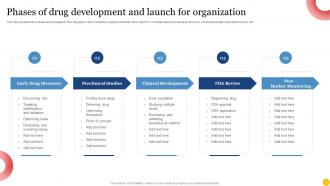
Phases Of Drug Development And Launch For Organization
Try Before you Buy Download Free Sample Product
Audience
Editable
of Time
The following slide showcases various stages of FDA drug approval for company to analyze potential risks in launch. It includes steps such as early discovery, preclinical studies, post market review, etc.
People who downloaded this PowerPoint presentation also viewed the following :
Phases Of Drug Development And Launch For Organization with all 6 slides:
Use our Phases Of Drug Development And Launch For Organization to effectively help you save your valuable time. They are readymade to fit into any presentation structure.
FAQs for Phases Of Drug Development And
The drug development process includes preclinical research, Phase I safety trials, Phase II efficacy studies, Phase III large-scale trials, and regulatory approval phases. These stages streamline pharmaceutical innovation by establishing safety profiles, determining optimal dosages, and demonstrating therapeutic effectiveness, with many biotechnology companies finding that structured development ultimately delivers faster market entry and enhanced patient outcomes.
Preclinical trials test drug safety and efficacy in laboratory settings using cell cultures and animal models, while clinical trials involve human participants across three phases to evaluate safety, dosage, and effectiveness. Through preclinical studies, pharmaceutical companies identify promising compounds and assess toxicity before human testing, ultimately streamlining the development process and minimizing risks when advancing to clinical phases.
Regulatory agencies oversee drug development by establishing safety and efficacy standards, reviewing clinical trial protocols, monitoring adverse events, and conducting comprehensive assessments at each phase milestone. Through agencies like FDA and EMA, pharmaceutical companies navigate structured approval pathways that ensure patient safety while streamlining market access, ultimately delivering safer therapeutics and competitive advantage.
Patient safety is assessed through rigorous monitoring protocols, adverse event reporting, dose-escalation studies, safety committees, and biomarker tracking across all development phases. Through systematic data collection and real-time analysis, pharmaceutical companies can identify safety signals early, adjust trial protocols, and ensure participant wellbeing, while regulatory bodies increasingly require comprehensive safety databases, ultimately delivering safer medications and faster approvals.
Common Phase I clinical trial challenges include patient recruitment difficulties, dose escalation safety concerns, adverse event monitoring complexities, regulatory compliance requirements, and limited efficacy data collection. These trials navigate uncertain safety profiles by carefully managing participant selection, implementing rigorous monitoring protocols, and maintaining regulatory transparency, with many pharmaceutical companies finding that robust Phase I design ultimately accelerates downstream development timelines.
Phase II trials shift focus from safety assessment to efficacy evaluation, featuring larger patient populations (100-300 participants), longer durations, and randomized controlled designs with placebo comparisons. While Phase I studies primarily determine safe dosing in healthy volunteers or small patient groups, Phase II trials target specific patient populations with the condition being treated, ultimately establishing whether the drug delivers therapeutic benefits and warrants advancement to larger Phase III studies.
**INPUT**: What factors determine the success rate of drugs entering Phase III trials? **OUTPUT**: Success rates for Phase III trials depend on robust Phase II data, clear regulatory guidance, appropriate patient selection criteria, and well-designed trial protocols. These factors work together by minimizing variables, ensuring statistical power, and addressing safety concerns, with pharmaceutical companies finding that thorough preclinical work and biomarker identification ultimately deliver higher approval rates and reduced development costs. [Word count: 58 words]
Biomarkers enhance drug development efficiency by enabling early efficacy assessment, identifying optimal patient populations, and reducing trial timelines through better endpoint measurement. Pharmaceutical companies leverage these biological indicators to streamline candidate selection, minimize late-stage failures, and accelerate regulatory approvals, with many organizations finding that biomarker-driven strategies significantly reduce development costs while improving success rates.
Placebos serve as critical control mechanisms in clinical trials by providing baseline comparisons against actual treatments, eliminating psychological bias, and ensuring statistical validity of results. Through blinded studies, pharmaceutical companies can accurately measure drug efficacy versus natural recovery rates, with many trials finding that placebo controls ultimately deliver more reliable data and regulatory approval confidence.
Adaptive trial designs significantly accelerate drug development timelines by allowing real-time modifications to protocols, sample sizes, and endpoints based on interim data analysis. These flexible approaches enable pharmaceutical companies to make faster go/no-go decisions, reduce patient exposure to ineffective treatments, and streamline regulatory pathways, ultimately delivering life-saving therapies to market months or years earlier than traditional fixed designs.
**INPUT**: What are the financial implications associated with each phase of drug development? **OUTPUT**: Drug development costs escalate dramatically through phases, with preclinical research requiring $10-15 million, Phase I trials $15-30 million, Phase II $40-80 million, and Phase III $100-300 million. These investments present both significant risk and opportunity, with pharmaceutical companies finding that successful Phase III completion delivers substantial competitive advantage and market positioning, ultimately enabling billion-dollar revenue streams.
Pharmaceutical companies prioritize drug development through market analysis, unmet medical need assessment, competitive landscape evaluation, regulatory pathway feasibility, and commercial potential analysis. These strategic considerations enable companies to allocate resources effectively, with many focusing on therapeutic areas like oncology, rare diseases, and chronic conditions that offer significant patient impact and revenue opportunities.
**INPUT**: What ethical considerations arise during the drug development process? **OUTPUT**: Ethical considerations in drug development include informed consent protocols, participant safety monitoring, equitable trial access, data transparency, and risk-benefit assessments throughout testing phases. These frameworks ensure patient protection while advancing medical innovation, with regulatory bodies like FDA and EMA requiring comprehensive ethical oversight, ultimately delivering safer therapeutics and maintaining public trust in pharmaceutical research.
Patient involvement in clinical trials enhances drug development by providing real-world safety data, efficacy measurements, and diverse population responses that regulatory agencies require for approval. Through direct participation, pharmaceutical companies gather comprehensive evidence on dosing, side effects, and therapeutic benefits across different demographics, ultimately accelerating the path to market while ensuring treatments deliver measurable outcomes for target patient populations.
Technological advancements shaping drug development include artificial intelligence for drug discovery, machine learning for clinical trial optimization, digital biomarkers for patient monitoring, blockchain for data integrity, and cloud computing for collaborative research. These technologies streamline phases by accelerating compound identification, enhancing patient recruitment, and improving data analysis, with pharmaceutical companies finding significantly reduced development timelines and costs.
-
Exclusive and extensive collection of templates. Really helped me create a professional presentation in just no time.
-
I came across many PowerPoint presentations with excellent creatives and I believe they would be beneficial to my work.