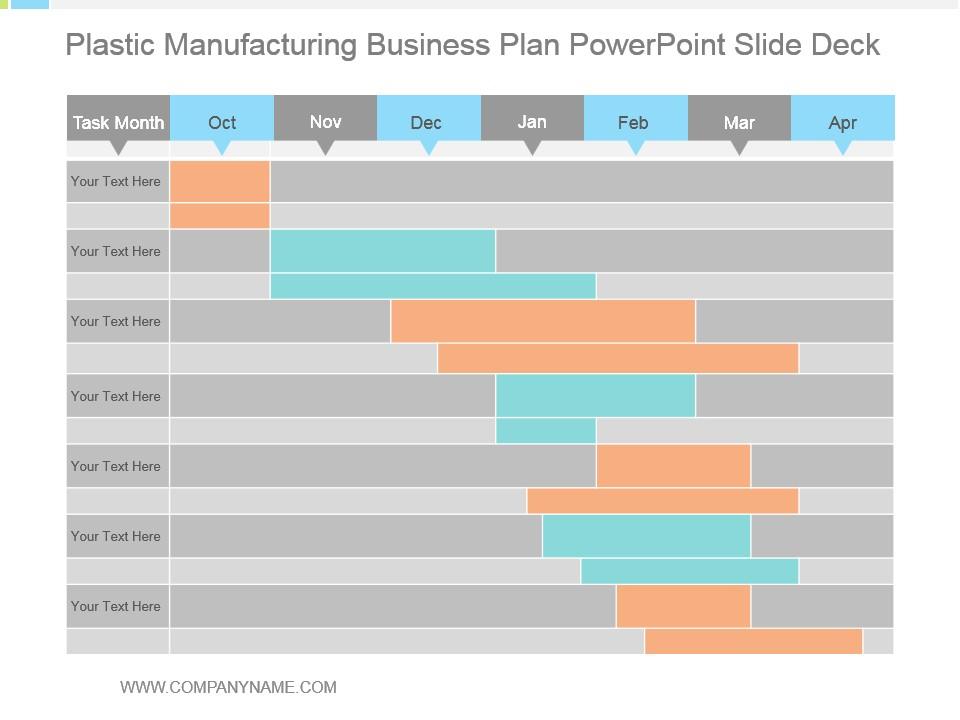
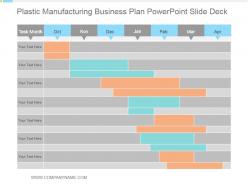
Plastic manufacturing business plan powerpoint slide deck
Try Before you Buy Download Free Sample Product
Audience
Editable
of Time
Get folks interested in honoring their commitments with our Plastic Manufacturing Business Plan Powerpoint Slide Deck. Discourage attempts to jilt.
People who downloaded this PowerPoint presentation also viewed the following :
Plastic manufacturing business plan powerpoint slide deck with all 5 slides:
Analyze flaws in the infrastructure with our Plastic Manufacturing Business Plan Powerpoint Slide Deck. Improve the degree of efficiency existing.
FAQs for Plastic manufacturing business plan
A successful plastic manufacturing business plan includes market analysis, production capacity planning, equipment specifications, regulatory compliance frameworks, and financial projections. These components work together by identifying target markets, determining optimal manufacturing processes, and ensuring scalability, with many manufacturers finding that detailed supplier relationships and quality control systems ultimately deliver operational efficiency and competitive advantage in increasingly demanding industrial markets.
Market research influences plastic manufacturing strategy by identifying customer needs, analyzing competitor pricing, evaluating market demand, and uncovering emerging opportunities in sectors like packaging, automotive, and medical devices. Through comprehensive market analysis, manufacturers can optimize product development, streamline production processes, and enhance resource allocation, ultimately delivering competitive advantages and improved operational efficiency in an increasingly dynamic marketplace.
Startups should focus on high-demand, low-competition plastic products like food packaging containers, automotive components, medical device parts, and custom injection-molded items for local businesses. These segments offer strong profit margins, recurring orders, and scalability opportunities, with many successful plastic manufacturers finding that specializing in 2-3 complementary product lines initially delivers sustainable growth and competitive positioning.
Manufacturing processes vary significantly across plastic types, with thermoplastics like polyethylene using injection molding and extrusion, while thermosets like epoxy require compression molding and curing processes. These distinct approaches enable manufacturers to optimize production efficiency, material properties, and cost structures, with automotive and packaging industries increasingly leveraging process-specific advantages to deliver enhanced product performance and competitive market positioning.
Initial capital investment for plastic manufacturing typically ranges from $500,000 to $2 million, depending on production scale, equipment specifications, facility requirements, raw material inventory, and regulatory compliance costs. While smaller operations can start with basic injection molding or extrusion equipment, larger facilities investing in advanced machinery and comprehensive production lines ultimately deliver greater operational efficiency and competitive advantage in increasingly diverse markets.
Sustainability has become critically important in plastic manufacturing, driven by regulatory pressures, consumer demand, environmental concerns, and competitive differentiation requirements. Companies increasingly adopt circular economy principles, bio-based materials, and advanced recycling technologies, with many manufacturers finding that sustainable practices reduce costs, enhance brand reputation, and deliver long-term operational advantages in today's environmentally conscious market.
New plastic manufacturers commonly face regulatory compliance complexities, high initial capital requirements for specialized equipment, raw material price volatility, environmental sustainability pressures, and establishing reliable supply chains. These challenges present both operational hurdles and strategic opportunities, with many successful manufacturers finding that early investment in sustainable technologies, strategic partnerships, and flexible production systems ultimately delivers competitive advantage in an increasingly environmentally-conscious marketplace.
Technology enhances plastic production efficiency through automation systems, IoT sensors, predictive maintenance tools, advanced molding equipment, and real-time quality control systems. These innovations streamline operations by reducing waste, minimizing downtime, and optimizing energy consumption, with many manufacturing facilities finding that automated processes deliver faster production cycles, lower operational costs, and consistently higher product quality.
Regulatory requirements for plastic manufacturing include environmental permits for emissions and waste disposal, workplace safety compliance under OSHA standards, product safety certifications, zoning approvals for industrial operations, and chemical handling licenses. These regulations ensure operational compliance while protecting workers and communities, with many manufacturers finding that proactive regulatory planning streamlines facility setup and enhances long-term operational efficiency.
Sourcing raw materials significantly impacts plastic manufacturing strategy by influencing cost structures, supply chain resilience, quality consistency, and production scalability. Strategic sourcing decisions determine operational margins, enable long-term supplier partnerships, and provide competitive positioning advantages, with many manufacturers finding that diversified sourcing networks ultimately deliver greater flexibility and reduced risk exposure.
Branding in plastic manufacturing establishes market differentiation, builds customer trust, communicates quality standards, and positions the company within specific industry segments. Through consistent branding strategies, manufacturers can command premium pricing, attract long-term partnerships with automotive, packaging, and consumer goods companies, while ultimately delivering enhanced market recognition and sustainable competitive advantage.
Companies can effectively market plastic products by emphasizing sustainability initiatives, highlighting specialized applications across industries like automotive and healthcare, leveraging digital marketing channels, and building strategic partnerships with distributors. Through targeted content marketing, trade show participation, and customer education about product innovations, manufacturers differentiate themselves while demonstrating value propositions, ultimately delivering stronger market positioning and enhanced customer relationships in an increasingly competitive environment.
Best practices for waste management in plastic manufacturing include implementing closed-loop recycling systems, optimizing material usage through precision molding, establishing comprehensive sorting protocols, partnering with certified waste processors, and adopting lean manufacturing principles. These approaches streamline operations by minimizing raw material costs, reducing environmental compliance risks, and enhancing operational efficiency, with many manufacturers finding that strategic waste reduction ultimately delivers significant cost savings and competitive advantage.
A business plan can address plastic recycling by incorporating reverse logistics systems, partnerships with recycling facilities, closed-loop manufacturing processes, and sustainable material sourcing strategies. Through circular economy principles, manufacturers can reduce raw material costs, meet regulatory requirements, and appeal to environmentally conscious consumers, while creating additional revenue streams from recycled products, ultimately delivering competitive advantage in an increasingly sustainability-focused market.
Financial projections for plastic manufacturing should include revenue forecasts, production cost analysis, equipment depreciation schedules, working capital requirements, and cash flow statements. These projections enable manufacturers to demonstrate scalability, assess profitability across different product lines, and secure investor confidence, with many plastic companies finding that detailed five-year financial models ultimately deliver better funding outcomes and operational planning.
-
Good research work and creative work done on every template.
-
Thanks for all your great templates they have saved me lots of time and accelerate my presentations. Great product, keep them up!