Predictive analytics quarterly roadmap with use cases

Predictive analytics quarterly roadmap with use cases
Slide 1 of 2
Favourites Favourites

Try Before you Buy Download Free Sample Product

Audience Impress Your
Audience
Editable 100%
Editable
Time Save Hours
of Time
The Biggest Sale is ending soon in
0
0
:
0
0
:
0
0
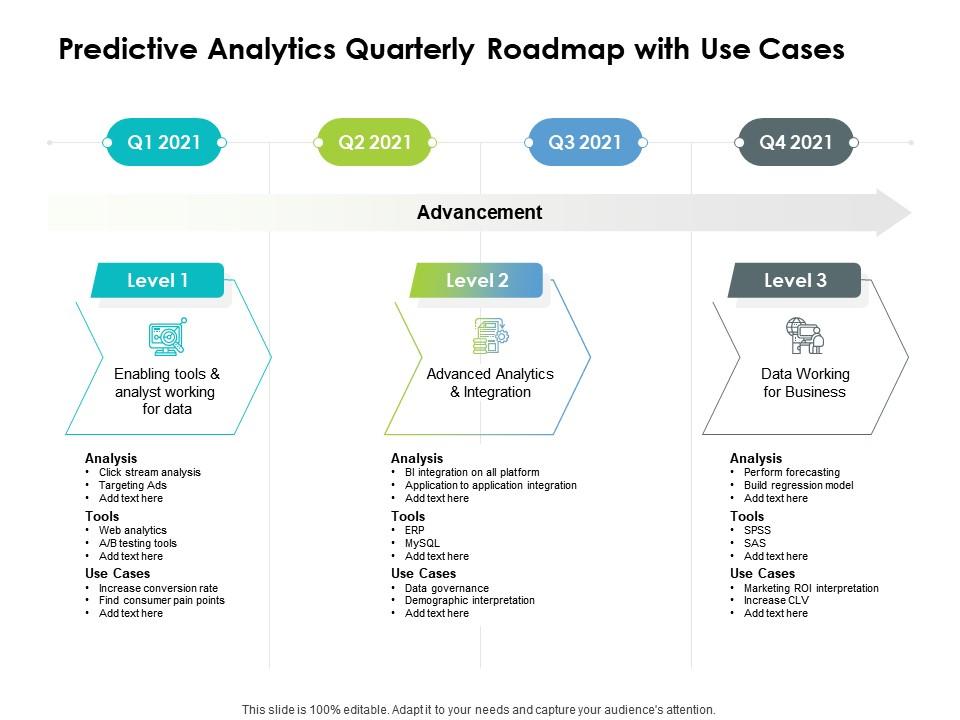
Presenting Predictive Analytics Quarterly Roadmap With Use Cases PowerPoint slide. This PPT slide is available at 4,3 and 16,9 aspect ratios. You can download this PPT theme in various formats like PDF, PNG, and JPG. This PowerPoint template is completely editable and you can modify the font size, font type, and shapes as per your requirements. Our PPT layout is compatible with Google Slides.

People who downloaded this PowerPoint presentation also viewed the following :

FAQs for Predictive analytics quarterly roadmap

Key components of a predictive analytics model include data collection and preprocessing, feature engineering, algorithm selection, model training, and validation testing. These elements work together by identifying patterns in historical data, selecting relevant variables, and applying machine learning techniques, with organizations in healthcare, finance, and retail finding that well-constructed models deliver accurate forecasting and strategic competitive advantages.

Businesses can effectively integrate predictive analytics by establishing clear data governance frameworks, investing in scalable technology infrastructure, training cross-functional teams, and embedding insights directly into operational workflows. Through strategic implementation, organizations in retail, healthcare, and financial services streamline forecasting, enhance customer targeting, and optimize resource allocation, ultimately delivering faster decision cycles and competitive advantage in data-driven markets.

Customer behavior data, historical transaction records, operational metrics, demographic information, and real-time interaction data are most valuable for predictive analytics accuracy. These data types enable organizations to identify patterns, forecast trends, and anticipate outcomes across sectors like retail, healthcare, and financial services, ultimately delivering enhanced decision-making capabilities and competitive advantages.

Machine learning enhances predictive analytics by automating pattern recognition, processing vast datasets in real-time, and continuously improving accuracy through algorithmic learning. These technologies enable organizations to identify complex correlations, predict customer behaviors, and optimize operations with greater precision, ultimately delivering faster insights and competitive advantage in increasingly data-driven markets.

Healthcare, financial services, retail, manufacturing, and telecommunications have experienced transformative advancements through predictive analytics, with applications ranging from disease diagnosis and fraud detection to inventory optimization and equipment maintenance. These industries leverage predictive models to enhance operational efficiency, reduce costs, and deliver superior customer experiences, ultimately gaining competitive advantages in increasingly data-driven markets.

Predictive analytics enhances customer experience by anticipating needs, personalizing interactions, and optimizing touchpoints across the customer journey. Through machine learning algorithms, businesses can deliver targeted recommendations, proactive support, and tailored marketing campaigns, with many retail and financial services companies finding significantly improved satisfaction rates and customer loyalty.

Ethical predictive analytics considerations include data privacy protection, algorithmic bias prevention, transparency in decision-making processes, consent management, and fairness across demographic groups. Organizations must balance predictive insights with individual rights, ensuring models don't perpetuate discrimination, while maintaining clear accountability frameworks that build trust with stakeholders and comply with evolving regulatory requirements.

Predictive analytics forecasts future outcomes using historical data and statistical models, while descriptive analytics examines past events and prescriptive analytics recommends specific actions. Through machine learning algorithms, predictive analytics enables organizations to anticipate customer behavior, market trends, and operational challenges, ultimately delivering proactive decision-making capabilities that enhance strategic planning and competitive advantage.

Common implementation challenges include data quality issues, insufficient technical expertise, integration complexities with existing systems, resistance to change, and unrealistic expectations about outcomes. While these obstacles can seem daunting, many organizations find that strategic planning, phased rollouts, and comprehensive training enable successful deployments, ultimately delivering enhanced decision-making capabilities and competitive advantage.

Predictive analytics enhances risk management by analyzing historical data patterns, identifying potential threats before they materialize, and enabling proactive mitigation strategies. Through advanced algorithms and machine learning models, financial institutions, insurance companies, and manufacturing organizations can anticipate market volatility, assess credit risks, and prevent operational failures, ultimately delivering better decision-making and competitive advantage.

Beginner-friendly predictive analytics tools include Python libraries like scikit-learn and pandas, R programming environment, Tableau for visualization, Microsoft Power BI, and cloud platforms like Google Analytics Intelligence. These technologies streamline model building, data processing, and insight generation, with many organizations finding that starting with user-friendly interfaces like Tableau enables faster learning while building analytical capabilities.

Success in predictive analytics projects is measured through model accuracy metrics like precision, recall, and F1-scores, alongside business impact indicators including ROI, cost savings, and operational efficiency improvements. Organizations typically track deployment metrics such as prediction speed, user adoption rates, and decision-making enhancement, with many finding that sustained competitive advantage ultimately defines long-term project success.

Yes, predictive analytics can be applied in real-time scenarios through streaming data processing, machine learning algorithms, and automated decision engines that analyze data as it's generated. Financial institutions use real-time predictive models for fraud detection during transactions, while retailers leverage them for dynamic pricing and inventory management, ultimately enabling immediate responses that enhance customer experiences and operational efficiency.

Data visualization transforms complex predictive analytics findings into accessible insights through interactive dashboards, trend charts, heat maps, and scenario modeling displays. These visual tools enable stakeholders across finance, healthcare, and retail to quickly identify patterns, communicate forecasts effectively, and make data-driven decisions, ultimately enhancing organizational agility and strategic planning capabilities.

Future trends shaping predictive analytics include real-time processing capabilities, automated machine learning platforms, edge computing integration, explainable AI models, and enhanced data privacy frameworks. These advancements streamline decision-making by delivering faster insights, reducing technical barriers, and enabling broader organizational adoption, with many enterprises finding that democratized analytics ultimately drives competitive advantage across departments.

Ratings and Reviews

0% of 100
Review Form
Write a review
Most Relevant Reviews

No Reviews