


Process improvement in banking sector powerpoint presentation slides




Try Before you Buy Download Free Sample Product
 Impress Your
 Audience
 100%
100% Editable
 Save Hours
 of Time


Process Improvement is one of the approaches to identify current challenges, analyze current process, and improve existing business processes by implementing suitable strategies within an organization. The primary aim of process improvement is to optimize and meet new quotas or standards of quality. This presentation will be helpful for any company who wants to implement a new process or wants to improve their current process by eliminating the key issues We have categorized this presentation into three major steps. 1) Identifying business opportunities for improvement; 2) Implement the required changes, and 3) Measure the impact of those changes. Under the first step ‘Identifying business opportunities for improvement’, we have covered the key challenges faced by the company in its current process, major opportunities under the new process, and the solutions for the identified issues offered by the new process. Additionally, we have provided the industry overview including the latest techniques of business improvement, competitive analysis, FMEA analysis identify possible failure, Risk preference Number calculation, and major barriers to implementing new process, and SWOT analysis. In the second step ‘Implement the Required Changes’, we have covered the key strategies to improve the process, key technologies, and stages where the company needs improvement; implementation of new technology in various company activities, and benefit of the implementation of the new process In the final step ‘Measure the impact of those changes’, the company forecasted based on strategy implementation the major KPIs, financial forecast, number of customer and customer retention rate forecast, and outlook of the process.
People who downloaded this PowerPoint presentation also viewed the following :
Content of this Powerpoint Presentation
Slide 1: This is cover slide for Process Improvement in Banking Sector PowerPoint presentation.
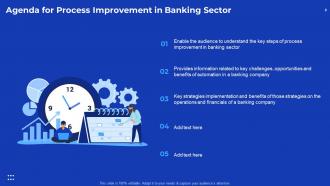
Slide 2: This is an Agenda for Process Improvement in Banking Sector PowerPoint slide.
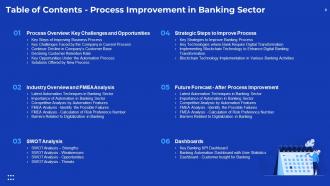
Slide 3: This is the Table of Contents slide that lists out all the essential elements covered in the deck.
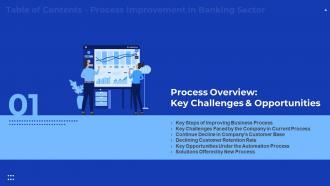
Slide 4: This slide presents process overview - Key Challenges and Opportunities.
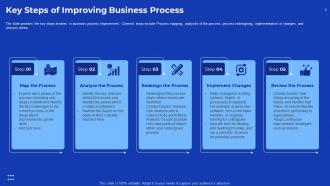
Slide 5: The slide provides the key steps involves in business process improvement. Covered steps include Process mapping, analyses of the process, process redesigning, implementation of changes, and process review.
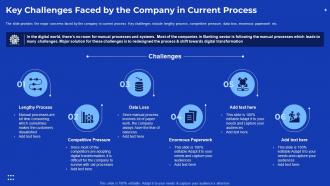
Slide 6: The slide provides the major concerns faced by the company in current process. Key challenges include lengthy process, competitive pressure, data loss, enormous paperwork etc.
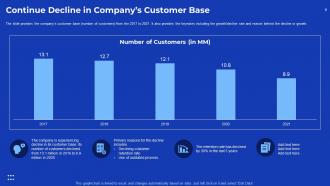
Slide 7: The slide provides the company’s customer base (number of customers) from the 2017 to 2021. It also provides the keynotes including the growth/decline rate and reason behind the decline or growth.
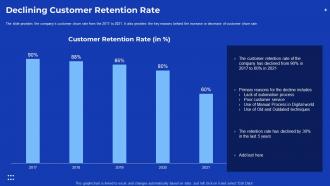
Slide 8: The slide provides the company’s customer churn rate from the 2017 to 2021. It also provides the key reasons behind the increase or decrease of customer churn rate.
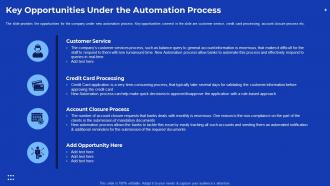
Slide 9: The slide provides the opportunities for the company under new automation process. Key opportunities covered in the slide are customer service, credit card processing, account closure process etc.
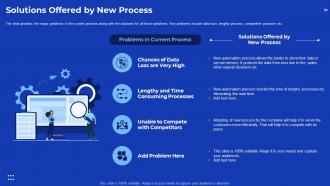
Slide 10: The slide provides the major problems in the current process along with the solutions for all those problems. Key problems include data loss, lengthy process, competitive pressure etc.
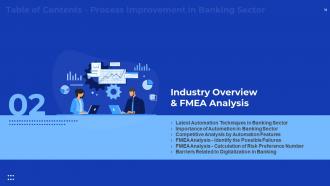
Slide 11: This slide presents Industry Overview and FMEA Analysis.
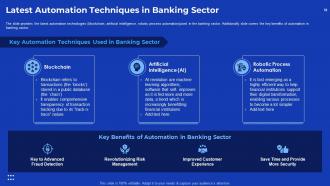
Slide 12: The slide provides the latest automation technologies (blockchain, artificial intelligence, robotic process automation)used in the banking sector. Additionally slide covers the key benefits of automation in banking sector.
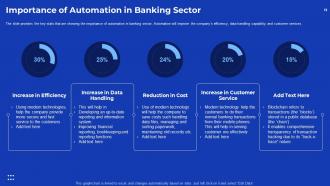
Slide 13: The slide provides the key stats that are showing the importance of automation in banking sector. Automation will improve the company’s efficiency, data handling capability, and customer services.
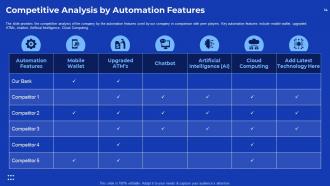
Slide 14: The slide provides the competitive analysis of the company by the automation features used by our company in comparison with peer players. Key automation features include mobile wallet, upgraded ATMs, chatbot, Artificial Intelligence, Cloud Computing.
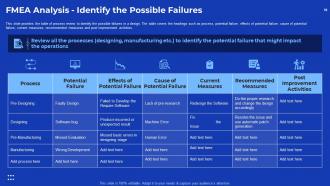
Slide 15: This slide provides the table of process review to identify the possible failures in a design. The table covers the headings such as process, potential failure, effects of potential failure, cause of potential failure, current measures, recommended measures and post improvement activities.
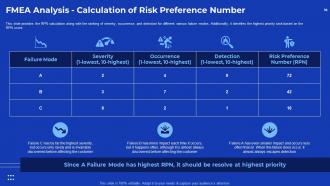
Slide 16: This slide provides the RPN calculation along with the ranking of severity, occurrence, and detection for different various failure modes. Additionally, it identifies the highest priority task based on the
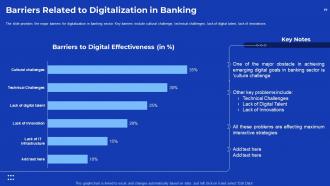
Slide 17: The slide provides the major barriers for digitalization in banking sector. Key barriers include cultural challenge, technical challenges, lack of digital talent, lack of innovations.
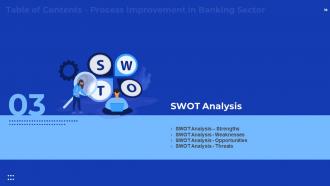
Slide 18: This slide talks about SWOT Analysis.
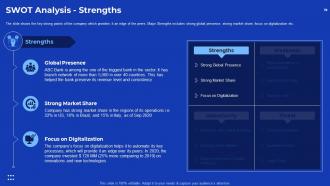
Slide 19: The slide shows the key strong points of the company which provides it an edge of the peers. Major Strengths includes strong global presence, strong market share, focus on digitalization etc.
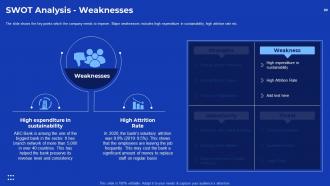
Slide 20: The slide shows the key points which the company needs to improve. Major weaknesses includes high expenditure in sustainability, high attrition rate etc.
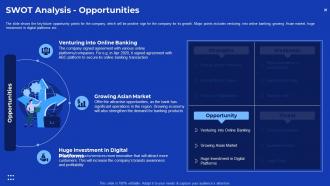
Slide 21: The slide shows the key future opportunity points for the company, which will be positive sign for the company for its growth. Major points includes venturing into online banking, growing Asian market, huge investment in digital platforms etc.
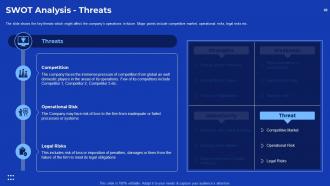
Slide 22: The slide shows the key threats which might affect the company’s operations in future. Major points include competitive market, operational risks, legal risks etc.
Slide 23: This slide showcases strategic steps to improve process.
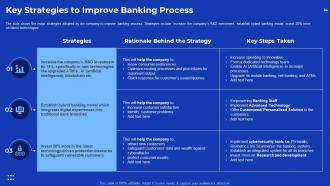
Slide 24: The slide shows the major strategies adopted by the company to improve banking process. Strategies include ‘increase the company’s R&D investment, establish hybrid banking model, invest 20% more on latest technologies
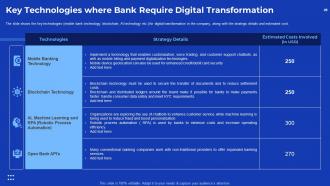
Slide 25: The slide shows the key technologies (mobile bank technology, blockchain, AI technology etc.) for digital transformation in the company, along with the strategic details and estimated cost.
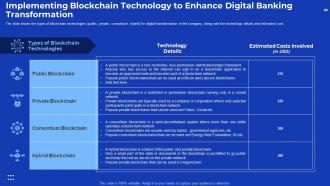
Slide 26: The slide shows the types of blockchain technologies (public, private, consortium, hybrid) for digital transformation in the company, along with the technology details and estimated cost
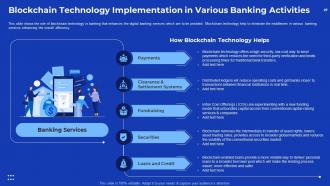
Slide 27: This slide shows the role of blockchain technology in banking that enhances the digital banking services which are to be provided. Blockchain technology help to eliminate the middlemen in various banking services enhancing the overall efficiency.
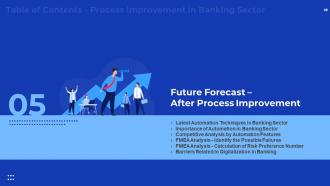
Slide 28: This slide presents future forecasts- After process improvement.
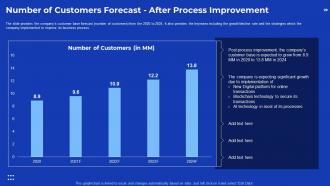
Slide 29: The slide provides the company’s customer base forecast (number of customers) from the 2020 to 2024. It also provides the keynotes including the growth/decline rate and the strategies which the company implemented to improve its business process.
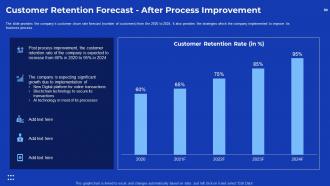
Slide 30: The slide provides the company’s customer churn rate forecast (number of customers) from the 2020 to 2024. It also provides the strategies which the company implemented to improve its business process.
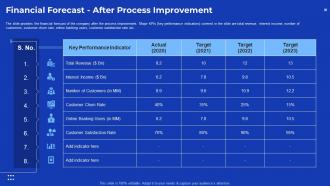
Slide 31: The slide provides the financial forecast of the company after the process improvement. Major KPIs (key performance indicators) covered in the slide are total revenue, interest income, number of customers, customer churn rate, online banking users, customer satisfaction rate etc.
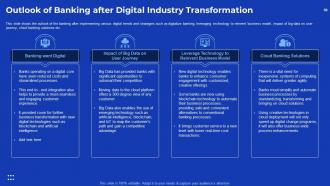
Slide 32: This slide shows the outlook of the banking after implementing various digital trends and strategies such as digitalize banking, leveraging technology to reinvent business model, impact of big data on user journey, cloud banking solutions etc.
Slide 33: This slide presents dashboards.
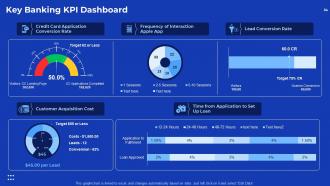
Slide 34: This slide showcases Key Banking KPI Dashboard.
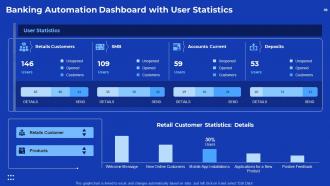
Slide 35: This slide presents Banking automation dashboard with user statistics.
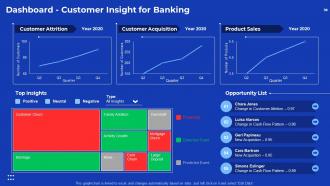
Slide 36: This slide presents Dashboard- customer Insight for banking.
Slide 37: This is an Icon Slide. Use it as per your needs.
Slide 38: This is an Additional Slide.
Slide 39: This is Our Mission slide to state your mission and vision.
Slide 40: This is Our Team slide with name and designation to fill.
Slide 41: This is a Clustered Column-Line chart to compare different products.
Slide 42: This is a Post It Notes slide to keep the important information at one place.
Slide 43: This is a Comparison slide that can be used to conduct comparative analysis.
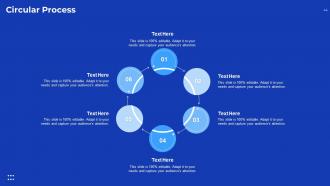
Slide 44: This is a Circular Process slide that can be used to present continous series of events.
Slide 45: This is Target image slide to present product/ entity, information etc.
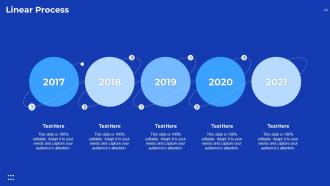
Slide 46: This is a Linear Process slide to showcase series of events.
Slide 47: This is a creative Puzzle image slide to state information, specifications etc.
Slide 48: This is a 30 60 90 Days Plan slide that can be used to create robust plans.
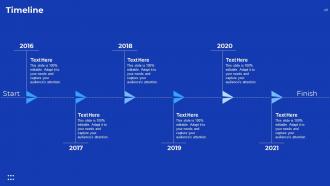
Slide 49: This is a Timeline slide that can be used to present chronological sequence of events.
Slide 50: This is a Thank You slide for acknowledgment. You can share your contact details here.
Process improvement in banking sector powerpoint presentation slides with all 50 slides:
Use our Process Improvement In Banking Sector Powerpoint Presentation Slides to effectively help you save your valuable time. They are readymade to fit into any presentation structure.










FAQs for Process improvement in banking sector
First thing - map out what's actually happening in your processes, not what you assume is happening. Customer complaints are gold for this stuff, plus talk to your frontline people since they see the real mess daily. Look at your processing times and error rates for patterns. Honestly, benchmarking against industry standards helps too, though sometimes those can be pretty outdated. Once you've got all that info, just prioritize by customer impact versus how hard it'll be to fix. Go for the easy wins first - builds momentum and keeps everyone motivated.
Tech can seriously help you streamline things and make customers happier. Automation's huge for boring stuff - account opening, loan processing, compliance checks. Frees up your people for actual important work. Mobile apps and chatbots honestly handle like 80% of basic questions without anyone needing to step in, which is pretty wild when you think about it. Data analytics will help with personalized recommendations and catching fraud right away. Oh, and don't try to do everything at once - that's a recipe for disaster. Pick whatever's driving you most crazy first and start there.
Honestly, data analytics has become huge for banks trying to fix their messy processes. You can pinpoint exactly where things get stuck - like why loan approvals take forever or where customer onboarding falls apart. The really neat thing? Predictive stuff catches issues before they become disasters. Banks are using it for compliance, fraud detection, all that jazz. Oh, and don't go crazy trying to analyze everything at once - that's a recipe for overwhelm. Pick one process that's clearly broken and dig into the numbers. You'll probably find patterns you never expected.
Your employees are basically walking goldmines of info - they deal with all the broken processes every single day. Set up regular check-ins, maybe monthly sessions with different teams. Suggestion boxes work too, though they're kinda old school. The thing is, frontline people know exactly where stuff gets stuck and what makes customers mad. I remember this one bank that cut their loan times in half just by asking tellers what was driving them crazy. Don't just collect feedback though - you have to actually do something with it or people stop caring.
Oh man, banking tech upgrades are brutal. Their systems are basically held together with digital duct tape - nobody even remembers how half of it works anymore. Compliance will eat you alive since regulators want documentation for every tiny change. People absolutely hate learning new stuff, especially the folks who've been doing things one way for like 20 years. Can't blame them honestly. Data integration between departments? Total mess. You're handling crazy amounts of sensitive info where one screw-up could tank everything. Honestly, start with small pilot programs and make sure the big decision-makers are on your side first.
Process mapping is honestly a game changer for finding where stuff gets stuck. Like, you'll see loan apps ping-ponging between departments for zero reason - it's wild how much unnecessary crap you discover. The visual part makes it super easy to show your boss exactly what's broken. You can cut out pointless approval steps and automate the boring repetitive stuff. Start with whatever process makes you want to scream (probably something customer-facing since those delays really sting). Once you map it all out, streamlining handoffs becomes way more obvious.
So here's the thing - customer journey mapping is basically like putting on X-ray goggles for your business processes. You map out every single touchpoint and boom, all the pain points become obvious. Where do customers get stuck? Which steps are total BS that nobody needs? I swear, half the time you'll find departments just passing people around in circles. The real magic happens when you spot what actually matters to customers versus what's just company bureaucracy. Oh, and don't try to map everything at once - pick one service and go deep on that first. Way less overwhelming.
Track three main things: customer stuff (wait times, complaints), how smoothly operations run (processing speed, costs), and whether your team's actually happy. Honestly, most people get obsessed with metrics that look impressive but don't mean anything. Before you change anything, write down your current numbers. Then check monthly - don't wait till the project's over to realize you're off track. Oh, and definitely ask your front-line people what success looks like to them. They'll catch problems you'd never see from your desk.
Build compliance checks into your workflow right from the start - don't just slap them on later. Map out every regulatory requirement first (boring but necessary). Design automated checkpoints and audit trails into your new process. Run changes by compliance early and often, then pilot test everything in a controlled space. Honestly, I've seen too many people treat compliance like the enemy when it should be part of the solution. Document everything obsessively so you can actually prove your improvements make compliance stronger, not weaker.
So banks are basically swapping out all their old-school manual stuff for AI that runs constantly. Like loan approvals that used to take forever? Now they're instant. Fraud gets caught in real-time, people can open accounts without leaving home - it's pretty wild honestly. Problem is you can't just flip a switch and upgrade everything at once. You'll have some processes running super smooth digitally while others are still painfully slow and paper-based. My advice? Figure out what's causing your biggest headaches first and tackle those. The speed difference will blow your mind once you see it working.
Map out which departments touch your process first - that's key. Bring people from each team into improvement sessions right away. Here's why it works: different teams spot bottlenecks that others miss entirely. You'll get the full workflow picture instead of just your piece. Honestly, single departments fixing things in isolation usually backfires. They'll "optimize" something that dumps extra work on someone else downstream. Been there! Getting everyone involved upfront means actual buy-in when it's time to implement changes. Way less pushback later.
Ugh, regulatory changes are such a pain - they make you totally rethink how you improve processes. But honestly? Sometimes it's not the worst thing. You have to build compliance checks into every workflow now, which sucks at first because everything slows down. The upside is you'll probably find inefficiencies you never noticed before. Since regulations keep changing (because of course they do), your processes need to bend without breaking. I'd go modular - build it so you can swap out compliance pieces without starting over. Map out which regs hit your current processes first. That'll show you the biggest headaches to tackle.
So here's the thing - customer-centric approaches totally change how you think about banking processes. Instead of designing around your internal systems (which is what most banks do), you actually start with what customers want and build backwards from there. Map out their whole experience, find where they're getting frustrated - like those ridiculous loan apps that take forever - then fix those pain points first. I swear it's like decluttering but for workflows. The whole point is that your super-efficient internal process doesn't matter if it makes customers want to scream. Always ask yourself: does this make their life easier? Then worry about the operational stuff.
Focus on the stuff that pisses people off most about their current bank. Mobile loan approvals that don't suck, accounts you can open instantly, financial advice that's actually useful - not generic garbage. Map out where customers waste time or get frustrated. Seriously, some banks killed it just by letting people change their address online instead of dragging them to a branch for something so basic. What makes your customers complain the most? That's literally your product roadmap. Fix the eye-roll moments first.
Start with monthly feedback sessions where people can actually pitch ideas without jumping through hoops. Most banks suck at this - way too scared of change. Mix up your teams every quarter so folks see different processes and catch stuff that doesn't make sense. Oh, and definitely celebrate wins publicly, even tiny ones. Give people actual time to work on improvements, not just their regular stuff. The biggest thing though? Leadership has to participate. I've seen this fail so many times when managers just sit back and expect everyone else to care.
-
Enough space for editing and adding your own content.
-
Design layout is very impressive.
-
Great experience, I would definitely use your services further.
-
The content is very helpful from business point of view.
-
Enough space for editing and adding your own content.
-
Easy to edit slides with easy to understand instructions.
-
Qualitative and comprehensive slides.
-
Visually stunning presentation, love the content.
-
Innovative and Colorful designs.
-
Unique design & color.