Process To Create Employee Referral Customer Marketing Strategies To Encourage

Rating:
80%
Process To Create Employee Referral Customer Marketing Strategies To Encourage Process To Create Employee Referral Customer Marketing Strategies To Encourage
Slide 1 of 9
Favourites Favourites

Try Before you Buy Download Free Sample Product

Audience Impress Your
Audience
Editable 100%
Editable
Time Save Hours
of Time
The Biggest Sale is ending soon in
0
0
:
0
0
:
0
0
Rating:
80%
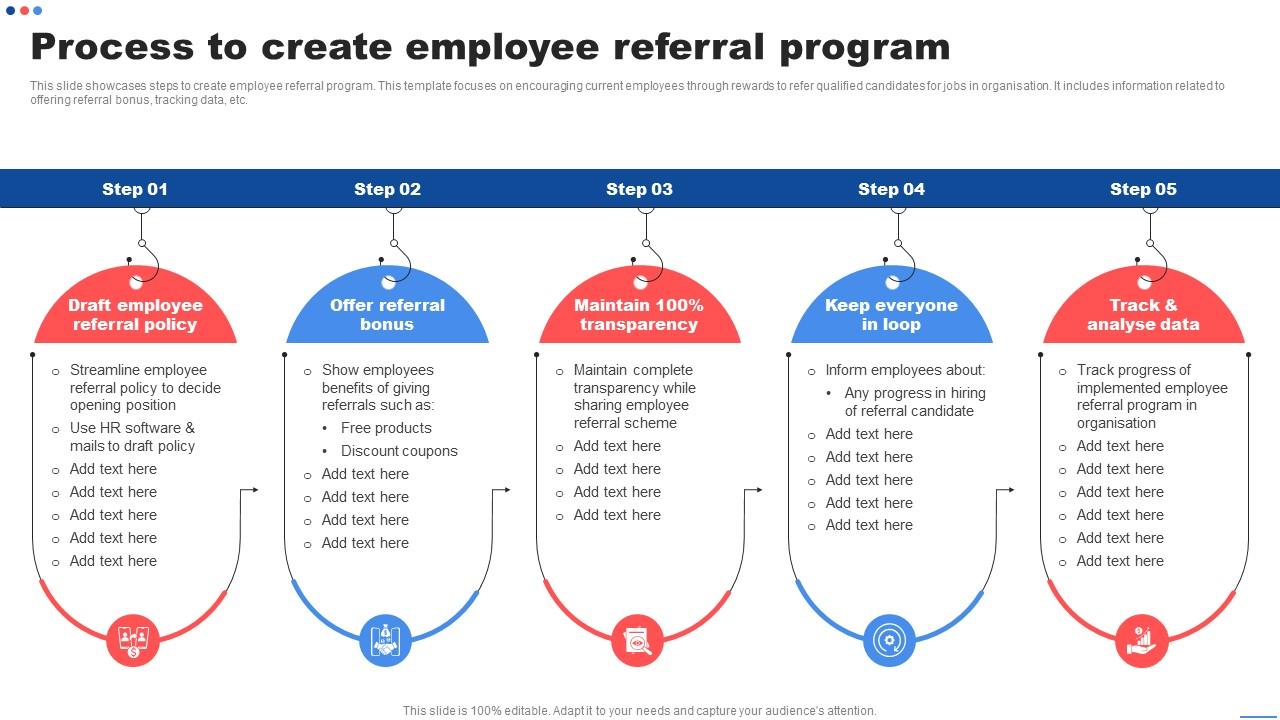
This slide showcases steps to create employee referral program. This template focuses on encouraging current employees through rewards to refer qualified candidates for jobs in organisation. It includes information related to offering referral bonus, tracking data, etc.Introducing Process To Create Employee Referral Customer Marketing Strategies To Encourage to increase your presentation threshold. Encompassed with five stages, this template is a great option to educate and entice your audience. Dispence information on Implemented Employee, Streamline Employee, Referrals Such, using this template. Grab it now to reap its full benefits.

FAQs for Process To Create Employee Referral Customer Marketing

Employee referral marketing strategies deliver reduced hiring costs, faster recruitment cycles, higher-quality candidates, improved employee retention, and enhanced company culture through trusted networks. These approaches streamline talent acquisition by leveraging existing relationships, minimizing training time, and increasing job satisfaction rates, with many organizations finding that referred employees stay longer and perform better, ultimately creating competitive advantages in today's tight labor market.

Organizations effectively measure employee referral program success through conversion rates, time-to-hire metrics, retention rates of referred candidates, cost-per-hire analysis, and employee participation levels. These comprehensive analytics enable companies to track quality improvements, reduce recruitment expenses, and enhance overall hiring efficiency, with many businesses finding that referred employees demonstrate 25% higher retention rates and significantly lower onboarding costs.

Company culture plays a pivotal role in employee referrals by fostering trust, engagement, and pride that motivates employees to recommend qualified candidates from their networks. A positive culture creates ambassadors who actively promote the organization, while supportive environments encourage participation through recognition programs, referral bonuses, and transparent communication, ultimately delivering higher-quality hires and reduced recruitment costs.

Companies can incentivize employee participation through monetary rewards, recognition programs, career advancement opportunities, flexible work arrangements, and exclusive perks. These strategic combinations enhance engagement by offering immediate financial benefits, public acknowledgment, and professional growth prospects, with many organizations finding that diverse incentive portfolios significantly increase referral quality and participation rates, ultimately delivering stronger recruitment outcomes.

**INPUT**: What strategies can be employed to communicate referral opportunities to employees? **OUTPUT**: Employee referral communication strategies include dedicated intranet portals, regular email campaigns, team meeting announcements, gamified leaderboards, and mobile app notifications. These approaches enhance engagement by creating visibility, streamlining the referral process, and recognizing contributions, with many organizations finding that multi-channel communication significantly increases participation rates and ultimately delivers higher-quality hires.

Organizations ensure diversity and inclusion in employee referral processes by implementing structured guidelines, expanding referral networks beyond immediate circles, providing unconscious bias training, and setting diversity targets with tracking mechanisms. Companies like tech firms and consulting organizations increasingly combine referral incentives with inclusive recruitment practices, mentorship programs connecting diverse employees with referral opportunities, ultimately delivering broader talent pools while maintaining the efficiency and cultural fit benefits that referrals provide.

Tools for enhancing employee referral programs include automated referral platforms, CRM integrations, mobile applications, analytics dashboards, and social sharing technologies. These systems streamline tracking, automate reward distribution, and provide real-time performance insights, with many organizations finding that integrated platforms reduce administrative overhead while increasing participation rates and ultimately delivering faster hiring cycles and improved candidate quality.

Onboarding for referred employees can be enhanced through accelerated integration programs, peer mentorship from referring employees, and recognition of their referral connection. These tailored approaches streamline cultural assimilation while leveraging existing relationships, with many organizations finding that personalized onboarding reduces time-to-productivity and strengthens retention rates significantly.

Common pitfalls include unclear program guidelines, inadequate incentive structures, poor communication about available opportunities, and lack of tracking systems to measure effectiveness. Organizations can avoid these challenges by establishing transparent referral processes, offering competitive rewards that motivate participation, regularly communicating open positions across departments, and implementing robust analytics to monitor program performance, ultimately delivering higher-quality hires and improved employee engagement.

Success stories from referrals can be leveraged in internal marketing through employee newsletters, company-wide meetings, recognition ceremonies, and digital dashboards showcasing achievements. These narratives enhance employee engagement by highlighting tangible outcomes like faster hiring, improved cultural fit, and reduced recruitment costs, while inspiring continued participation and demonstrating the strategic value of employee contributions to organizational growth.

Key metrics include referral conversion rates, time-to-hire for referred candidates, retention rates of referred employees, cost-per-hire reductions, and employee participation rates in referral programs. These measurements enable organizations to assess program ROI, identify top-performing referrers, and optimize recruitment strategies, with many companies finding that referred employees demonstrate 25% higher retention and significantly lower acquisition costs.

Social media enhances employee referral programs by providing easy sharing mechanisms, expanding reach through personal networks, and creating engaging campaigns that motivate participation. Platforms like LinkedIn, Facebook, and Twitter enable employees to seamlessly share job openings with their connections, while gamified social campaigns encourage participation through recognition and rewards, ultimately delivering broader talent pools and faster recruitment cycles.

Effective employee referral training should include understanding ideal customer profiles, referral process workflows, communication techniques, and CRM system usage. Organizations should provide role-playing workshops, referral tracking tools, presentation templates, and ongoing coaching sessions, with many companies finding that comprehensive training programs increase referral quality by 40-60% while enhancing employee confidence in identifying prospects.

Employee referral marketing strategies vary significantly across industries, with financial services emphasizing compliance and background verification, healthcare focusing on specialized certifications and cultural fit, and technology companies leveraging social networks and innovation-driven referrals. These sector-specific approaches streamline recruitment by targeting relevant talent pools, reducing hiring costs, and accelerating candidate quality assessment, ultimately delivering faster placements and stronger organizational alignment.

Legal considerations for employee referral programs include compliance with equal employment opportunity laws, anti-discrimination regulations, tax reporting requirements for referral bonuses, and ensuring fairness in selection processes. These frameworks help organizations streamline hiring while maintaining regulatory compliance, with many companies finding that structured referral policies enhance recruitment transparency and minimize legal risks while delivering competitive talent acquisition advantages.

Ratings and Reviews

80% of 100
Review Form
Write a review
Most Relevant Reviews
  1. 80%

    by Cornelius Alexander

    I was confident and well prepared for my presentation for the first time ever. With SlideTeam’s templates, I could deliver one of my best presentations. Will be coming back for more!
  2. 80%

    by James Lewis

    Requested a complete pitch deck. Delivered immediately and with high quality well researched content.

2 Item(s)

per page: