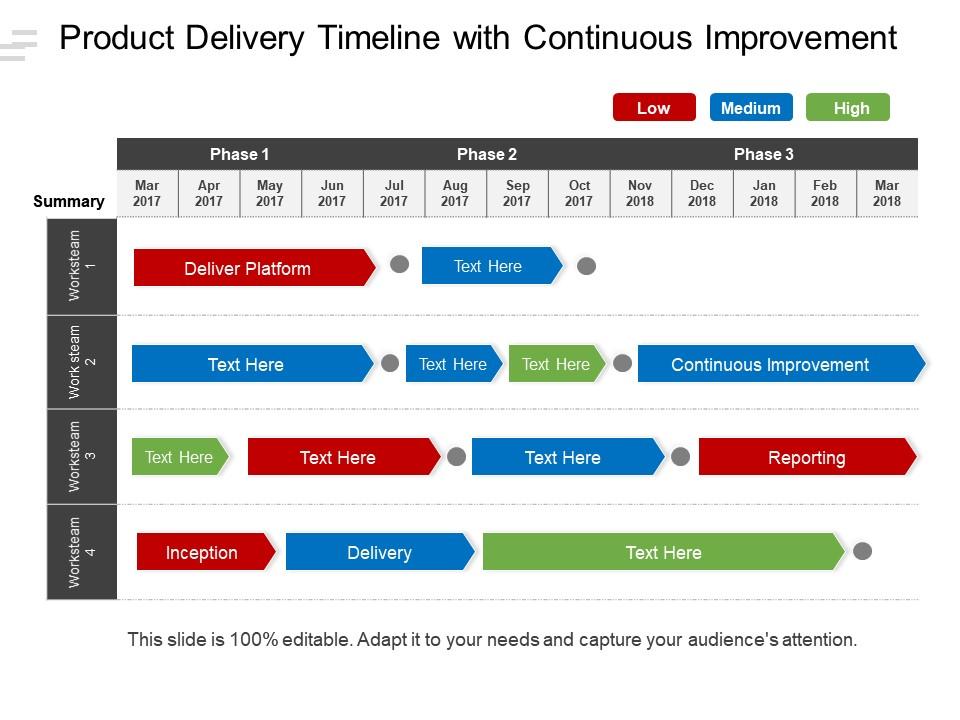
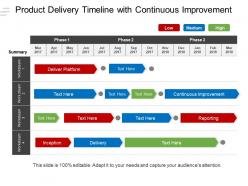
Product delivery timeline with continuous improvement
Try Before you Buy Download Free Sample Product
Audience
Editable
of Time
Display your firm fundamentals on our product Delivery Timeline With Continuous Improvement. They will be bullish about your chances.
People who downloaded this PowerPoint presentation also viewed the following :
Product delivery timeline with continuous improvement with all 5 slides:
Generate interest in the journey with our product Delivery Timeline With Continuous Improvement. Come up with an exciting itinerary.
FAQs for Product delivery timeline
So basically it's about putting people before rigid processes and actually listening to customers instead of just following contracts. You adapt based on real feedback rather than assumptions - which honestly makes way more sense than those old waterfall methods where you'd plan everything upfront then pray it worked. The magic happens because you're shipping working pieces constantly. Problems show up early when they're cheap to fix, not at the end when everything's expensive and messy. Your team stays connected to what customers actually need. My advice? Find the smallest thing you can build that's actually useful and get that out the door first.
So basically, instead of planning everything upfront for months like the old waterfall approach, Agile breaks work into 2-4 week sprints. You're constantly getting user feedback and can actually change direction when needed. It's like using GPS that reroutes you vs those old printed MapQuest directions that left you screwed if there was construction. Your team works cross-functionally, which honestly makes way more sense. When requirements change (and they always do), you can pivot fast. I'd suggest trying shorter planning cycles in whatever you're working on now - just to see how it feels different.
So there's basically three big ones: Scrum, Kanban, and SAFe. Most teams start with Scrum - you do 2-4 week sprints with a cross-functional team. Pretty standard stuff. Kanban's actually way better if you're doing support work or anything where priorities keep changing (honestly wish more people knew about this one). SAFe is what big companies use when they've got tons of teams that need to sync up, but man it can feel bureaucratic. I'd say just start with Scrum if you have a proper product team. You can always switch things up once you see what's not working.
Honestly, both are game-changers for getting your team on track. With Scrum, those sprint cycles force you to actually prioritize stuff instead of letting everything become "urgent." Daily standups keep everyone from going rogue too. Kanban's where you really see the magic though - put your workflow on a board and boom, suddenly it's obvious where things always get stuck. Scrum creates this natural urgency with time-boxing, while Kanban stops your team from trying to do fifteen things at once. Start with mapping your current process on a Kanban board first. You'll be shocked at what you discover.
Look, you've got three main roles to worry about. Product Owner decides what gets built and prioritizes everything. Development Team does the actual coding and building. Then there's the Scrum Master who's basically removing roadblocks and keeping meetings productive - though honestly, some teams skip this role entirely. Daily standups keep everyone synced up, plus you'll have sprint planning and retrospectives. The key is making sure people don't stay stuck in their lanes too much. Yeah, define the roles clearly, but encourage everyone to jump in and help each other out when needed.
Honestly, Agile's pretty adaptable once you stop trying to copy tech companies exactly. Healthcare might need those long compliance reviews between sprints. Fintech? More security checks obviously. Manufacturing could do longer sprints that actually match production schedules - makes way more sense. The core stuff stays the same though: iterative delivery, collaboration, feedback loops. You're just tweaking ceremony timing, sprint lengths, your "done" definition. Really depends on your industry's biggest pain points. Start there and work backwards to modify the standard practices. Way better than forcing some cookie-cutter approach that doesn't fit your reality.
Track velocity and cycle time first - those are your bread and butter. Sprint burndown's useful too. But honestly? Customer satisfaction and defect rates matter way more than internal stuff sometimes. Don't sleep on team happiness either - I've seen miserable teams tank entire projects faster than you'd think. Most people try measuring everything at once, which is a mistake. Pick maybe 3-4 metrics max. Oh, and definitely watch those retrospective action items - they'll tell you if you're actually improving or just going through the motions.
So with Agile, stakeholders are basically part of your team now - they're not just dropping requirements and vanishing until launch day. Every sprint review (like every 1-2 weeks) they're giving feedback, which honestly feels intense at first but saves your ass later. Way better than the waterfall approach where they disappear for months then suddenly hate everything. You catch problems early when fixes are cheap, not expensive. Oh, and definitely warn them upfront that they can't just check out - regular involvement isn't negotiable if you want this to work.
Honestly, the hardest part is just getting people to stop trying to plan every detail months ahead. Teams get so used to waterfall that they panic without a massive upfront plan. Role confusion hits hard too - suddenly nobody knows who's actually making decisions. Governance becomes a nightmare if your company's still stuck with approval processes that take forever. I've seen it kill momentum so many times. Best bet? Find one team that's actually excited about trying something new. Get a few wins with them first, then wave those success stories around to convince the doubters and executives.
Honestly, feedback loops are everything in Agile. Your daily standups should catch blockers fast. Sprint retros help the team figure out what's actually working. But here's what really matters - get real users involved way earlier than you think. Show them demos, test prototypes, whatever. I learned this the hard way on my last project. Don't save stakeholder check-ins for the end of sprints either. Spread those touchpoints throughout. Maybe just try one new feedback thing this sprint? See how it feels.
So Jira's pretty much everywhere for project management, and Azure DevOps handles the full development cycle really well. Teams use Slack or Microsoft Teams constantly for chatting, plus Confluence for docs. GitHub or GitLab are must-haves for version control and CI/CD - automated deployments are a lifesaver, trust me. Miro or Figma work great for planning sessions and retros. Honestly though, integration matters way more than picking the "perfect" tool. I'd grab one solid project management platform first and build everything else around that. Don't overthink it.
Honestly, agile's whole thing is baking in constant improvement. You get those retrospectives every sprint - usually 1-2 weeks - where you actually talk about what sucked and what didn't. Way better than waiting until a project's dead to figure out where you went wrong. Daily standups catch problems before they blow up into real issues. Plus you're getting user feedback super early, so if something's not working, you can change direction fast. The key though? Don't just talk about improvements in retros - actually implement the small stuff right away. I've seen too many teams where great ideas just die in some backlog.
Daily check-ins are honestly a game changer - don't skip those. When you do retrospectives, actually tackle the stuff that's blocking people instead of just talking in circles (I've sat through way too many useless ones). Sprint goals should be realistic or your team will constantly feel like they're drowning. Oh, and rotate who runs meetings! It stops one person from dominating everything. Make sure people feel safe speaking up about problems without getting shut down. Acknowledging what individuals did well during standups helps too. Small wins matter more than you'd think.
Honestly, Agile keeps you flexible because you're working in these short 1-2 week sprints with constant feedback. Instead of planning everything upfront (which never works anyway), you plan just enough to start, then pivot based on what you learn. Your backlog becomes this living thing that changes with stakeholder input and shifting priorities. It feels messy at first if you're a detailed planner type - I get that. But the magic happens when you embrace shorter planning cycles. Regular retrospectives help you catch what needs fixing early. Way better than waiting months to find out you built the wrong thing.
Honestly, just document what actually matters - user stories, acceptance criteria, maybe some sprint notes. Don't go overboard with those massive requirement docs that nobody ever looks at again (learned that the hard way). Visual stuff helps too. Screenshots, quick diagrams, whatever makes sense. The key is keeping everything updated as you go instead of letting it pile up into this huge maintenance nightmare. Oh, and if you're writing docs more than you're coding... yeah, you've definitely overdone it. Keep it simple but useful.
-
Wonderful templates design to use in business meetings.
-
I discovered this website through a google search, the services matched my needs perfectly and the pricing was very reasonable. I was thrilled with the product and the customer service. I will definitely use their slides again for my presentations and recommend them to other colleagues.