

Product market matrix ppt examples slides




Try Before you Buy Download Free Sample Product
 Impress Your
 Audience
 100%
100% Editable
 Save Hours
 of Time


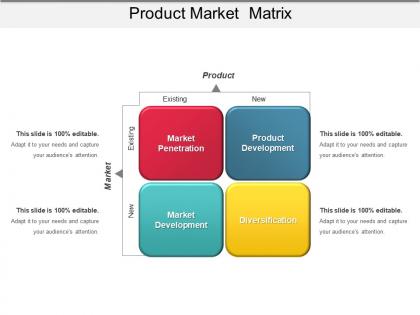
Outline the different strategies to increase market share with our product market matrix PPT examples slides. Use this slide of product market growth matrix to showcase the strategy that a company uses for market penetration, product development, market development and diversification. Our product marketing PowerPoint presentation is helpful to focus on existing customers and keeping them happy. This slideshow is useful to demonstrate that you have deep knowledge of who your customers are, what they want, what influences their decisions, what are their problem areas, and how you can provide them with solutions? Use this product marketing strategy template to showcase the importance of collected customer data which your company can use to develop new products based on those informations, as well as to create smarter marketing strategies to leverage business. Our brand marketing strategy slideshow can be used for gathering detailed information about customers, setting the price for the products and identifying and evaluating your competition. Download this marketing mix template and for more visit our website. Your ideas deserve some plaudits. Our Product Market Matrix Ppt Examples Slides will generate applause.
People who downloaded this PowerPoint presentation also viewed the following :
Product market matrix ppt examples slides with all 5 slides:
Firmly establish your authority with our Product Market Matrix Ppt Examples Slides. Exercise effective command and control.



FAQs for Product market matrix
A product market matrix is a strategic framework that maps existing and new products against current and potential markets, creating four growth strategies: market penetration, market development, product development, and diversification. This tool enables organizations to systematically evaluate expansion opportunities, allocate resources strategically, and identify optimal growth paths, with many companies finding that it streamlines decision-making while maximizing competitive advantage across diverse market scenarios.
The product market matrix elements—existing/new products and existing/new markets—help businesses systematically evaluate four distinct growth strategies: market penetration, market development, product development, and diversification. By analyzing these quadrants, companies can assess risk levels, resource requirements, and potential returns, with many organizations finding that this framework enables strategic decision-making and identifies the most viable paths for sustainable expansion.
The four primary strategies in the product market matrix are market penetration, market development, product development, and diversification. These strategies enable organizations to systematically evaluate growth opportunities by balancing existing versus new products and markets, with many companies finding that market penetration offers lower risk while diversification delivers higher growth potential.
Businesses can assess their current market position using the product market matrix by categorizing their offerings into market penetration, market development, product development, and diversification quadrants based on existing versus new products and markets. This strategic analysis enables companies to identify growth opportunities, resource allocation priorities, and competitive positioning within their industry landscape, with many organizations finding that systematic evaluation through this framework reveals untapped market segments and guides strategic investment decisions for sustainable expansion.
Market penetration serves as the foundation strategy within the product market matrix, focusing on increasing sales of existing products to current customers through enhanced marketing, competitive pricing, and improved distribution channels. This low-risk approach enables organizations to maximize revenue from established market relationships, with many companies finding that deeper penetration strategies often deliver immediate returns while building stronger customer loyalty and market share before pursuing expansion opportunities.
Companies leverage the product market matrix to diversify by systematically exploring market penetration, market development, product development, and diversification strategies across existing and new markets. Through this strategic framework, organizations identify expansion opportunities, assess risk levels, and allocate resources effectively, with many retail and technology companies finding that structured diversification ultimately delivers sustainable growth and competitive advantage.
Common pitfalls include oversimplifying market complexities, neglecting customer feedback during positioning decisions, misallocating resources across matrix quadrants, and failing to adapt strategies as markets evolve. Many organizations find that rigid adherence to initial matrix placements, without considering competitive dynamics or emerging customer needs, ultimately limits growth opportunities and market responsiveness.
The product market matrix focuses specifically on growth strategies through product and market dimensions, unlike broader frameworks such as SWOT analysis, Porter's Five Forces, or balanced scorecards that examine multiple strategic factors. While other tools analyze competitive positioning, internal capabilities, or performance metrics, this matrix delivers targeted expansion pathways by combining existing and new products with existing and new markets, ultimately enabling organizations to identify specific growth opportunities and resource allocation priorities.
The product market matrix can be effectively adapted for service-oriented industries by replacing "products" with service offerings, capabilities, or solutions while maintaining the same strategic framework. Banks use it to map financial services across customer segments, hospitals apply it to medical specialties and patient demographics, and consulting firms leverage it to align expertise areas with industry verticals, ultimately enabling service organizations to identify growth opportunities and optimize resource allocation.
Effectiveness metrics include market share growth, revenue per product line, customer acquisition costs, profit margins by segment, and return on investment for each matrix quadrant. These financial and operational indicators help organizations assess whether their market penetration, development, or diversification strategies are delivering competitive advantages, with many companies finding that tracking customer lifetime value and market position changes provides the clearest strategic insights.
Businesses use the product market matrix to respond to competitive threats by evaluating market penetration, product development, market development, and diversification strategies based on their competitive position. Through strategic analysis of existing versus new products and markets, companies can identify defensive moves like strengthening market share or offensive tactics like entering new segments, ultimately enabling rapid pivots and sustained competitive advantage.
The product market matrix provides startups with insights into market penetration opportunities, product development needs, market expansion timing, and diversification risks across different customer segments and offerings. Through this strategic framework, emerging companies can identify low-risk growth paths, optimize resource allocation, and prioritize market entry strategies, with many startups finding that systematic analysis reduces costly missteps while accelerating sustainable growth.
Companies should revisit their product market matrix strategy quarterly or semi-annually, with major reassessments during significant market shifts, competitive changes, or product launches. This regular evaluation enables organizations to identify emerging opportunities, reallocate resources strategically, and adapt to evolving customer needs, ultimately maintaining competitive advantage in increasingly dynamic markets.
Technology and data analytics enhance product market matrix application through advanced customer segmentation, real-time market analysis, predictive modeling, automated performance tracking, and AI-driven opportunity identification. These tools streamline strategic decision-making by delivering precise market insights, accelerating product positioning, and enabling dynamic portfolio optimization, with many organizations finding that data-driven matrix applications significantly improve competitive advantage and resource allocation efficiency.
Successful product market matrix implementations include Apple's iPhone targeting premium consumers, Amazon's AWS expanding from internal infrastructure to enterprise services, Tesla's progression from luxury to mass-market vehicles, and Netflix's evolution from DVD rentals to streaming across demographics. These companies strategically diversified by leveraging existing capabilities while entering new market segments, ultimately delivering sustained growth and competitive advantage through systematic matrix-based expansion strategies.
-
Excellent work done on template design and graphics.
-
Great product with highly impressive and engaging designs.