Project control plan with integration management

Rating:
87%
Project control plan with integration management
Slide 1 of 2
Favourites Favourites

Try Before you Buy Download Free Sample Product

Audience Impress Your
Audience
Editable 100%
Editable
Time Save Hours
of Time
The Biggest Sale is ending soon in
0
0
:
0
0
:
0
0
AI-Ready
Upload this template to AI and ask it to make any changes to content or color
100% editable Powerpoint Template for AI-assisted presentations. Finish your work in less time. Download Prompt Kit ​
Works with
Microsoft PowerPoint
Microsoft 365
Claude for PowerPoint
ChatGPT
Google Slides
Microsoft Copilot
Rating:
87%
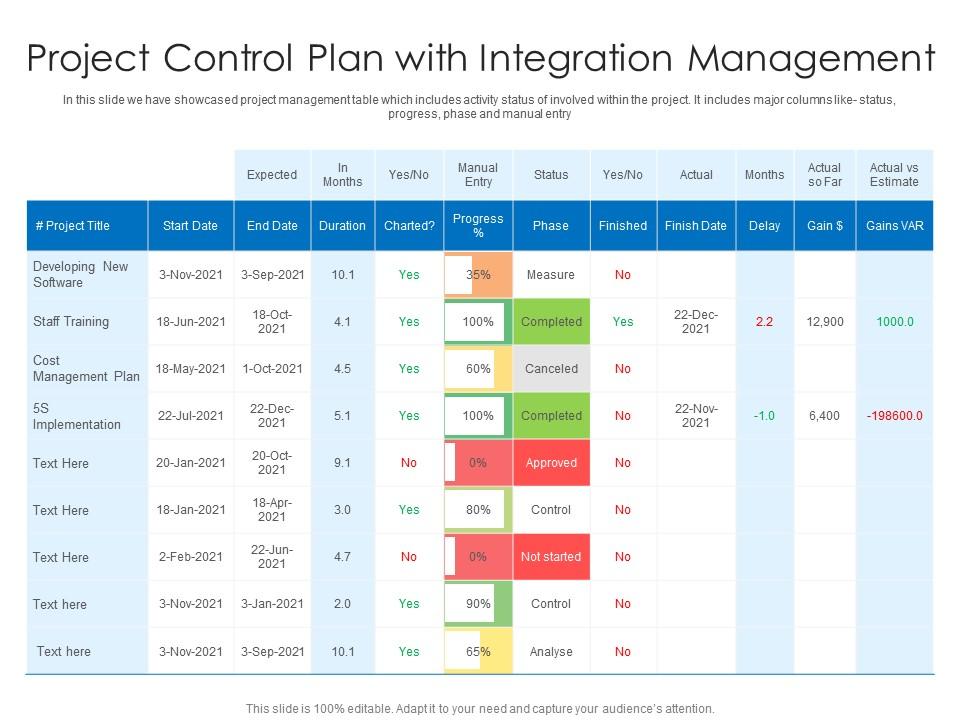
In this slide we have showcased project management table which includes activity status of involved within the project. It includes major columns like- status, progress, phase and manual entry. Presenting our well-structured Project Control Plan With Integration Management. The topics discussed in this slide are Implementation, Cost Management Plan, Staff Training. This is an instantly available PowerPoint presentation that can be edited conveniently. Download it right away and captivate your audience.

FAQs for Project control plan

Alright, so there are six main processes you gotta know. First is developing the project charter, then creating your project management plan. While you're executing, you'll be directing project work AND managing knowledge (that second one always catches people off guard). Throughout everything, you're also monitoring and controlling the work. Finally, you close out the project when it's done. These processes basically coordinate all your other project stuff together - think of them as the glue that holds everything else in place. Oh, and don't stress too much about memorizing the exact order at first.

Okay so basically it's like being the conductor of an orchestra - you're making sure all the different parts of your project actually work together instead of going rogue. Communication channels need to be solid from day one. Dependencies between teams? You'll be tracking those constantly. One team changes something and suddenly another team's timeline is screwed - that's the kind of mess you're preventing. Honestly the regular check-ins can feel annoying but they're worth it. Without someone coordinating everything, you get scope creep, conflicting priorities, and disconnected teams. Pretty much a recipe for disaster.

Get yourself a solid project charter and integrated plan first - keeps everyone on the same page about what you're actually doing. Break big tasks down with a work breakdown structure, trust me on this one. Change control is huge too (seriously, I've watched projects completely implode without it). Regular check-ins and dashboards help you catch problems early. Oh, and find decent project management software that puts everything in one spot - documents, communications, all of it. Nothing worse than hunting through ten different places for project info. These tools aren't fancy but they work.

Honestly, communication is everything here. Set up weekly calls with everyone involved - trust me, misaligned people will kill your project faster than bad code. Create some kind of shared dashboard or doc where folks can actually see how their stuff connects to the bigger picture. The trick is explaining *why* you're making certain integration choices and how it affects their work specifically. Nobody likes feeling like integration is just being forced on them, you know? Make it feel collaborative instead. Oh, and those check-ins I mentioned? Don't skip them even when things seem fine.

Honestly, change management is what keeps your integrated project from falling apart when stuff inevitably shifts. Set up a change control board right away - trust me on this one. When stakeholders ask for "just a tiny adjustment" (spoiler: it's never tiny), you'll need a solid process to track how that ripples through your scope, timeline, and budget. Document everything too. I know it seems tedious, but you'll be grateful for that paper trail later when you're explaining why deadlines moved. Without proper change control? Your nice, organized project plan becomes a hot mess real quick.

Honestly, integration management is your secret weapon for catching problems early. You get this overview of how all your project pieces fit together - scope, timeline, resources, the whole mess. Dependencies are where things usually blow up, so that's what I always watch first. Picture being an air traffic controller spotting two planes on a collision course. Same energy. When you're tracking changes across everything, you'll see those ripple effects coming before they wreck your day. Map out where different parts of your project connect - that's typically where your nastiest surprises are lurking.

Honestly, most project failures I've seen come down to teams not talking to each other properly. Scope creep is huge too - people keep adding stuff without any real change control process. Here's what kills me though: so many teams treat integration like something they'll figure out later instead of planning for it from day one. Nobody takes ownership either - everyone thinks someone else has it covered. You really need to nail down who's responsible for what early on. Do regular check-ins throughout the project, not just at the big milestones. Trust me, start planning integration during kickoff and you'll thank yourself later.

Dude, project charters are honestly game-changers for keeping everything tied together. They get all your stakeholders on the same page right from the start - same vision, same scope, no confusion. Without one, teams just wing it and you end up with a mess (trust me on this one). Your charter becomes like a roadmap that connects all the different moving pieces back to what you're actually trying to accomplish. When conflicts pop up between teams or someone tries sneaking in extra work, you've got that solid reference point to fall back on. Spend time making it super clear upfront - you'll thank yourself later when things get chaotic.

Look, you need to stay on top of your project's pulse constantly - scope, budget, timeline, quality, all of it. Think of yourself as watching multiple dashboards at once. Regular check-ins are huge because tiny problems turn into absolute nightmares if you're not paying attention. I learned this the hard way on a project last year, honestly. Set up your monitoring system early so you'll catch stuff before it spirals. Small course corrections beat major crisis mode every single time. Without tracking, you're basically hoping everything magically works out.

Honestly, most integration problems come down to communication breakdowns. Get your teams talking regularly - weekly syncs work great. Shared dashboards are clutch so everyone can see what's happening. Oh, and standardize how people report stuff or you'll get a million different formats that make no sense. The informal chats matter just as much as the official meetings though. I can't tell you how many times I've seen projects go sideways because one team had zero clue about another team's roadblocks. Dependencies pop up everywhere, so the earlier people flag issues, the better. Really comes down to creating space for actual conversations.

Honestly, start with schedule and budget variance - those two will tell you immediately if your integration's working or falling apart. Stakeholder satisfaction is massive too because angry stakeholders make everything harder (learned that one the hard way). I'd also watch how often scope keeps changing and how fast you're turning around change requests. Quality metrics matter but don't go crazy tracking everything. Pick maybe 2-3 that actually make sense for your project and stick with those. Communication breakdowns are worth noting too, though sometimes those just happen regardless.

So in agile, integration is happening all the time during sprints instead of those rigid phase gates waterfall loves. You're getting feedback constantly and making adjustments on the fly. Way better approach honestly. Traditional methods make you plan everything upfront with formal change processes - agile lets you adapt as you go. Your job changes from being the person who follows the plan no matter what to more of a team facilitator. Communication becomes huge since you'll be dealing with changes and feedback way more often. It's actually pretty refreshing once you get used to it.

Oh man, you're gonna hit some walls for sure. Resource conflicts are brutal - everyone wants the same people and budget. Dependencies between projects will mess you up too, like when Team A is waiting on Team B's stuff and nothing moves. Communication gets wild when you're juggling updates for different stakeholders across multiple things. Honestly, scope creep becomes your worst enemy because one change cascades everywhere else. Start with solid governance early (trust me on this). Get some planning tools that actually show you where projects connect. Otherwise you'll be putting out fires constantly.

Dude, cultural stuff will absolutely torpedo your global team integration if you're not careful. Some cultures are brutally direct, others dance around problems forever - makes escalating issues a nightmare. Then there's the whole time thing - I've seen teams miss deadlines because half the people think "10am meeting" means 10:15 is fine. Decision-making gets weird too. Hierarchical cultures need like five approvals while others want everyone's input first. Power dynamics mess with how people actually talk to leadership during integrations. Honestly? Just map this stuff out early and build extra time into your processes. Way better than scrambling later.

Honestly, just get everyone talking regularly - cross-functional workshops are clutch for tackling integration stuff hands-on instead of endless meetings about meetings (ugh). Daily standups help too, but keep them snappy. Set up shared dashboards so teams can actually see what's happening in real time. The biggest thing? Break down silos from day one. I'd start with a kickoff where teams map out who depends on what - seriously game-changing for clarity. Oh, and pick tools that don't make people want to throw their laptops out the window.

Ratings and Reviews

87% of 100
Review Form
Write a review
Most Relevant Reviews
  1. 80%

    by Clair Gray

    Design layout is very impressive.
  2. 80%

    by Dean Dixon

    Great quality slides in rapid time.
  3. 100%

    by Clark Ruiz

    Innovative and attractive designs.

3 Item(s)

per page: