Project implementation model for health centre

Rating:
80%
Project implementation model for health centre
Slide 1 of 2

or

Favourites Favourites

Try Before you Buy Download Free Sample Product

Audience Impress Your
Audience
Editable 100%
Editable
Time Save Hours
of Time
The Biggest Sale is ending soon in
0
0
:
0
0
:
0
0
Rating:
80%
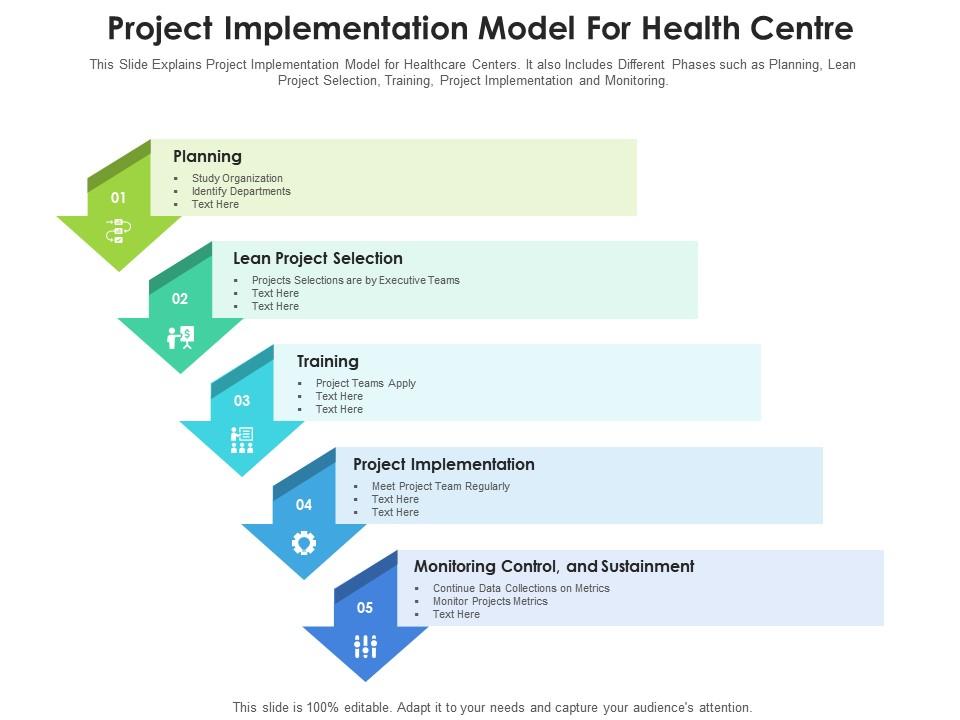
This Slide Explains Project Implementation Model for Healthcare Centers. It also Includes Different Phases such as Planning, Lean Project Selection, Training, Project Implementation and Monitoring. Presenting our set of slides with name Project Implementation Model For Health Centre. This exhibits information on five stages of the process. This is an easy-to-edit and innovatively designed PowerPoint template. So download immediately and highlight information on Planning, Project Implementation, Monitoring Control, Training, Lean Project Selection.

FAQs for Project implementation model

Key phases in health center project implementation include planning and assessment, design and development, procurement and construction, staff recruitment and training, and system integration and testing. These phases work together by establishing clear timelines, ensuring regulatory compliance, and coordinating multiple stakeholders, with many healthcare organizations finding that systematic implementation ultimately delivers improved patient care and operational efficiency.

Stakeholder engagement is effectively managed through regular communication schedules, structured feedback mechanisms, clear role definitions, and transparent progress reporting throughout each project phase. Healthcare projects particularly benefit from early involvement of medical staff, administrators, and patients in planning decisions, with many health centres finding that consistent stakeholder input reduces implementation resistance and ultimately delivers smoother system adoption.

Community involvement serves as a cornerstone for health center project success, enhancing local ownership, cultural alignment, trust-building, and sustainable resource mobilization. Through active engagement, these projects achieve better health outcomes, increased utilization rates, and long-term viability, with many rural and urban health initiatives finding that community-driven approaches ultimately deliver more effective services and stronger operational sustainability.

Community health assessments, demographic analysis, epidemiological surveys, stakeholder consultations, and focus group discussions enable comprehensive population needs evaluation. These methods streamline data collection by engaging local healthcare providers, community leaders, and residents directly, while analyzing existing health records and socioeconomic indicators, ultimately delivering targeted service planning and resource allocation strategies.

Technology can be integrated through electronic health records, telemedicine platforms, automated appointment systems, data analytics tools, and mobile health applications. These solutions streamline patient care by reducing administrative burdens, enabling remote consultations, and improving diagnostic accuracy, with many healthcare facilities finding that strategic technology adoption ultimately delivers faster patient services, lower operational costs, and enhanced treatment outcomes.

Critical performance indicators include patient satisfaction scores, treatment outcome improvements, operational efficiency metrics, cost reduction percentages, and staff productivity measures. These KPIs enable healthcare administrators to assess project impact through reduced wait times, enhanced patient experiences, and streamlined workflows, with many health centers finding that comprehensive measurement ultimately delivers sustainable improvements and competitive advantages in increasingly patient-centered healthcare environments.

**INPUT**: How can we ensure sustainability and long-term impact post-implementation? **OUTPUT**: Sustainability requires establishing robust monitoring systems, securing ongoing funding streams, training local staff for independent operations, and creating scalable processes that adapt to evolving needs. Healthcare organizations increasingly find that strategic partnerships with community stakeholders, continuous performance evaluation, and integration with existing health infrastructure ultimately deliver lasting impact while reducing long-term operational costs and enhancing patient care quality. **Word count: 58 words**

Funding sources for health center projects include federal grants, state allocations, private foundation funding, community development financial institutions, and public-private partnerships. These sources can be accessed through comprehensive grant applications, stakeholder engagement, and strategic partnerships with healthcare organizations, with many centers finding that diversified funding approaches ultimately deliver greater financial stability and enhanced community health outcomes.

Regulatory requirements significantly influence health center implementation by dictating facility standards, equipment specifications, staffing qualifications, and operational protocols throughout the development process. These compliance frameworks, while presenting initial complexity, ultimately streamline operations by establishing clear quality benchmarks, with many healthcare organizations finding that early regulatory integration reduces approval timelines and enhances patient safety outcomes.

Common project implementation challenges include resource constraints, stakeholder resistance, timeline delays, budget overruns, and inadequate communication protocols. Healthcare organizations mitigate these through comprehensive risk assessment, phased rollout strategies, and robust change management programs, with many medical facilities finding that early stakeholder engagement and continuous monitoring ultimately deliver smoother transitions and improved patient care outcomes.

Training and capacity building can be effectively incorporated through structured onboarding programs, continuous skill development workshops, mentorship systems, and competency-based assessments tailored to healthcare workflows. These approaches enhance staff proficiency by combining hands-on practice, digital learning platforms, and peer collaboration, with many health centers finding that systematic training reduces implementation timelines while improving patient care outcomes.

**INPUT**: What tools and frameworks are best suited for monitoring and evaluation of health center projects? **OUTPUT**: Effective monitoring and evaluation frameworks for health center projects include logic models, balanced scorecards, results-based frameworks, digital dashboards, and community feedback systems. These tools streamline project oversight by tracking clinical outcomes, operational efficiency, and patient satisfaction metrics, with many healthcare organizations finding that integrated monitoring approaches ultimately deliver improved care quality and resource optimization. [Word count: 56 words]

Intercultural competency enhances project outcomes by fostering trust, improving communication clarity, and ensuring culturally appropriate solution design that resonates with diverse community needs. Through culturally sensitive engagement strategies, health centers achieve higher patient participation rates, reduced implementation resistance, and more effective service delivery, with many facilities finding that culturally competent teams deliver significantly better health outcomes and community acceptance.

Strategies include establishing integrated care networks, implementing shared electronic health records, creating multidisciplinary care teams, developing standardized communication protocols, and organizing regular cross-provider meetings. These approaches streamline patient care by improving information flow, reducing service duplication, and enhancing care coordination, with many healthcare systems finding that collaborative frameworks ultimately deliver better patient outcomes and operational efficiency.

Data collection and analysis transforms health center decision-making by providing evidence-based insights for resource allocation, patient care optimization, and operational efficiency improvements. Through comprehensive health informatics systems, administrators can identify service gaps, predict patient volumes, and streamline workflows, ultimately delivering faster patient services and reduced operational costs while enhancing care quality across departments.

Ratings and Reviews

80% of 100
Review Form
Write a review
Most Relevant Reviews
  1. 80%

    by Douglass Riley

    Design layout is very impressive.

1 Item

per page: