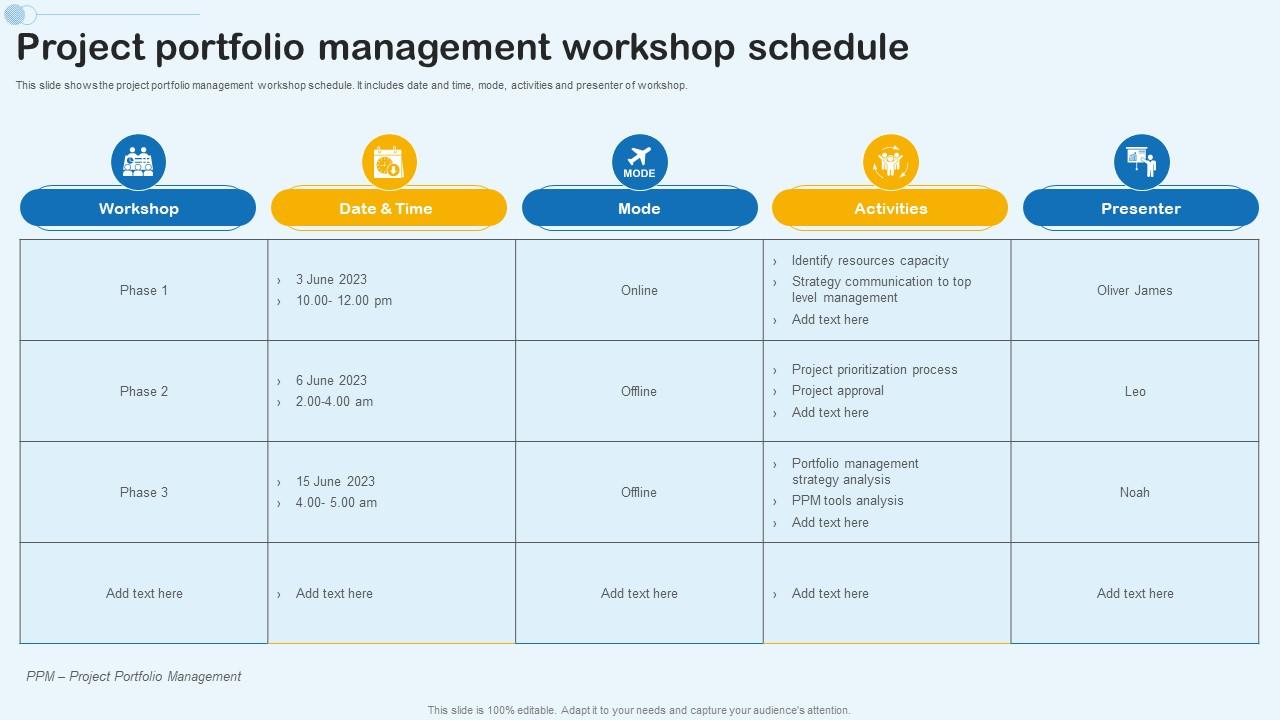
Project Portfolio Management Workshop Schedule
Try Before you Buy Download Free Sample Product
Audience
Editable
of Time
This slide shows the project portfolio management workshop schedule.It includes date and time, mode, activities and presenter of workshop.
People who downloaded this PowerPoint presentation also viewed the following :
Project Portfolio Management Workshop Schedule with all 6 slides:
Use our Project Portfolio Management Workshop Schedule to effectively help you save your valuable time. They are readymade to fit into any presentation structure.
FAQs for Project Portfolio
Effective project portfolio management includes strategic alignment, resource allocation, risk assessment, performance monitoring, and stakeholder governance. These components work together by ensuring projects support business objectives, optimizing resource distribution across initiatives, and maintaining portfolio balance, with many organizations finding that this integrated approach delivers enhanced operational efficiency and competitive advantage.
Organizations align their project portfolios with strategic goals through systematic evaluation frameworks, performance metrics tied to business objectives, regular portfolio reviews, and resource allocation prioritization. This strategic alignment enables companies to focus investments on high-impact initiatives, eliminate projects that don't support core objectives, and ultimately deliver measurable business outcomes while maintaining competitive advantage.
Prioritization enables organizations to allocate resources strategically across projects based on business value, risk assessment, and strategic alignment with organizational objectives. This systematic approach helps portfolio managers balance competing demands, optimize resource utilization, and maximize returns, with many companies finding that effective prioritization reduces project conflicts while accelerating delivery of high-impact initiatives.
Project portfolio management tools improve decision-making by providing real-time visibility into resource allocation, project performance metrics, and strategic alignment across initiatives. These platforms enable executives to compare ROI projections, identify bottlenecks, and prioritize high-value projects, with many organizations finding that centralized dashboards streamline approval processes and enhance strategic resource distribution.
Key portfolio success metrics include ROI, strategic alignment scores, resource utilization rates, portfolio risk indices, and schedule performance indicators. These measurements enable organizations to assess financial returns, strategic contribution, and operational efficiency across projects, with many enterprises finding that balanced scorecards combining financial and strategic metrics deliver comprehensive portfolio visibility and competitive advantage.
Resource allocation strategies significantly impact project portfolio management by determining project prioritization, timeline feasibility, and overall portfolio success through optimized resource distribution across initiatives. Strategic allocation enables organizations to maximize ROI, minimize resource conflicts, and enhance project delivery rates, with many companies finding that data-driven allocation frameworks ultimately deliver better portfolio outcomes and competitive advantage.
Common project portfolio management challenges include resource allocation conflicts, inadequate prioritization frameworks, poor strategic alignment, insufficient performance tracking, and limited cross-project visibility. These obstacles often result in competing priorities between departments, with many organizations finding that streamlined portfolio governance and integrated dashboards significantly enhance decision-making capabilities, ultimately delivering better resource utilization and strategic outcomes.
Risk management integrates into project portfolio decisions through comprehensive risk assessments, scenario modeling, risk-weighted scoring matrices, and diversification strategies across projects. Organizations leverage these approaches by evaluating potential threats during portfolio selection, balancing high-risk high-reward initiatives with stable projects, and continuously monitoring risk exposure, ultimately delivering more resilient portfolios and strategic competitive advantage.
Network analysis, dependency mapping, critical path evaluation, resource conflict assessment, and risk correlation studies help identify project interdependencies within portfolios. These techniques enable portfolio managers to visualize relationships, optimize resource allocation, and sequence initiatives strategically, with many organizations finding that systematic dependency assessment reduces scheduling conflicts and enhances overall portfolio performance.
Stakeholder engagement significantly influences project portfolio outcomes by ensuring alignment with strategic objectives, securing resource commitments, and facilitating informed decision-making throughout the portfolio lifecycle. Engaged stakeholders provide clearer requirements, faster approvals, and stronger support for project prioritization, with many organizations finding that consistent stakeholder communication reduces project conflicts and ultimately delivers better portfolio performance and strategic value.
Regular portfolio reviews and adjustments ensure projects remain aligned with strategic objectives, resource constraints, and market conditions through systematic evaluation of performance, priorities, and outcomes. These assessments enable organizations to reallocate resources, terminate underperforming initiatives, and capitalize on emerging opportunities, with many companies finding that quarterly reviews significantly improve portfolio ROI and strategic alignment.
Project portfolio management supports innovation by systematically evaluating, prioritizing, and allocating resources to breakthrough initiatives, emerging technologies, and strategic R&D investments. Through structured portfolio reviews, organizations can balance risk across innovative ventures while maintaining operational projects, with many companies finding that dedicated innovation portfolios accelerate time-to-market and deliver sustainable competitive advantages.
**INPUT**: What best practices should be followed for effective portfolio reporting? **OUTPUT**: Effective portfolio reporting best practices include standardized metrics across projects, regular cadence scheduling, stakeholder-specific dashboards, real-time data integration, and executive summary formats. These approaches streamline decision-making by enhancing transparency, minimizing reporting overhead, and enabling faster resource reallocation, with many organizations finding that consistent reporting frameworks ultimately deliver improved project outcomes and strategic alignment. [Word count: 57 words]
Portfolio management adapts to market changes through dynamic resource reallocation, regular portfolio reviews, strategic pivoting capabilities, and flexible prioritization frameworks. These approaches enable organizations to shift investments between projects based on emerging opportunities, with many financial services and technology companies finding that agile portfolio strategies deliver faster market responsiveness and sustained competitive advantage.
Emerging technologies enhancing project portfolio management include artificial intelligence for predictive analytics, machine learning for resource optimization, blockchain for transparent tracking, cloud-based platforms for real-time collaboration, and advanced data visualization tools. These technologies streamline decision-making, automate routine tasks, and enable better resource allocation, with many organizations finding that AI-driven insights significantly improve portfolio performance and strategic alignment.
-
“Detailed and great to save your time.”
-
Wide collection of templates available. SlideTeam has made it easier to create presentations in just a few minutes.