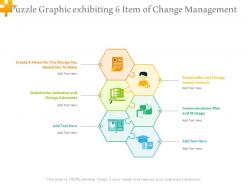
Puzzle graphic exhibiting 6 item of change management
Try Before you Buy Download Free Sample Product
Audience
Editable
of Time
Get handed over the controls with our Puzzle Graphic Exhibiting 6 Item Of Change Management. Everyone will follow your call.
People who downloaded this PowerPoint presentation also viewed the following :
Puzzle graphic exhibiting 6 item of change management with all 2 slides:
Get handpicked with our Puzzle Graphic Exhibiting 6 Item Of Change Management. They assure you an excellent assessment.
FAQs for Puzzle graphic exhibiting 6 item
Key steps in successful change management include establishing urgency, building a guiding coalition, developing a clear vision, communicating effectively, empowering employees, generating short-term wins, and sustaining momentum. These steps work by creating organizational alignment, reducing resistance, and ensuring systematic adoption, with many companies finding that structured approaches ultimately deliver smoother transitions and higher success rates.
Organizations effectively communicate change through transparent messaging, regular updates, multiple communication channels, leadership engagement, and two-way feedback mechanisms. By combining town halls, digital platforms, and direct supervisor conversations, companies enable employees to understand the rationale, timeline, and personal impact, while addressing concerns proactively, ultimately building trust and reducing resistance throughout the transformation process.
Leadership plays a pivotal role in facilitating organizational change by establishing clear vision, communicating strategic direction, securing necessary resources, and modeling adaptive behaviors throughout the transformation process. Effective leaders in healthcare systems, manufacturing companies, and financial institutions create psychological safety, address resistance proactively, and maintain momentum during transitions, ultimately delivering higher adoption rates and sustainable organizational outcomes.
Resistance to change can be identified through employee feedback surveys, declining productivity metrics, increased absenteeism, and informal communication patterns that reveal concerns or skepticism. Proactive management involves transparent communication about change benefits, involving employees in planning processes, providing comprehensive training and support, and addressing specific concerns through regular check-ins, ultimately building buy-in and smoother transitions.
Effective change management tools include stakeholder mapping, communication frameworks, training programs, resistance assessment matrices, and progress tracking dashboards. These methodologies work by identifying key influencers, establishing clear communication channels, and building employee capability, with many organizations finding that combining structured approaches like Kotter's 8-step process with digital collaboration platforms ultimately delivers smoother transitions and higher adoption rates.
Integrating change management into organizational culture requires embedding adaptability into core values, training leaders as change champions, establishing continuous feedback mechanisms, and creating reward systems that celebrate innovation. Organizations like Microsoft and Amazon demonstrate this by fostering growth mindsets, empowering cross-functional teams, and maintaining open communication channels, ultimately delivering enhanced agility and competitive advantage in rapidly evolving markets.
Change management success metrics include employee adoption rates, performance indicators, stakeholder satisfaction scores, timeline adherence, and return on investment measurements. These metrics work together by tracking behavioral shifts, operational improvements, and financial outcomes, with many organizations finding that combining quantitative data with qualitative feedback delivers comprehensive insights into transformation effectiveness and long-term sustainability.
Employee training and development support change management by equipping staff with necessary skills, building confidence in new processes, and reducing resistance through understanding. Through targeted programs, organizations enhance communication, accelerate adoption rates, and foster a culture of continuous improvement, with many companies finding that well-trained employees become change champions who drive successful transformation initiatives.
Effective stakeholder buy-in strategies include transparent communication, early involvement in planning, addressing concerns proactively, demonstrating clear benefits, and providing adequate training and support. These approaches work by building trust, reducing resistance, and aligning individual interests with organizational goals, with many companies finding that consistent engagement and showing quick wins ultimately delivers smoother transitions and sustained commitment.
Organizational structures significantly influence change management through communication flows, decision-making speed, and resource allocation mechanisms. Hierarchical organizations often require more extensive approval processes and top-down cascading, while flatter structures enable faster adaptation and cross-functional collaboration, with many companies finding that decentralized approaches ultimately deliver greater agility and employee engagement during transformational initiatives.
Common change management pitfalls include insufficient communication, lack of leadership buy-in, inadequate training, resistance management failures, and unrealistic timelines. These challenges often derail transformation initiatives in organizations across industries, with many companies finding that addressing employee concerns early, maintaining transparent progress updates, and securing executive support throughout the process ultimately delivers smoother transitions and higher adoption rates.
Technology enhances change management effectiveness by providing real-time analytics, automated communication workflows, digital training platforms, and progress tracking dashboards that streamline implementation processes. These tools enable organizations to monitor adoption rates, identify resistance patterns early, and deliver personalized support interventions, ultimately accelerating transformation timelines while reducing costs and improving employee engagement across all organizational levels.
Feedback loops are crucial in change management as they enable continuous monitoring, real-time adjustments, and stakeholder engagement throughout transformation initiatives. These mechanisms help organizations identify resistance early, measure progress against objectives, and refine strategies based on employee responses, ultimately delivering more successful implementations and higher adoption rates across all organizational levels.
Organizations ensure changes align with long-term strategic goals by establishing clear strategic frameworks, conducting thorough impact assessments, and maintaining consistent communication across all levels. Through strategic planning sessions and regular milestone reviews, companies can evaluate alignment effectiveness, adjust implementation approaches, and monitor progress indicators, with many finding that structured change governance ultimately delivers sustainable competitive advantage and organizational resilience.
Failed change initiatives reveal that inadequate communication, insufficient leadership commitment, and poor employee engagement are primary failure drivers, along with unrealistic timelines and lack of clear vision. These failures teach organizations that successful transformation requires transparent communication strategies, comprehensive training programs, and strong stakeholder buy-in, with many companies finding that addressing resistance early and maintaining consistent leadership support ultimately delivers sustainable change and competitive advantage.
No Reviews