Qualitative and quantitative risk analysis ppt example
Try Before you Buy Download Free Sample Product
Audience
Editable
of Time
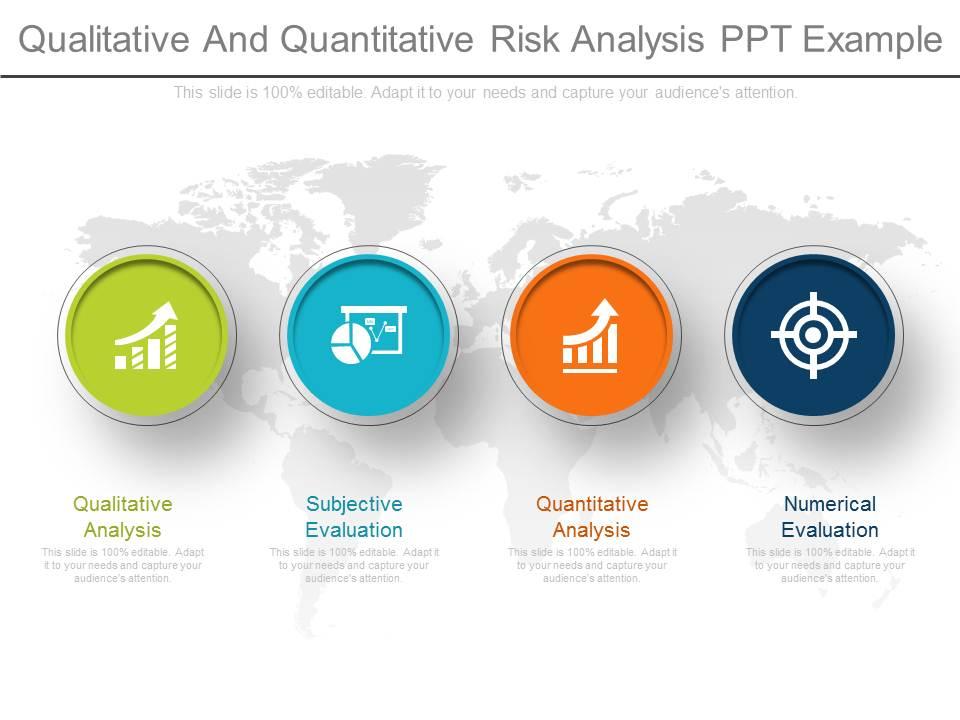
In order to monitor the qualitative and quantitative risk in business and develop a response plan, it’s important to infuse technology and not use the traditional approach. In order to define and declare the set goals and objectives, use the high quality content, work on sales conversion rates, design a good sales cycle plan and thus win all the crucial factors by your side – all can be managed using this pre designed PPT visual, which offers high resolution in color effects and diagrams. The qualitative and quantitative risk analysis PPT design helps to define strategic, cross functioning and interconnecting text so that development of investment tools and branding of product and service becomes way much easy. Meaningfully aligned icons, with a professional touch to presentation slide show help to analyze the situation well and work on highest impact objectives like budget, schedule and source or effect based quality. It’s important to have pre designed rating scale that not only keeps the PPT slide well in order but also boosts productivity.Even guesses come good with our Qualitative And Quantitative Risk Analysis Ppt Example. They are based on established facts.
People who downloaded this PowerPoint presentation also viewed the following :
Qualitative and quantitative risk analysis ppt example with all 7 slides:
Our Qualitative And Quantitative Risk Analysis Ppt Example make assimilation easier. They ensure better absorption.
FAQs for Qualitative and quantitative risk
Key components of comprehensive risk analysis include risk identification, probability assessment, impact evaluation, risk categorization, and mitigation planning. These elements work together by systematically cataloging potential threats, quantifying their likelihood and consequences, and developing strategic responses, with organizations across finance, healthcare, and manufacturing finding that this structured approach enhances decision-making and operational resilience.
Qualitative risk assessment uses descriptive categories and expert judgment to evaluate probability and impact, while quantitative methods employ numerical data, statistical models, and mathematical calculations for precise risk measurement. While quantitative approaches deliver more accurate financial predictions and measurable outcomes, qualitative methods prove more effective for emerging risks and complex scenarios where historical data is limited, with many organizations finding that combining both approaches ultimately enhances comprehensive risk management and strategic decision-making.
Historical data and predictive analytics serve as the foundation for effective risk analysis by identifying patterns, trends, and potential vulnerabilities across past incidents and market conditions. Through machine learning algorithms and statistical modeling, organizations in banking, insurance, and manufacturing can forecast potential risks, optimize resource allocation, and develop proactive mitigation strategies, ultimately delivering enhanced decision-making capabilities and competitive advantage.
Organizations ensure current risk analysis by regularly updating threat assessments, incorporating emerging technologies like AI-powered monitoring, conducting quarterly reviews, and integrating real-time data feeds from multiple sources. Through continuous stakeholder feedback and cross-industry benchmarking, companies can adapt their frameworks to evolving regulatory requirements and market conditions, ultimately maintaining competitive advantage while minimizing exposure.
Common risk analysis pitfalls include inadequate data collection, over-reliance on historical patterns, siloed departmental approaches, insufficient scenario planning, and poor stakeholder communication. These oversights can lead to blind spots in strategic planning, with many organizations finding that comprehensive cross-functional collaboration and regular reassessment ultimately delivers more accurate threat identification and competitive advantage.
Visual presentation tools enhance risk analysis communication by transforming complex data into clear charts, heat maps, dashboards, and infographics that stakeholders can quickly understand and act upon. These tools enable risk managers to present probability matrices, trend analyses, and impact assessments more effectively, with many organizations finding that visual risk reports accelerate decision-making and improve stakeholder buy-in significantly.
Risk analysis supports project management decision-making by identifying potential threats, assessing their probability and impact, evaluating mitigation strategies, prioritizing resource allocation, and informing contingency planning. Through systematic risk assessment, project managers can make data-driven choices about timelines, budgets, and scope adjustments, ultimately delivering more predictable outcomes and enhanced stakeholder confidence.
Cultural and regulatory differences significantly shape risk analysis in global operations by requiring localized compliance frameworks, varied stakeholder expectations, and different risk tolerance levels across regions. These differences influence assessment methodologies, reporting standards, and mitigation strategies, with many multinational organizations finding that standardized approaches must be adapted for local markets while maintaining consistent global oversight and strategic coordination.
Risk tolerance levels determine acceptable risk thresholds for organizations, guiding strategic decision-making, resource allocation, and operational boundaries during risk analysis. By establishing clear tolerance parameters, businesses can prioritize mitigation efforts, balance growth opportunities with potential losses, and make informed choices that align with stakeholder expectations, ultimately enabling sustainable operations while pursuing competitive advantage in increasingly complex market environments.
Stakeholders can be effectively engaged through structured interviews, collaborative workshops, risk assessment surveys, regular communication updates, and cross-functional team participation throughout the analysis process. These approaches enable organizations to capture diverse perspectives, validate risk assumptions, and build consensus around mitigation strategies, with many finding that early stakeholder involvement significantly improves risk identification accuracy and implementation success.
Best practices for integrating risk analysis into strategic planning include continuous risk assessment, scenario planning, stakeholder involvement, regular monitoring systems, and cross-functional collaboration. These approaches enable organizations to identify potential threats early, develop contingency strategies, and make informed decisions, with many companies finding that systematic integration ultimately delivers enhanced operational resilience and competitive advantage.
Technology like AI and machine learning significantly enhances risk analysis accuracy by processing vast datasets, identifying complex patterns, and providing real-time assessments that human analysts might miss. These technologies enable financial institutions and insurance companies to streamline fraud detection, optimize loan approvals, and deliver more precise risk predictions, ultimately reducing operational costs while improving decision-making speed and reliability.
Key metrics include risk identification coverage, assessment accuracy rates, mitigation response times, false positive ratios, and compliance alignment scores. These measurements enhance organizational resilience by tracking predictive performance, operational efficiency, and strategic alignment, with many financial institutions and healthcare organizations finding that comprehensive metric dashboards ultimately deliver improved decision-making speed and competitive advantage.
Scenario analysis enhances risk understanding by modeling multiple future conditions, stress-testing assumptions, and revealing hidden vulnerabilities across different business environments. Through systematic evaluation of best-case, worst-case, and moderate scenarios, organizations streamline contingency planning, optimize resource allocation, and strengthen strategic decision-making, ultimately delivering enhanced preparedness and competitive advantage.
Organizations can continuously improve risk analysis capabilities through regular risk assessment updates, advanced analytics integration, cross-functional team training, automated monitoring systems, and stakeholder feedback loops. These strategies enhance decision-making by identifying emerging threats faster, streamlining response protocols, and building organizational resilience, with many financial services and healthcare institutions finding that systematic capability building ultimately delivers competitive advantage and operational efficiency.
-
Awesomely designed templates, Easy to understand.
-
The content is very helpful from business point of view.