


Real estate appraisal and a review of valuation powerpoint presentation slides





Try Before you Buy Download Free Sample Product
 Impress Your
 Audience
 100%
100% Editable
 Save Hours
 of Time


Introducing our real estate appraisal and a review of valuation PowerPoint presentation slides. Analyze the key real estate market with the help of our property investment PowerPoint deck. This estate analysis PPT theme consists of a slide that talks about the key takeaways related to real estate valuation. Assimilating this property finance PPT layout helps you give a brief on client information. This readymade property sponsor inspection PowerPoint design contains a slide that talks about the role of property inspection and examination. Incorporating this particular plot investment sources PPT theme lets you state the factors influencing the market value of real estate. This property cost inspection PowerPoint creative set contains slides which visually overview the property locations and nearby landmarks.This estate appraisal PPT deck lets you make required variations to icons and colors. Choose this property inspection PowerPoint design to showcase organization and assurance. Download this PPT slide to explore true perfection.
People who downloaded this PowerPoint presentation also viewed the following :
Content of this Powerpoint Presentation
Slide 1: This is a Template that illustrates the topic Real Estate Appraisal.
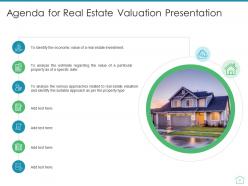
Slide 2: This slide illustrates the Agenda for Real Estate Valuation Presentation covering the aspects that identify the economic value of a real estate investment, analyze the estimate regarding the value of a particular property as of a specific date, and more.
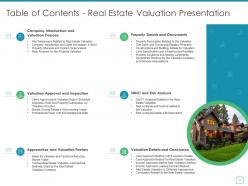
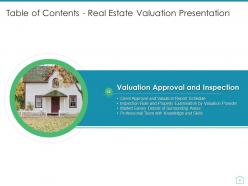
Slide 3: This is a Table of Contents slide that illustrates the topics including, Real Estate Valuation Presentation, Client Approval and Valuation Report Schedule, Inspection Role and Property Examination by Valuation Provider, Market Survey Details of Surrounding Areas, and more.
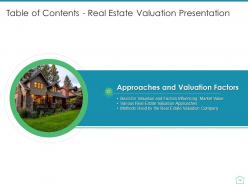
Slide 4: This is a Table of Contents slide that illustrates the topic Real Estate Valuation Presentation.
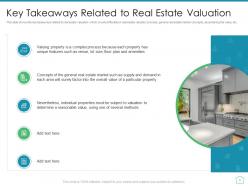
Slide 5: This slide shows the key takeaways related to real estate valuation which covers difficulties in the real estate valuation process, general real estate market concepts, ascertaining fair value, etc.
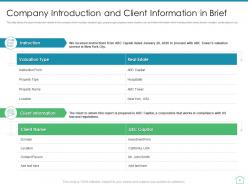
Slide 6: This slide shows the basic introduction related to the company which includes valuation type, property type, property name, location, and client information.
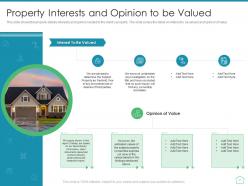
Slide 7: This slide shows the property details the interests and opinions related to the client’s property.
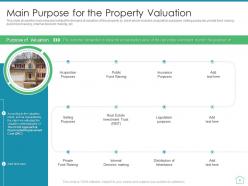
Slide 8: This slide shows the main reasons behind the demand of valuation of the property by a client including, acquisition purposes, selling purposes, private fundraising, public fundraising, internal decision making, etc.
Slide 9: This is a Table of Contents slide that illustrates the topic Real Estate Valuation Presentation.
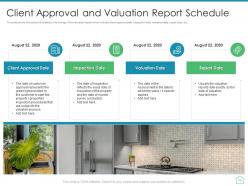
Slide 10: This slide shows the schedule related to the timings of the valuation report including, client approval date, inspection date, valuation date, report date, etc.
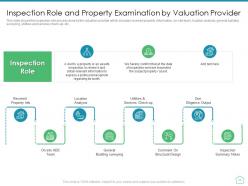
Slide 11: This slide shows the inspection role process done by the valuation provider that includes received property information, on-site team, location analysis, general building surveying, utilities and services check-up, etc.
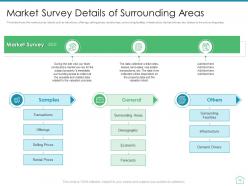
Slide 12: This slide shows the market survey details, such as transitions, offerings, selling prices, rental prices, surrounding facilities, infrastructure, demand drivers, etc, related to the surrounding areas.
Slide 13: This slide shows the professional team details of the real estate valuation provider company with their knowledge and skills specifications such as group CEO, head of the valuation department, etc.
Slide 14: This is a Table of Contents slide that illustrates the topic of Approaches and Valuation Factors.
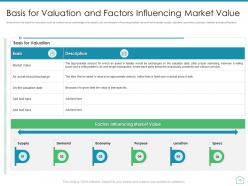
Slide 15: This slide shows the basis for valuation, such as market value, exchange of assets, and factors influencing market value.
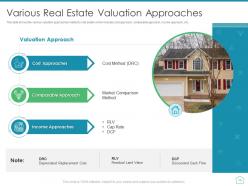
Slide 16: This slide shows the various valuation approaches related to real estate including, the cost approach, comparable approach, income approach, etc.
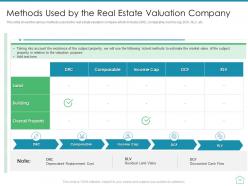
Slide 17: This slide shows the various methods used by the real estate valuation company that includes DRC, comparable, income cap, DCF, RLV, etc.
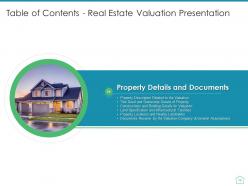
Slide 18: This is a Table of Contents slide that illustrates the topic of Property Details and Documents.
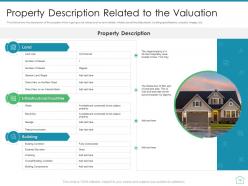
Slide 19: This slide shows the description of the property which is going to be valued, such as land details, infrastructural facilities details, building specifications, property images, etc.
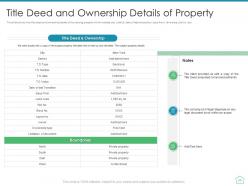
Slide 20: This slide shows the title deed and ownership details of the valuing property that includes city, district, date of the last transaction, issue from, land area, plot no. etc.
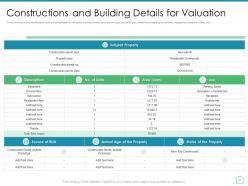
Slide 21: This slide shows the construction and building details for valuation, such as construction permit type, property type, basement details, ground floor, mezzanine, restaurant floor, etc.
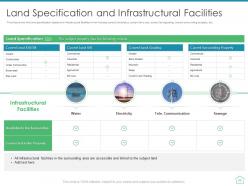
Slide 22: This slide shows the land specification details and infrastructural facilities including, current land status, current land use, current land grading, current surrounding property, etc.
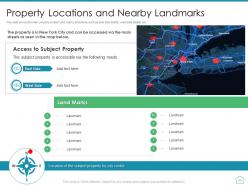
Slide 23: This slide shows the main property location and nearby landmarks, such as east side details, west side details, etc.
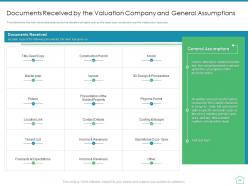
Slide 24: This slide shows the main documents received by the valuation company, such as title deed copy, construction permit, master plan, layout, etc.
Slide 25: This is a Table of Contents slide that illustrates the topic of SWOT and Risk Analysis.
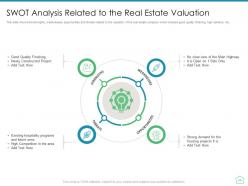
Slide 26: This slide shows the strengths, weaknesses, opportunities, and threats related to the valuation of the real estate company, which includes good quality finishing, high demand, etc.
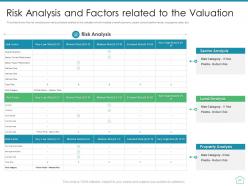
Slide 27: This slide shows the risk analysis and various factors related to the valuation including, the overall economy, sector current performance, occupancy rates, etc.
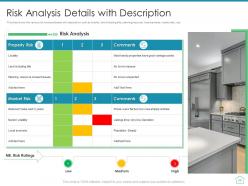
Slide 28: This slide shows the various risk analysis factors with descriptions, such as locality, land including title, planning resource, improvements, market risks, etc.
Slide 29: This is a Table of Contents slide that illustrates the topic of Valuation Details and Conclusion.
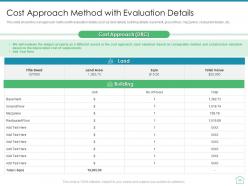
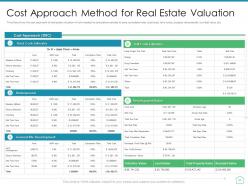
Slide 30: This slide shows the cost approach method with evaluation details, such as land details, building details, basement, ground floor, mezzanine, restaurant details, etc.
Slide 31: This slide shows the cost approach of real estate valuation including, the calculations related to the area, completion rate, total costs, land value, property value details, rounded value, etc.
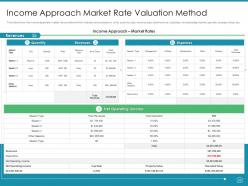
Slide 32: This slide shows the income approach market value method including, various seasons, units, quantity, rate, revenue type, total revenue, total days, net operating income, cap rate, and more.
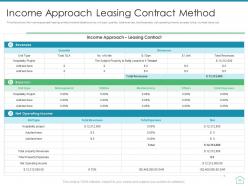
Slide 33: This slide shows the income approach leasing contract method details, such as unit type, quantity, total revenues, total expenses, net operating income, property value, rounded value, etc.
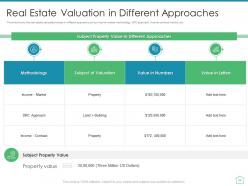
Slide 34: This slide shows the real estate calculated values in different approaches, such as income-market methodology, DRC approach, Income-contract method, etc.
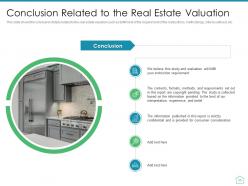
Slide 35: This slide shows the conclusion details related to the real estate valuation, such as the fulfillment of the requirement of the instructions, methodology, criteria outlined, etc.
Slide 36: This is an Icon Slide that illustrates the topic of Real Estate Appraisal and a Review of Valuation.
Slide 37: This template illustrates the beginning of the Additional Slides.
Slide 38: This is an About Us slide that includes the information related to the company’s Professional, Creative, and Talented Employees.
Slide 39: This is Our Team slide that includes the information of various Employees and their Designation.
Slide 40: This slide illustrates the company’s Mission, Vision, and Goals.
Slide 41: This is a 100% editable Puzzle template that can adapt to your needs and capture your audience's attention.
Slide 42: This is a Post-It Notes slide that can be used to mention critical information.
Slide 43: This is a 30-60-90 Day Plan slide that can be used to illustrate various projects and strategies.
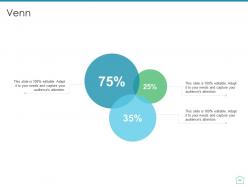
Slide 44: This is a Venn Diagram slide that can be easily customized with your statistics.
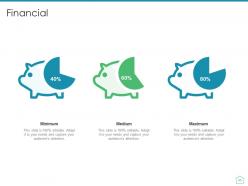
Slide 45: This is a Financial slide that depicts the Minimum, Medium, and Maximum contribution towards a project.
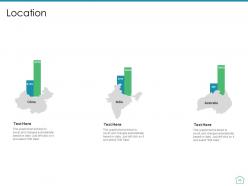
Slide 46: This is a Location slide that is linked to Excel and changes automatically based on data.
Slide 47: This slide depicts the Timeline Process of various project ideas and frameworks.
Slide 48: This is a Thank You slide that illustrates the Company Address, Contact Details, Email, and more.
Real estate appraisal and a review of valuation powerpoint presentation slides with all 48 slides:
Use our Real Estate Appraisal And A Review Of Valuation Powerpoint Presentation Slides to effectively help you save your valuable time. They are readymade to fit into any presentation structure.






FAQs for Real estate appraisal and a review of valuation
Location's huge obviously, but don't forget condition and size matter just as much. Recent sales in your area will give you the best baseline. Market trends, renovations, neighborhood stuff - it all adds up. Age of the house plays a role too. Here's the thing though - sometimes random factors like traffic noise or an awesome view can totally throw off your expectations. My cousin's place sold way higher just because of the mountain view. You gotta look at everything together, not just pick one thing and run with it.
Dude, location is literally everything when it comes to appraisals. School districts matter huge. So do crime rates, how close you are to stuff you actually need, and whether you can get around easily. A house right by a highway? It's gonna appraise way lower than the exact same house on some quiet side street. Market conditions are crazy different too - I've seen identical places where one's $300k and another's $500k just because of the zip code. Oh, and definitely point out any cool location perks to your appraiser since they're usually rushing through.
So basically comps are everything when you're getting your place appraised. They look at what similar houses actually sold for in your area - usually within the past 6 months. Your appraiser takes those sales and adjusts based on differences like size, condition, all that stuff. Honestly, finding truly comparable properties is trickier than it sounds. Same neighborhood helps, but square footage and condition matter way more than people think. Without decent comps, you're just throwing darts at a board. I'd definitely ask your appraiser which ones they used - some are better than others.
Yeah so basically the economy totally messes with property values. Rising interest rates? Fewer buyers show up. Inflation hits construction costs and rent prices - everything costs more these days, obviously. Job growth in your area is huge too since people need work to buy houses. I always forget about this but market supply matters a ton - like if there's way too many houses or not enough, values swing pretty dramatically. Check recent economic data and local employment stuff before you wrap up. It'll back up your numbers and you won't miss any major shifts happening.
Property condition can totally make or break your appraisal. Appraisers check everything - structural stuff, cosmetic issues, how it stacks up against other homes that sold nearby. Got a leaky roof or sketchy wiring? Your value's gonna tank compared to houses that are move-in ready. But honestly, even small fixes can help your case. I'd do a walkthrough beforehand and tackle any obvious problems or safety stuff that might freak them out. Oh, and look at it like you're seeing it for the first time - that helps you spot things you've been ignoring.
So here's the deal - appraisers will add value for good renovations, but what you spent doesn't always equal what you get back. They're basically comparing your updated house to other renovated homes that sold recently in your area. Kitchens and bathrooms usually give you the biggest bang for your buck. But that crazy custom wine cellar you installed? Yeah, might not impress them as much as you think. Oh, and definitely check out what improvements actually worked for your neighbors before you start tearing down walls.
So there are basically three ways appraisers figure out your home's value. Most common is comparing recent sales of similar houses nearby - you've probably done this yourself on Zillow. Then there's the cost approach where they calculate what it'd cost to rebuild your place from scratch, which honestly seems kinda weird but whatever. For investment properties, they use income approach and look at potential rental money. Oh and newer or unique homes sometimes rely more on that cost method since there aren't good comparisons. Your appraiser will probably mix these depending on your specific situation and what's happening in your local market.
Honestly, they're totally different beasts. Houses are pretty simple - appraisers just look at what similar homes sold for nearby. But commercial stuff? Way more complex since you're dealing with income streams, cap rates, all that financial stuff. Takes forever too - like weeks instead of days. Plus it costs way more and you need specialized appraisers who actually know office buildings or whatever you're buying. I learned this the hard way when we tried using our regular guy for a small warehouse. Make sure whoever you hire has done your specific property type before.
Zoning totally controls what you can do with a property, which directly hits the value. Can't open a shop if it's zoned residential - learned that the hard way when my cousin tried! Most people never even check zoning until they've got big dreams for a place. Mixed-use and commercial zones usually appraise way higher than residential-only areas. Appraisers factor this stuff in automatically. You'll want to look up the zoning early on and see if there's any changes coming down the pipeline. Honestly, it's one of those boring details that can make or break a deal.
First thing - clean everything and get rid of clutter so the appraiser can actually see your place. Fix obvious stuff like dripping faucets or any peeling paint. All your lights should work too. Basically think of it like company's coming over, but way more intense lol. Make a list of any improvements you've done recently with what they cost and when - new floors, kitchen reno, HVAC, whatever. If you know about similar houses that sold nearby recently, grab that info too. The goal is making your house look amazing while giving them real numbers to back up your value.
So basically the bank orders an appraisal to make sure they're not lending you more than the house is worth. Makes sense, right? An independent appraiser comes out and confirms the value matches your loan amount. If it comes back too low, you're kinda screwed - you'll either need to renegotiate the price, bring extra cash, or walk away entirely. Honestly such a stressful part of the whole process! But it does protect you from overpaying too, which is huge in this market.
Dude, schools make or break property values - seriously, good districts can boost prices 10-20%. Parks, reliable trash pickup, decent police response... all that stuff matters way more than people think. Transit access is massive too. I learned this the hard way when I almost bought near a sketchy bus stop lol. Nobody wants to feel like the city forgot their neighborhood exists. When you're looking at comps, definitely factor in these amenities because buyers will absolutely pay extra for convenience. It's wild how much a good elementary school down the street can add to your home value.
Honestly, your biggest headache will be that comp sales become worthless when prices are bouncing around every month. You're stuck trying to value something today with sales from months ago that don't mean anything anymore. Kind of like using an old map, you know? Plus your adjustment calculations get way messier since you have to factor in these crazy market swings. Clients and lenders will definitely push back harder on your numbers too. I'd start watching weekly trends in your main areas - oh, and definitely get tight with some active agents who can give you the real scoop on what's actually happening out there.
Zillow's decent for a rough idea, but don't count on it being super accurate. Those algorithms miss tons of stuff - like if you renovated your kitchen or if the house next door is falling apart. Remember when Zillow had to shut down their whole house-flipping thing? Yeah, their estimates were that bad. A real appraiser actually walks through your place and knows the local market way better. For anything serious like refinancing or selling, you'll want the professional route. Online tools are fine if you're just being nosy about your neighbor's house value though.
Don't let clients bully you into hitting their magic number - I've seen appraisers cave on this and it never ends well. Your signature's on that report, so you better be able to defend every conclusion. Stay competent for whatever property type you're handling, keep client info confidential, and base everything on real market data. Keep your license current too (obvious but people forget). Honestly, the whole job comes down to independence and accuracy. If you can't stand behind the numbers, don't put them down.
-
Great quality slides in rapid time.
-
Thanks for all your great templates they have saved me lots of time and accelerate my presentations. Great product, keep them up!
-
Topic best represented with attractive design.
-
Unique design & color.