

Real Estate Development Investment Proposal Report Sample Example Document




Try Before you Buy Download Free Sample Product
 Impress Your
 Audience
 100%
100% Editable
 Save Hours
 of Time


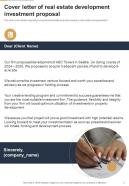
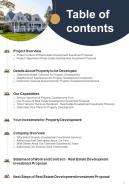
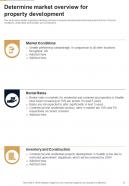
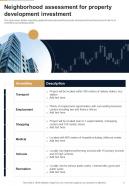
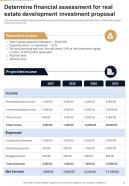
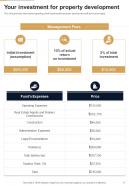
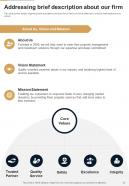
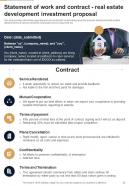
Get sufficient monetary support from your stakeholders using this readily-available Real Estate Development Investment Proposal. It includes the project context wherein you can share the exact requirement of the funds from the client. It also provides information related to the marketing overview of property development investment projects using which you can talk about the market conditions and the prevailing rental rates. Also, you can throw some light on the neighbourhood assessment for property development in terms of the amenities provided. Determine floor plans, and depict the clients investment for property development with an associated price. Convince your investors in your firm by showcasing how you are performing better than your competitors. Talk about the past projects that you have handled successfully. Present your companys vision, mission, and background and introduce your team in front of the viewers. Finalize the deal by getting it signed by the clients utilizing the statement of work and contract slide and decide the next steps to be taken. Download it now.
People who downloaded this PowerPoint presentation also viewed the following :
Real Estate Development Investment Proposal Report Sample Example Document with all 34 slides:
Use our Real Estate Development Investment Proposal Report Sample Example Document to effectively help you save your valuable time. They are readymade to fit into any presentation structure.








FAQs for Real Estate Development Investment Proposal Report
A successful real estate development investment proposal includes comprehensive market analysis, detailed financial projections, site feasibility studies, development timeline, and risk assessment frameworks. These components work together by demonstrating market demand, projected returns, and operational viability, with many institutional investors and development firms finding that thorough proposals significantly enhance funding approval rates and strategic partnership opportunities.
Market analysis influences real estate investment feasibility by assessing demand patterns, pricing trends, competitive landscape, demographic shifts, and economic indicators within target locations. Through comprehensive market research, developers can identify optimal property types, pricing strategies, and timing decisions, while minimizing risks and maximizing returns, ultimately delivering strategic advantages in increasingly competitive markets.
Key financial metrics include net present value (NPV), internal rate of return (IRR), cash-on-cash returns, debt service coverage ratios, and projected capitalization rates. These metrics enable investors to assess profitability, risk exposure, and market positioning comprehensively, with many institutional investors and private equity firms finding that detailed financial projections ultimately deliver transparency and confidence in strategic investment decisions.
Zoning laws and regulations significantly influence development proposals by determining permitted land uses, building heights, density requirements, setback distances, and parking specifications. These regulatory frameworks can present both challenges and opportunities, with many developers finding that early engagement with planning authorities, strategic site selection, and compliance planning ultimately streamlines approval timelines and enhances project viability.
Location significantly influences investment evaluation through accessibility, demographic alignment, infrastructure quality, zoning regulations, and future development potential. Strategic locations near transportation hubs, growing employment centers, or emerging neighborhoods often deliver higher appreciation rates, stronger rental demand, and better exit strategies, with many developers finding that prime positioning ultimately determines long-term profitability and competitive advantage.
Developers can effectively assess investment risks through comprehensive market analysis, financial modeling, due diligence reviews, regulatory compliance audits, and environmental assessments. These strategies enable risk mitigation by diversifying project portfolios, securing appropriate insurance coverage, and establishing contingency reserves, with many developers finding that thorough feasibility studies and strategic partnerships ultimately deliver more predictable returns and competitive market positioning.
Real estate development financing options include construction loans, bridge financing, mezzanine debt, equity partnerships, and permanent mortgage financing. These funding mechanisms enable developers to secure capital for land acquisition, construction phases, and long-term ownership, with many projects combining multiple sources to optimize cost structures and minimize risk exposure throughout development cycles.
Environmental assessments can be integrated through comprehensive due diligence sections, regulatory compliance documentation, sustainability impact analyses, and risk mitigation strategies within the proposal framework. These evaluations enhance investor confidence by demonstrating environmental stewardship, regulatory adherence, and long-term viability, while many development firms find that proactive environmental integration ultimately delivers competitive advantages and streamlined approval processes.
A solid project timeline demonstrates credibility, enables accurate financial projections, and helps investors assess risk by showing realistic development phases, regulatory approvals, and market entry strategies. With many real estate investors finding that detailed timelines reduce uncertainty, these schedules ultimately enhance investor confidence while enabling better resource allocation and competitive positioning in increasingly dynamic markets.
Different real estate types require distinct investment proposal structures, with residential focusing on demographic analysis and rental yields, commercial emphasizing tenant creditworthiness and lease terms, and industrial prioritizing location logistics and long-term stability. These variations influence financing structures, risk assessments, and return projections, with many developers finding that commercial properties demand more complex cash flow modeling while residential investments streamline approval processes through standardized metrics.
Supporting documents should include financial projections and cash flow analyses, market research and feasibility studies, architectural plans and development timelines, legal documentation covering zoning and permits, and detailed contractor bids. These comprehensive materials enable investors to assess project viability, risk factors, and profit potential, with many investment committees finding that thorough documentation significantly accelerates approval processes and enhances funding confidence.
Developers demonstrate ROI potential through detailed financial projections, market analysis showing demand trends, comparable property performance data, and clear revenue streams from sales or rentals. Through comprehensive feasibility studies, developers present cash flow models, break-even timelines, and projected profit margins, with many successful proposals including sensitivity analyses that account for market fluctuations, ultimately delivering transparency and investor confidence.
Community engagement in the proposal stage is significant because it identifies potential concerns early, builds stakeholder support, and ensures regulatory compliance while reducing project risks. Through public consultations, neighborhood meetings, and feedback sessions, developers can address traffic, environmental, and zoning concerns proactively, ultimately delivering smoother approval processes and stronger community relationships that enhance long-term project success.
Global economic factors significantly influence local real estate investment proposals through interest rate fluctuations, currency exchange rates, inflation levels, and international capital flows. These macroeconomic conditions affect financing costs, investor confidence, and market liquidity, with many developers finding that proposals must increasingly incorporate economic scenario planning, risk mitigation strategies, and flexible financing structures to remain viable in volatile markets.
Common pitfalls include underestimating construction costs, overlooking regulatory requirements, inadequate market analysis, unrealistic timelines, and insufficient contingency planning. These oversights can derail projects by creating budget overruns, regulatory delays, and market misalignment, with many developers finding that thorough due diligence and conservative financial projections ultimately deliver stronger investor confidence and project success.
-
Innovative and Colorful designs.
-
“Superb. What a great finding. Thankful for SlideTeam. We were paying people to make slides which went all in vain. We are so happy to have found you.”