Recruitment Tracking Report For Hiring Procedure Streamlining Employment Process
Try Before you Buy Download Free Sample Product
Audience
Editable
of Time
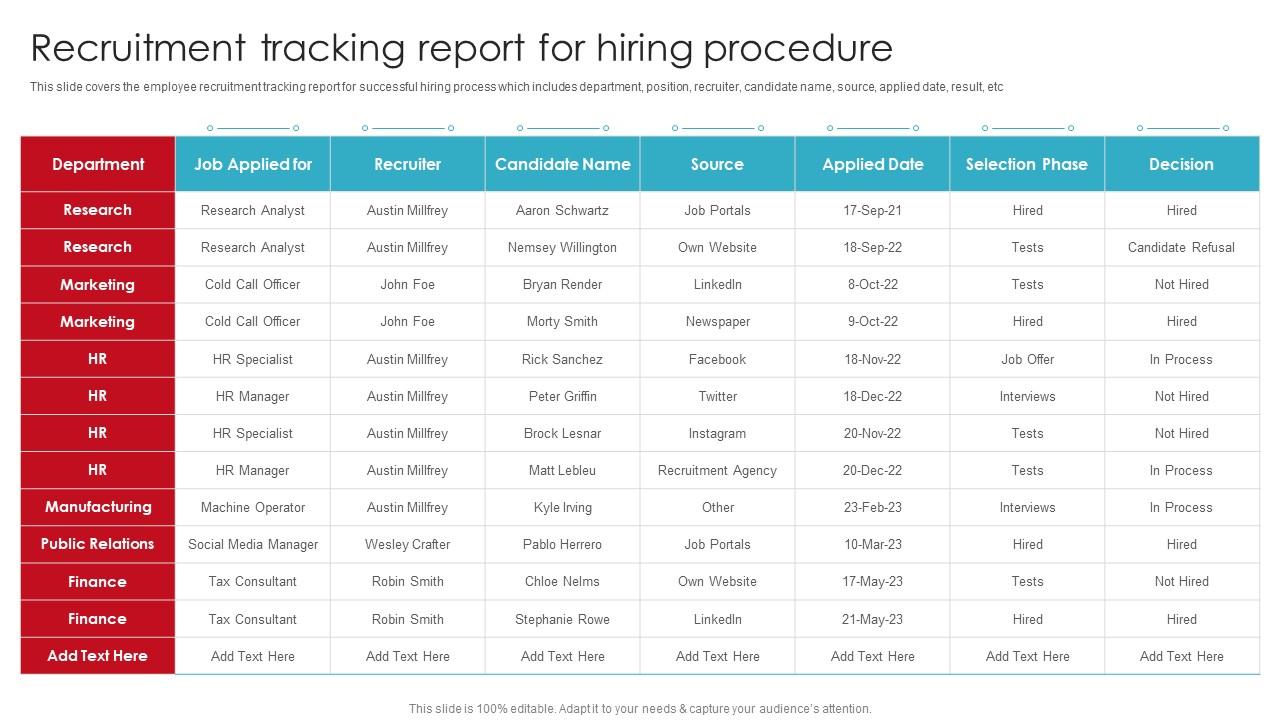
This slide covers the employee recruitment tracking report for successful hiring process which includes department, position, recruiter, candidate name, source, applied date, result, etc
People who downloaded this PowerPoint presentation also viewed the following :
Recruitment Tracking Report For Hiring Procedure Streamlining Employment Process with all 6 slides:
Use our Recruitment Tracking Report For Hiring Procedure Streamlining Employment Process to effectively help you save your valuable time. They are readymade to fit into any presentation structure.
FAQs for Recruitment Tracking Report For Hiring Procedure
Honestly, just get something that follows candidates from start to finish - application through hiring or rejection. Your main pieces are candidate database, tracking applications, scheduling interviews, and keeping communication logs. Automated emails are clutch because people hate being ignored. Also grab reporting so you can spot where things get stuck and timing issues. Job board integration will save you so much tedious posting work. Here's what I'd do though - map your actual process first, then find software that fits it. Don't bend over backwards adapting to some clunky system that doesn't match how you work.
Honestly, tracking just saves everyone from that awful limbo feeling when you apply somewhere and hear... nothing. I mean, we've all sent applications into the void, right? Set up those auto-emails first thing - when someone applies, when you're reviewing, all that stuff. Most companies are terrible at this, so you'll already look way more professional. When candidates have questions, you won't be scrambling to find their info either since it's all right there. Quick responses make such a difference. The whole thing just shows you actually respect people's time instead of treating them like disposable resumes.
Track time-to-fill, cost-per-hire, and quality of hire first. Source effectiveness matters too - which job boards actually work vs just flooding you with random resumes. Offer acceptance rates tell you if candidates actually want to work there. Oh, and candidate experience scores are clutch. Honestly, retention after 6-12 months is what really counts though. That's where you see if you're hiring right or just filling seats. Don't overcomplicate it early on - nail these basics then get fancy with tracking later.
So your ATS basically connects through APIs or direct plugins with whatever HR stuff you're already using - HRIS, payroll, onboarding platforms. Pretty standard these days. When you hire someone, their candidate data just flows over and becomes their employee record automatically. No more copying info between systems like some kind of data entry robot. Calendar apps, email, Slack - they all sync up for notifications too. Just don't let your vendor talk you into something that doesn't play nice with your current setup. Map out what you've got first, then see what actually integrates before you sign anything.
Honestly, candidate feedback is like getting the real scoop on your hiring process. When people say your application was a nightmare or they got radio silence after interviews, that's gold - it shows exactly where your system's breaking down. Survey everyone, even rejected candidates, because they'll tell you which stages need better updates or personal touches. Look for patterns in what they're saying. Maybe your automated emails suck, or interviewers aren't following up when they should. It's basically free consulting on how to fix your workflow, and nobody knows the pain points better than the people actually going through it.
Dude, you should totally try automating the resume screening first - it'll scan through hundreds of applications super fast and rank them for you. Interview scheduling and candidate matching can be automated too, which honestly saves so much time on the boring admin stuff. The machine learning aspect is pretty cool because it gets better at picking good candidates over time (though I've still seen some weird matches lol). Everything gets tracked automatically instead of you having to update spreadsheets constantly. Start with just the resume filtering though and see how it goes before diving into the other features.
Oh man, data silos are gonna be your worst enemy. Candidate info gets spread across emails, spreadsheets, random tools - it's chaos honestly. Been there. Get everyone using one ATS system and automate those status updates so you're not doing everything manually. Pipeline reviews with hiring managers help too, though some of them hate meetings lol. Standardized workflows are clutch so your team isn't all over the place. The hardest part? Getting everyone to actually stick with whatever system you pick instead of going rogue.
Honestly, tracking your recruiting process is a game-changer because it shows you exactly where things get stuck. Like when candidates just sit in "interview scheduling" limbo for weeks - usually because hiring managers are crazy busy. Once you see the data, you can fix the slowest parts first. Maybe automate those boring status emails or figure out which job boards actually deliver faster hires. I'd start by timing each stage you have now, then tackle whatever's eating up the most time. It's wild how much faster things move when you're not just guessing where the problems are.
Honestly, most companies totally botch the data retention part - they'll hoard resumes for years when they should delete them. Only collect what's actually relevant to the job and get clear consent upfront. Protected stuff like age or race is off-limits unless you legally need it for diversity reports. Lock down access controls and be transparent about how long you're keeping their info. GDPR gives candidates deletion rights, so you better be able to actually remove their data when asked. Set up regular cleanups too. Otherwise old applications just pile up forever in your system.
Honestly, it totally depends on your industry. Tech companies are obsessed with coding challenge pass rates and technical screens - makes sense. Healthcare? They're all about credential verification since, you know, people's lives are literally at stake. Manufacturing tracks time-to-fill super aggressively because production lines can't just sit there waiting. Finance goes crazy with background checks (paranoid but fair). Retail keeps it simple since they hire tons of people with quick turnover anyway. I'd just peek at what your competitors are measuring and copy the smart stuff.
Honestly, start simple with your recruiting - you don't need all the bells and whistles yet. Pipeline management and multi-board job posting are must-haves. Email integration is clutch because who has time to jump between systems? Basic filtering helps weed out the obvious nos. Get something with team feedback features and interview scheduling too. I'd skip the fancy AI tools for now (probably overhyped anyway) and focus on getting rid of those messy spreadsheets. Free trials are your friend - test the workflow before you commit to anything.
Look at your hiring data to see where diverse candidates are dropping off. Track demographics from applications all the way to final hires - you'll probably find some eye-opening patterns. Interview stage killing your numbers? Job boards not hitting the right people? The data will tell you exactly what's broken. Honestly, most companies think they're doing better than they actually are until they run the numbers. Set some real diversity targets so you're not just crossing your fingers and hoping. Start with whatever pipeline data you've got, then zero in on the biggest problem spots for underrepresented groups.
Honestly, it's a game changer - no more drowning in spreadsheets or losing track of candidates. Everything gets automated and centralized, so you're not frantically searching through emails wondering if you called that one guy back. Your team actually knows what's happening too. The analytics are probably my favorite part because you can finally see which job boards are worth the money (spoiler: most aren't). I'd go with something basic at first though. Don't get sucked into all the fancy features - you'll just overwhelm yourself and never use half of them anyway.
Check your recruitment data at least weekly, but honestly daily is way better when you're in active hiring mode. Weekly reviews catch trends early - like people bailing at certain stages or your hiring timeline getting slower. Trust me, I totally missed an obvious pattern once because I wasn't looking often enough! Also do monthly deep dives for the bigger picture stuff. Pipeline health and conversion rates are your main focus points. Short bursts work better than those marathon review sessions anyway. Adjust how often you check based on how much hiring you're actually doing.
Honestly, the stuff that's actually working right now is AI matching candidates better and predictive analytics that'll flag who might quit. Mobile applications are basically required now - nobody wants to fill out forms on desktop anymore. Chatbots handle the boring initial questions, which is a lifesaver. Skills-based hiring is exploding too, where systems actually read what people can do instead of just keyword matching. Oh, and everyone's obsessed with tracking candidate experience now - like measuring where people drop off in your process. But here's the thing: don't try to implement everything at once. Pick one feature, test how it affects your hiring speed, then build from there.
-
“Love it! I was able to grab an exciting proposal because of SlideTeam.”
-
Great work on designing the presentation. I just loved it!