


Region market analysis powerpoint presentation slides





Try Before you Buy Download Free Sample Product
 Impress Your
 Audience
 100%
100% Editable
 Save Hours
 of Time


Our Region Market Analysis Powerpoint Presentation Slides are topically designed to provide an attractive backdrop to any subject. Use them to look like a presentation pro.
People who downloaded this PowerPoint presentation also viewed the following :
Content of this Powerpoint Presentation
Slide 1: This title slide introduces the Region Market Analysis. Add the name of your company here.
Slide 2: This is the Agenda slide for Region Market Analysis.
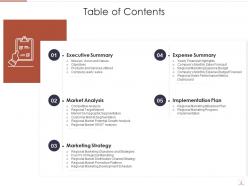
Slide 3: It contains the Table of Contents. It includes - Marketing Strategy, Executive Summary, Market Analysis, etc.
Slide 4: This is a table of content slide introducing the Executive Summary.
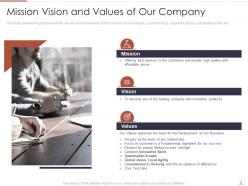
Slide 5: This slide presents the Mission, Vision, and Values of Our Company. It provides a glimpse of the mission, vision, and values of the company such as integrity, customer focus, respect for people, sustainable growth, etc.
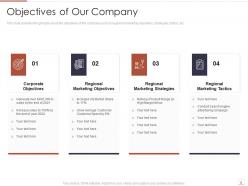
Slide 6: This slide presents the Objectives of Our Company. It provides a glimpse of the objectives of the company such as regional marketing objectives, strategies, tactics, etc.
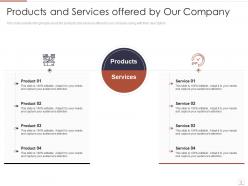
Slide 7: This slide presents the Products and Services offered by Our Company. It provides a glimpse of the products and services offered by our company along with their description.
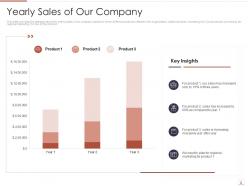
Slide 8: This slide presents the Yearly Sales of Our Company. It provides a glimpse of the yearly sales of our company based on three different products offered in the organization, sales have been increasing for 2 products but we need to do regional marketing for one of the products.
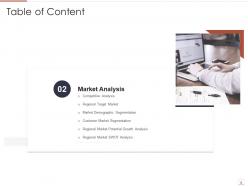
Slide 9: This is a table of content slide introducing the Market Analysis.
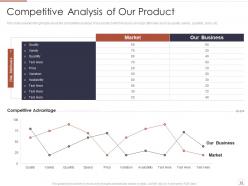
Slide 10: This slide presents the Competitive Analysis of Our Product. It provides a glimpse of the competitive analysis of our product which focuses on major attributes such as quality, variety, quantity, price, etc.
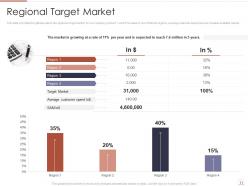
Slide 11: This slide presents the Regional Target Market. It provides a glimpse of the regional target market for our company product 1 which focuses on four different regions, the average customer spending, and serviceable available market.
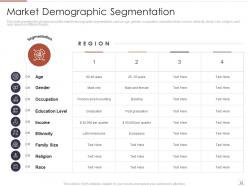
Slide 12: This slide presents the Market Demographic Segmentation. It provides a glimpse of the market demographic segmentation such as age, gender, occupation, education level, income, ethnicity, family size, religion, and race based on a different region.
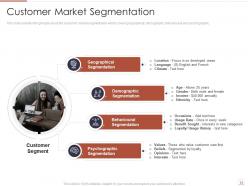
Slide 13: This slide presents the Customer Market Segmentation. It provides a glimpse of the customer market segmentation which covers geographical, demographic, Behavioural, and psychographic.
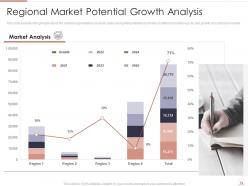
Slide 14: This slide presents the Regional Market Potential Growth Analysis. It provides a glimpse of the market segmentation on yearly basis along with potential customers in different market regions and the growth of a particular market.
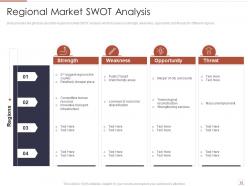
Slide 15: This slide presents the Regional Market SWOT Analysis. It provides a glimpse of the regional market SWOT analysis which focuses on strengths, weaknesses, opportunities, and threats for different regions.
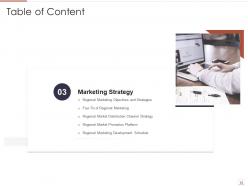
Slide 16: This is a table of content slide introducing the Marketing Strategy.
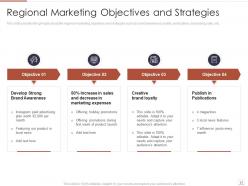
Slide 17: This slide presents the Regional Marketing Objectives and Strategies. It provides a glimpse of the regional marketing objectives and strategies such as brand awareness, loyalty, publications, increasing sales, etc.
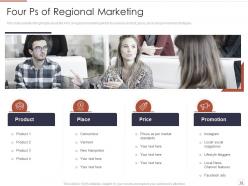
Slide 18: This slide presents the Four Ps of Regional Marketing. It provides a glimpse of the 4 Ps of regional marketing which focuses on product, place, price, and promotional strategies.
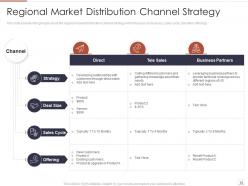
Slide 19: This slide presents the Regional Market Distribution Channel Strategy. It provides a glimpse of the regional market distribution channel strategy which focuses on deal size, sales cycle, and other offerings.
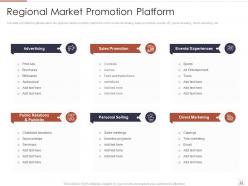
Slide 20: This slide presents the Regional Market Promotion Platform. It provides a glimpse of the regional market promotion platforms which cover advertising, sales promotions, events, PR, personal selling, direct marketing, etc.
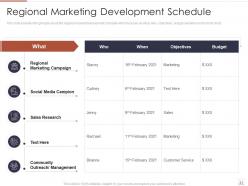
Slide 21: This slide presents the Regional Marketing Development Schedule. It provides a glimpse of the regional market development schedule which focuses on what, who, objectives, budget, and when in this time chart.
Slide 22: This is a table of content slide introducing the Expense Summary.
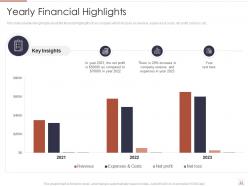
Slide 23: This slide presents the Yearly Financial Highlights. It provides a glimpse of the financial highlights of our company which focuses on revenue, expenses & costs, net profit, net loss, etc.
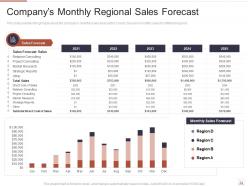
Slide 24: This slide presents the Company’s Monthly Regional Sales Forecast. It provides a glimpse of the company’s monthly sales forecast for 5 years based on monthly sales for different regions.
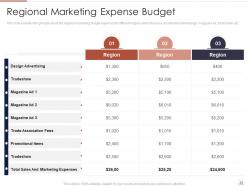
Slide 25: This slide presents the Regional Marketing Expense Budget. It provides a glimpse of the regional marketing budget expenses for different regions which focuses on advertisement design, magazine Ads, tradeshow, etc.
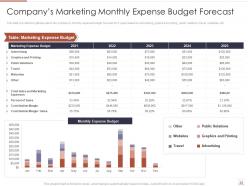
Slide 26: This slide presents the Company’s Marketing Monthly Expense Budget Forecast. It provides a glimpse of the company’s monthly expense budget forecast for 5 years based on advertising, graphics & printing, public relations, travel, websites, etc.
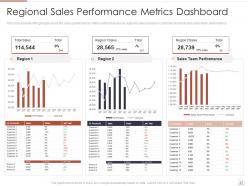
Slide 27: This slide presents the Regional Sales Performance Metrics Dashboard. It provides a glimpse of the sales performance metrics which focus on regional sales based on customer demands and sales team performance.
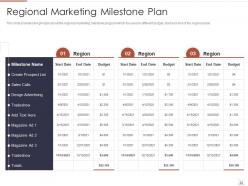
Slide 28: This slide presents the Regional Marketing Milestone Plan. It provides a glimpse of the regional marketing milestone program which focuses on different budgets, start, and end of the regional plan.
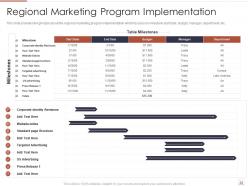
Slide 29: This slide presents the Regional Marketing Program Implementation. It provides a glimpse of the regional marketing program implementation which focuses on milestone start date, budget, manager, department, etc.
Slide 30: This is the Region Market Analysis Icons Slide.
Slide 31: This slide presents the Additional Slides.
Slide 32: This slide contains the information about the company aka the ‘About Us’ section. This includes the Value Clients, the Target Audience, and Preferred by Many.
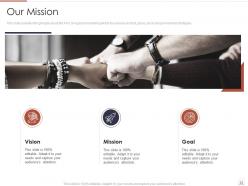
Slide 33: This slide provides the Mission for the entire company. This includes the vision, the mission, and the goal.
Slide 34: This slide presents Our Goal.
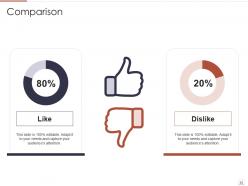
Slide 35: This slide presents the Comparison between the percentages of likes and dislikes.
Slide 36: This slide provides a Venn diagram that can be used to show interconnectedness and overlap between various departments, projects, etc.
Slide 37: This is a slide with a 30-60-90-Days Plan to set goals for these important intervals.
Slide 38: This is the Puzzle slide to show the art of the project.
Slide 39: This slide contains Post-It Notes that can be used to express any brief thoughts or ideas.
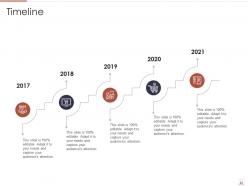
Slide 40: This slide is a Timeline template to showcase the progress of the steps of a project with time.
Slide 41: This is a Thank You slide where details such as the address, contact number, email address are added.
Region market analysis powerpoint presentation slides with all 41 slides:
Use our Region Market Analysis Powerpoint Presentation Slides to effectively help you save your valuable time. They are readymade to fit into any presentation structure.



FAQs for Region market analysis
Key economic indicators for region market analysis include GDP growth rates, unemployment levels, inflation rates, consumer spending patterns, and population demographics. These metrics enable businesses to assess market potential, purchasing power, and competitive landscape across different territories, with many organizations finding that comprehensive indicator analysis streamlines resource allocation and enhances strategic market entry decisions.
Regional demographics significantly shape market trends through age distribution, income levels, cultural preferences, education rates, and household composition, directly impacting purchasing patterns and product demand. These demographic factors enable businesses to tailor strategies across different regions, with retailers adapting product mixes and marketing approaches to local populations, ultimately delivering more targeted customer experiences and competitive market positioning.
Competitive landscape significantly influences regional market opportunities by determining market entry barriers, pricing strategies, customer acquisition costs, and strategic positioning requirements. In regions with established players, like financial services in London or tech companies in Silicon Valley, new entrants must differentiate through innovation, niche specialization, or superior customer experiences, ultimately creating opportunities for market disruption and competitive advantage.
Regional market analysis helps identify potential growth sectors by examining demographic trends, economic indicators, competitive landscapes, consumer behavior patterns, and infrastructure developments across specific geographic areas. Through comprehensive data analysis, businesses can pinpoint emerging opportunities in sectors like healthcare, technology, or renewable energy, while understanding local market dynamics, ultimately enabling strategic investment decisions and targeted expansion plans that capitalize on regional advantages.
Effective region market analysis methodologies include demographic segmentation, competitive landscape mapping, economic indicator assessment, consumer behavior studies, and regulatory environment evaluation. These approaches streamline market entry decisions by identifying local opportunities, understanding cultural preferences, and assessing competitive positioning, with many multinational companies finding that comprehensive regional analysis ultimately delivers faster market penetration and sustainable competitive advantage.
Local culture significantly influences product positioning by shaping consumer preferences, communication styles, values, and purchasing behaviors across different regions. Companies must adapt messaging, imagery, pricing strategies, and even product features to resonate with cultural norms, with many global brands finding that localized positioning in markets like Asia, Europe, and Latin America delivers stronger customer connections and competitive advantage.
Regulatory environments significantly influence market entry strategies, product positioning, compliance costs, and competitive positioning across different regions. Companies operating in highly regulated sectors like pharmaceuticals, financial services, and telecommunications must adapt their approaches by localizing offerings, establishing regulatory partnerships, and implementing region-specific compliance frameworks, ultimately delivering competitive advantage through strategic regulatory navigation.
Businesses can leverage regional strengths and weaknesses by conducting comprehensive demographic studies, analyzing local competition patterns, assessing economic indicators, and evaluating infrastructure capabilities within target markets. Through strategic market segmentation, companies identify opportunities in underserved regions, capitalize on local advantages like skilled workforces or favorable regulations, and develop tailored strategies that minimize regional risks while maximizing competitive positioning.
Tools for regional market analysis include market research platforms, demographic analytics software, competitive intelligence systems, geospatial mapping technologies, and social media monitoring tools. These technologies streamline data collection, visualization, and interpretation, with many retail chains and financial institutions finding that integrated analytics platforms deliver faster market insights, enhanced targeting precision, and ultimately stronger competitive positioning in regional markets.
Global events significantly reshape regional market dynamics through supply chain disruptions, currency fluctuations, trade policy changes, consumer behavior shifts, and investment flow alterations. These external shocks create both challenges and opportunities, with many regional markets finding that diversification strategies, local partnerships, and agile operational frameworks ultimately deliver enhanced resilience and competitive positioning during volatile periods.
Businesses can mitigate regional market risks through diversification strategies, local partnerships, phased market entry, regulatory compliance programs, and flexible supply chain management. These approaches enable organizations to navigate political instability, currency fluctuations, and cultural barriers while maintaining operational continuity, with many companies finding that strategic local alliances significantly reduce market entry risks and accelerate growth.
Urbanization trends create expanding market opportunities by concentrating consumer bases, increasing infrastructure investment, and driving demand for services like transportation, housing, and technology. Cities in emerging markets particularly benefit from this demographic shift, with businesses finding enhanced distribution efficiency, larger talent pools, and improved digital connectivity, ultimately delivering greater market penetration and scalable growth potential.
Consumer segmentation enables businesses to identify distinct customer groups within specific regions based on demographics, behaviors, purchasing patterns, and cultural preferences. This strategic approach helps companies tailor their products, marketing strategies, and distribution channels to local market conditions, with retailers and service providers finding significantly improved customer engagement, higher conversion rates, and enhanced competitive positioning in diverse regional landscapes.
Historical market data enhances predictive insights by establishing baseline patterns, identifying cyclical trends, and revealing correlation factors that influence regional performance over time. Through advanced analytics and machine learning algorithms, organizations can analyze past consumer behaviors, economic indicators, and market fluctuations to forecast demand shifts, ultimately enabling strategic resource allocation and competitive positioning in target regions.
Partnerships and collaborations enable market expansion by providing local expertise, shared resources, established distribution networks, regulatory knowledge, and reduced entry costs. Through strategic alliances, companies can leverage partner relationships to accelerate market penetration, minimize operational risks, and enhance customer reach, with many organizations finding that collaborative approaches deliver faster regional growth than independent expansion efforts.
-
Illustrative design with editable content. Exceptional value for money. Highly pleased with the product.
-
Out of the box and creative design.
-
Excellent products for quick understanding.